While the rest of the world revels in the tournament, Italians are purposefully ignoring it; ‘I don’t give a f—.’
ROME—The World Cup is in full swing and people the world over are having a ball.
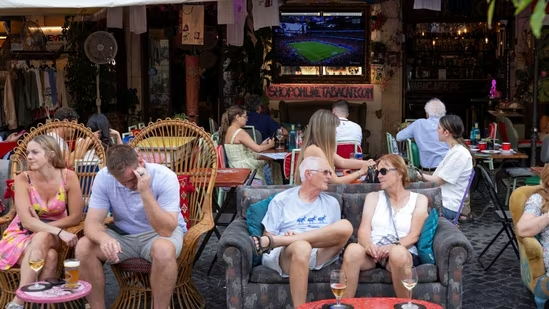
But in Rome, it’s easy to forget there is a tournament. Few bars are showing it and only tourists are watching.
“Sometimes, I feel a flicker of curiosity and I wonder what’s going on at the World Cup,” said Saverio Massi Benedetti, a fund manager and avid fan of AS Roma, the biggest team in the Italian capital.
“So I google ‘World Cup 2026,’ but as soon as the page loads, the spark of interest has already died inside me.”
The failure of Italy’s national team to qualify for the World Cup, for the third time in a row, is such an embarrassment in this soccer-mad country that Italians are purposefully ignoring it.
While the group phase was reaching its dramatic culmination in North America, retiree Stefania Tentarelli went to her cobblestone local piazza to watch fellow pensioners play an 18th-century Neapolitan card game.
Later that evening, she was thinking about going to the theater, or maybe the opera. She has no plans to watch any of the tournament.
“I really don’t care,” said Tentarelli, who lives in the picturesque Trastevere district. She has been watching World Cups since she was a child, but this time she has seen zero games. “I don’t give a f—,” concurred her friend, a part-time soccer referee.
At a Milan pizzeria that normally airs matches, the screens were showing a news segment about a gathering of Vespa riders. The pizzeria’s owner said he had no idea which games were happening.
Carlo Antonio Fayer is a Roma season-ticket holder. He’s also an architect who designed a new soccer stadium in the Tuscan city of Arezzo. This past season, Fayer attended nearly every Roma game, and most of lower-league Arezzo’s matches too.
But as the World Cup knock-out rounds got under way, Fayer was cruising off the coast of Tuscany in a motor boat with some friends.
“I’m passionate about soccer. It’s a fundamental part of my life,” he said. “And until today, I haven’t watched a single game of the World Cup.”
On a recent evening, the Rome sports bar Delirum Café was mostly empty, save for a table of Norwegian tourists watching their team play Ivory Coast.
“Foreigners want to watch the World Cup,” said Andrea Giuliani, the bar’s owner. “Many Italians are pretending it’s not really happening.”
If Italians come into the bar, he said, it’s to watch Wimbledon. The late hour of some World Cup matches doesn’t help in a country with no rooting interest.
Italy is a soccer-obsessed nation, where many people follow clubs and players with cultlike devotion.
Carmine Russo made a vow to his friends. If his beloved Inter Milan won the Italian championship and rival AC Milan failed to qualify for the European Champions League, he would go on a religious pilgrimage. His prayers came true.
Soon after the World Cup started, Russo hiked the Camino de Santiago pilgrimage route in remote northern Spain.
He confesses to catching one game—a victory for Spain—in a ramshackle café in a Galician village.
“Can you see how low we’ve sunk?” he said. “I’m an Italian who is abroad during the World Cup, and who hasn’t seen his national team play at the World Cup in years.”
Italy is one of the most successful nations in soccer history, with four World Cup titles, level with Germany and trailing only five-time winner Brazil.
Lately, however, it has become the most wildly inconsistent team in the world. After winning its last World Cup title in 2006, Italy flopped in the first round in 2010 and 2014.
It won the European championship in 2021, yet failed to qualify for the World Cups of 2018 in Russia and 2022 in Qatar.
Some Italians joke that the country boycotted the tournaments in Russia, Qatar and the U.S. on principle. (The choice of all three hosts was politically controversial.)
It wasn’t always like this. The World Cup used to define childhood summers for generations of Italians. The heat, the blurry TVs in the piazza, the cheers spilling from apartment buildings when Italy scored. The whole country would stop for the Mondiali, with cars vanishing from the streets and stores closing early.
Some moments are seared in the collective memory. Nearly every Italian over 40 remembers Roberto Baggio missing the decisive penalty against Brazil in the 1994 final. Older Italians will never forget Marco Tardelli sealing Italy’s triumph in 1982 with an iconically wild goal celebration.
In the euphoria of the 2006 win, millions took over the central squares of cities, towns and villages across the peninsula.
Carlo Attardi, a 40-year-old lawyer, spent that heady night in a sea of flags on Rome’s Piazza del Popolo.
“I swear I have goosebumps just talking about it,” he said. “People were jumping into the fountains. We forgot all our problems.” He also forgot to tell his mother he wouldn’t be coming home that night. She frantically phoned hospitals and the police, thinking he was dead.
Attardi, who now lives in Germany and has two young children, is sad for a new generation of kids who have never even seen Italy at the World Cup.
“It’s a national tragedy,” said Attardi. “The World Cup is a party, a soccer party that all your friends are going to, but you are not, because you are not invited.”
Write to Margherita Stancati at margherita.stancati@wsj.com and Marcus Walker at Marcus.Walker@wsj.com