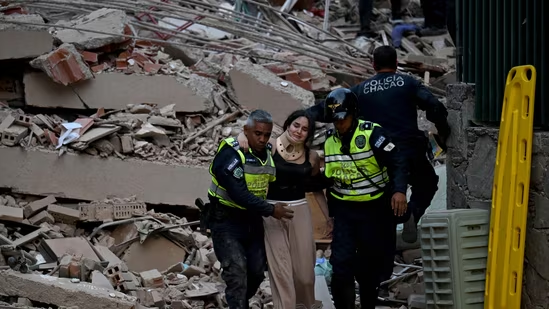
At least 164 people died and around a thousand sustained injuries after two earthquakes, called a “doublet”, rocked Venezuela in quick succession on Wednesday evening.
Experts believe the death toll could rapidly climb as rescue operations continue.
Track the aftermath of the Venezuela quakes live here
Wednesday evening’s 7.2 and 7.5 magnitude earthquakes were among the strongest to strike the country in more than a century. In 1990, Venezuela’s capital Caracas was struck by a 7.7-magnitude earthquake.
The US Geological Survey said the first earthquake hit west of Moron on the Caribbean coast, about 170 kilometers west of Caracas. It had a depth of 22 kilometres. The second earthquake, at an even higher magnitude, struck 39 seconds later, with a depth of 10 kilometers and an epicenter 16 kilometers southwest of Moron.
Buildings collapsed and authorities warned of landslides and liquefaction in affected regions. The USGS issued a red-level PAGER alert, which meant the earthquake was likely to cause major destruction and significant loss of life.
What is an earthquake ‘doublet’?
A doublet is a pair of earthquakes that occur one after the other, not too far apart in time and location. These differ from the usual pattern of mainshock, followed by aftershocks, which are usually lower in magnitude and intensity, according to a paper in the journal Nature.
Mark Quigley, associate professor of earthquake science at the University of Melbourne, wrote for TheConversation on Thursday that doublets are typically of similar magnitude. They may be “causally linked, but seismologically distinct”, he said.
“This means the seismic waves from each quake are separated by a gap in time, and/or originate from distinct sources. Although the Venezuelan earthquake epicentres were within mere kilometres of each other, seismic wave information from the USGS suggests they likely originated from different faults with different rupture styles,” he wrote.
In Venezuela’s case, Quigley said, it was likely that the first earthquake triggered the second one.
ALSO READ | Venezuela struck by two earthquakes: How scientists detect tremors and measure magnitude
“This could have happened because Earth’s crust displacement in the first earthquake fault increased stress on the second earthquake’s source fault. Additionally, the passage of seismic waves from the first earthquake could have rattled nearby faults already prone to a rupture, causing them to fail,” he said.
Venezuela, straddling the South American and Caribbean plates, sits near multiple fault lines.
USGS said the two plates moved past each other, about 20mm per year. Accordingly to Quigley, this movement builds up stress along fault zones in northern parts of the country and paves the way for frequent, shallow earthquakes.
ALSO READ | Venezuela rocked by monster earthquakes: Key updates as country declares emergency
How common are ‘doublets’
An earthquake doublet isn’t common, but has been recorded in the past.
In 2023, Turkey was hit by a 7.8-magnitude earthquake, which was followed by another 7.6-magnitude one nine hours later, with an epicentre 100 kilometres apart.
A 2025 study published in Nature analysed the Turkey earthquakes and noted that composition of the crust can affect how the two shocks play out. When a large earthquake occurs in an area with a specific composition, it does not just release energy, but also redistributes stress throughout the faults.
This stress transfer can increase the likelihood of failure in nearby fault segments that were already close to breaking, the study notes.