Nada Farhoud travelled to Malawi, the fourth poorest country in the world, where almost 14 million people do not even have access to a decent toilet
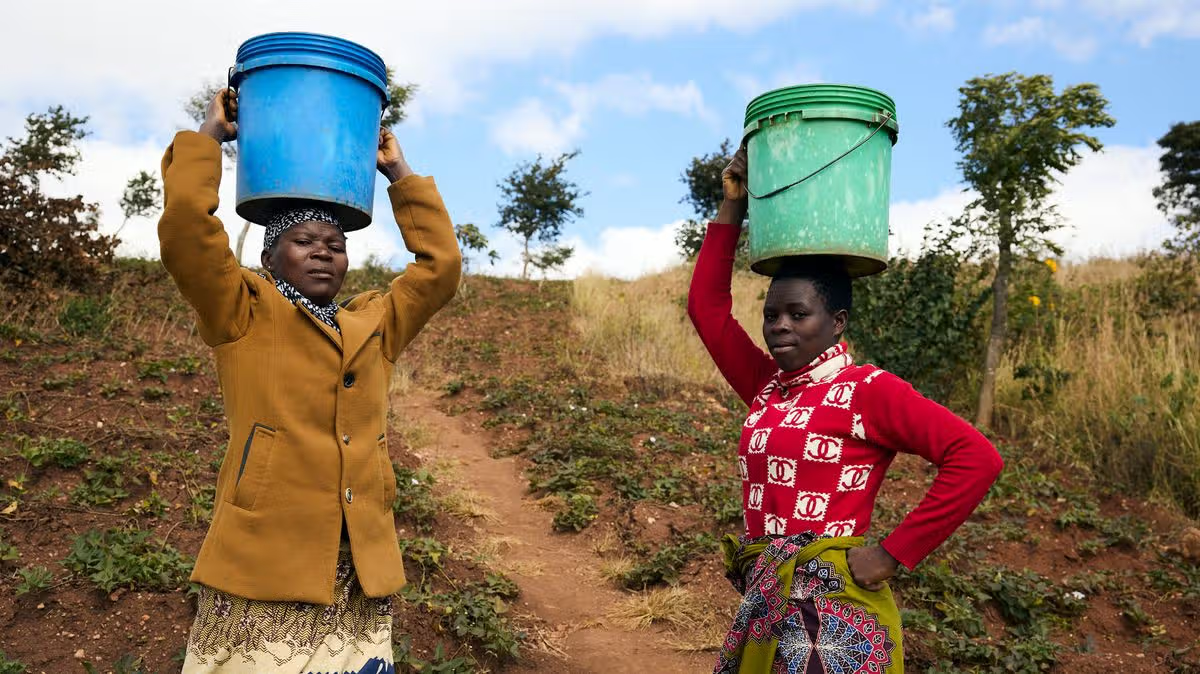
At 3am every morning, Dina Njati begins an exhausting eight-hour struggle to provide her family with water.
The 37-year-old climbs down a steep hillside before filling a 20-litre container from a tiny muddy pond and hauling it back home on her head. Then she does it again until she has collected the water her family needs to cook, wash their clothes and bathe. But the gruelling trek is only part of her ordeal.
The only water source serving her village of Mkambabisi, Malawi, is often so contaminated that it leaves both Dina and her young daughter sick. “It has happened so many times. We know it’s the water,” she said. “But we don’t say it out loud because where else are we going to get water?”
Sadly, Dina’s struggle is far from unique. Across Malawi, one in three people lack access to clean water, while almost 14 million people – more than half the population – do not have a decent toilet.
Yet change is finally within reach. In just a few weeks, a new borehole funded by the Wimbledon Foundation and installed by WaterAid is due to transform life in Dina’s village, replacing dangerous daily journeys with clean water just minutes from her home.
The change will also allow Dina to reclaim the career in carpentry she was forced to abandon when she had to move to the area to care for her ageing grandfather, who could no longer fetch water for himself. Since then, she has barely picked up her tools.
“My hope is that when my daughter grows up, she shouldn’t experience what I have wanted to become something people talk about as ‘once upon a time’, not something she has to live through,” she added.
I travelled to Malawi with chef and Great British Menu presenter Andi Oliver, 62, to see how something many of us take for granted – turning on a tap – can mean the difference between health and disease, dignity and hardship, and in some cases, life and death.
Andi said: “I just can’t imagine having to do that every single day and still be this positive, powerful, passionate and talented woman with such a clear vision for the future.
“As soon as I asked what she wanted to do when the water arrives, she just exploded with ideas. She’s got a business plan. Bringing water to this village is like turning a switch. It’s like turning the lights on, turning hope on, turning possibility on.”
The consequences of unsafe water are visible everywhere. They affect children before school, families trying to grow food and women carrying the greatest burden of collecting water. But nowhere are the risks more stark than in maternity clinics.
Sisters Eliza Brutula, 37, and Trinity Mbewe, 26, both gave birth at Kangolwa Centre in Chimbindu yet their experiences of becoming mothers could hardly have been more different.
Hours after labour Eliza was forced to make a treacherous 10-minute descent to the nearby River Katete to wash herself using water contaminated by agriculture and other industries.
She said: “For me I accepted my fate. This is what I went through, but now when I see this generation… they’re able to go through it the easier way.”
Eliza explained how some of her friends have had to make the journey during the wet season in muddy conditions adding: “if you fall into a ditch and you’re too weak to climb out, it could take a long time before anyone realises you haven’t come back. But after WaterAid installed a clean water supply at the clinic, Trinity simply turned on a tap after giving birth.”
The difference is about far more than convenience. Without clean water, proper sanitation and hygiene, mothers and newborn babies are at far greater risk of life-threatening infections, including maternal sepsis.
Across sub-Saharan Africa, an estimated 36 mothers die from the infection every day, making women almost 150 times more likely to die than mothers in Europe and North America.
Malawi bears one of the highest maternal sepsis burdens in the region, recording 77,536 cases in 2023 – resulting in 107 deaths. WaterAid says that clean water, toilets, and handwashing could cut maternal and newborn deaths in half.
Loveless Chipokasa, 43, remembers giving birth before the clinic had running water. Desperate for a drink afterwards, she was told there was no water available. “They took a cup and stood by the roof to catch the rainwater,” she recalled.
Margaret Zephena, 33, also gave birth before clean water reached the clinic and remembers making the same treacherous walk to the river after giving birth, only to be confronted by local people who complained that new mothers should not wash there. “I felt like my rights were being violated,” she said. “I’d just given birth. I wanted to wash. I wanted to feel good.”
Today, both women have relatives give birth at the same clinic under very different circumstances, where turning on a tap has replaced desperate searches for rainwater and exhausting walks to the river.
For many of us, access to running water is something we barely notice until it disappears. For Andi, that realisation came within hours of arriving in Malawi.
She said: “It definitely gives you perspective and makes me grateful for the life that I do have. But clean, accessible water is a human right. It’s not a favour. Everybody should be able to turn on the tap and get clean, accessible water.”
The effects of clean water do not end with better health- they can also shape an entire future. Just a few hours apart in rural Malawi, two 18-year-old girls are living remarkably different lives because of something as simple as whether they have a reliable source of clean water.
Until 2022, Elshaday Gabriel spent up to an hour and a half every morning carrying 20-litre containers meaning she often arrived late for school after queuing. WaterAid installed three taps in her village Thundy four years ago.
“Now the water is nearby, I have more time to study,” she added. As a result, the teenager has secured a place at college to train as a nurse. Asked why she chose the profession, her answer is simple: “I want to serve my community.”
For Lydia Konjwani who lives in the same village as Dina, that future still feels painfully out of reach. Every morning she wakes at 2am to begin collecting water before school, making repeated trips and queuing for hours before hurrying to class exhausted.
“I sleep at school because I’m tired,” she says. “If I didn’t have to wake up so early to fetch water, I would do better. I’d be able to concentrate.”
The consequences have already altered the course of her education. Last year she became so ill with diarrhoea caused by contaminated water, that she missed her exams and was forced to repeat a year at school. Her dream of becoming either a teacher or a police officer now feels uncertain.
WaterAid is due to bring clean water to Lydia’s village in the coming weeks. Asked whether that could change her future, her answer comes without hesitation. “Yes,” she says. “Definitely.”
For 45 years, farmer Dyson Jambo relied on muddy river water that regularly spread disease but today he proudly grows tomatoes beside his home in Thundy using the village water supply. “My life is full of joy,” he says, explaining that having water nearby means he can irrigate his crops, monitor them every morning and sell the harvest for extra income.
Nearby wash cooking pots under the tap, a simple task we take for granted but something that would have been impossible a few years ago.
Peter Phiri, WaterAid’s Malawi Country Director said:“Across Malawi, one in three people still lacks access to clean water. As a result, women face life-threatening risks during childbirth, newborns are exposed to preventable, often deadly, infections, and entire communities are held back, their potential limited by the absence of this basic resource.
“We’re proud of the progress in Ntchisi, where women can now give birth more safely and communities have the foundations to grow and thrive.”
Andi added: “People don’t want somebody else to transform their lives for them. Give them access to clean water and they can transform their own lives. That’s what people want.”
“Everything really does start with water.”