Fuel shortages across Russia have triggered a new political challenge for President Vladimir Putin, as a relentless Ukrainian drone campaign aimed at the country’s oil refineries has brought the war home for most ordinary Russians.
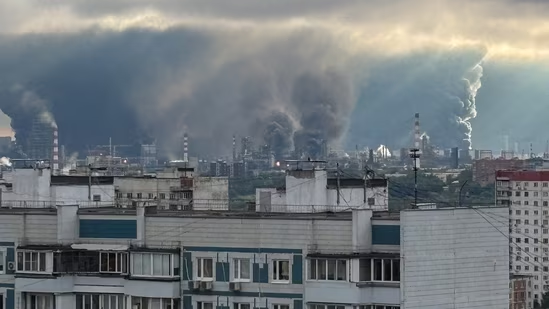
While Ukraine has targeted Russian energy facilities for years, the quantity and firepower of Ukrainian drones and missiles have risen. This has allowed Kyiv to hit refineries as far as Tyumen, 1,200 miles away in Siberia, and permitted the spectacular raid that broke through thick layers of air defenses and destroyed Moscow’s main refinery on June 18, the turning point of the current crisis.
Some 28% of Russia’s refining capacity was offline as of June 20, estimated Sergey Vakulenko, former head of strategy at Gazprom Neft, a large Russian oil company, and now a senior fellow at the Carnegie Russia Eurasia Center in Berlin.
“All of this is due to the steep rise in the number of drones that Ukraine is able to fire,” he said. The problem isn’t in logistical difficulties or market imbalances anymore, Vakulenko added, “but in the physical lack of fuel.”
For the first time in decades, Russia is planning to start importing fuel, Kremlin spokesman Dmitry Peskov said Tuesday, adding that Moscow is negotiating with several nations that he declined to name. Only faraway refiners, such as those in India, could fill in the enormous gap. Such imports would take weeks to arrive by sea and would further stretch Russia’s budget, already consumed by war expenses.
Once one of the world’s main exporters of petroleum products, Russia has banned exports of gasoline and jet fuel for months as Ukrainian attacks intensified. On Sunday, Putin said he is considering a ban on exporting diesel.
Russia’s fuel shortages are nationwide but vary across the vast country. In Moscow, which is usually insulated from the impact of the war that Putin unleashed in 2022, many gas stations have been closed in recent days. At those that are open, there are often hourslong waits.
In some provinces, particularly parts of Siberia and North Caucasus, residents reported having to wait overnight or longer to fill up. In the Siberian region of Irkutsk, the government started providing portable toilets alongside mileslong fuel lines.
Filling up jerrycans with gasoline was banned in much of Russia, and cars were limited to as little as five gallons at a time. Diesel shortages aren’t yet as severe, as Russia’s diesel-refining capacity was much higher to start with.
Tensions are rising. In western Russia, the government of the Oryol region plans to allow fuel sales only to locally registered vehicles, with one refueling a week. At gas stations in the Krasnodar region, brawls have erupted between locals and drivers arriving to fuel up from nearby Crimea, where all fuel sales had been suspended as a result of the Ukrainian drone blockade. One of Krasnodar’s main refineries was blown up Sunday.
Improvised rationing systems, from QR codes to manually assembled lists, popped up across Russia, in a reminder of Soviet-style privations.
“There is clearly a social crisis over fuel, and it can become political, but so far there are no serious consequences,” said Andrei Kolesnikov, Moscow-based analyst for the Novaya Gazeta and New Times publications. “This intensifies the sense of tiredness that turns into irritation. But since people have no instruments to change the situation, all they do is grumble about the authorities, and about the fact that the war isn’t ending.”
The fuel shortages have become commonplace as the campaign season for Russia’s parliamentary elections, slated for September, kick into gear. While no one expects a free or fair vote, elections allow a platform for Russians to quietly air grievances, and Putin is under pressure to make sure the fanfare of the ballot isn’t spoiled.
One Moscow resident said his wife has had to wait in line for gasoline for more than two hours and suggested it would color their views of the authorities ahead of the election.
In remarks over the weekend, Putin showed no intention of seeking a ceasefire with Ukraine and rejected the idea of limiting Russia’s own long-range strikes. Though such a deal would end Ukrainian attacks on refineries, Putin said it wouldn’t serve Moscow’s interests because Russia enjoys an overwhelming advantage in firepower.
While Russian officials initially blamed the fuel shortages on speculators and panic buying, Putin acknowledged for the first time on Sunday that the shortfall is real.
“Problems for the motorists, and for the businesses, remain. There are, regrettably, lines at gas stations, and sometimes you can’t find the right brand of gasoline,” he said. “We also understand the difficulties that agriculture businesses and farmers encounter in the summer season…The harvest depends on this.”
The very fact that Putin—rather than lesser officials—spoke up about the fuel issue signals just how challenging it has become, said Janis Kluge, an economist at the German Institute for International and Security Affairs.
“The crisis is already so widespread that it would be dangerous for Putin not to address it,” Kluge said. “He would have looked like he’s out of touch. It tells you that this is a serious problem and that they are worried.”
To provide some relief, Russian authorities have allowed lower-grade fuel to be sold, scrapping previous restrictions. Moscow’s Kommersant newspaper reported on Tuesday that Russia is also considering allowing refineries to produce once again the low-grade Euro-2 standard gasoline that has been banned since 2013. Euro-2 can damage modern engines but is suitable for older cars.
All in all, fuel in Russia remains relatively cheap by global standards, with gasoline sold below 80 rubles a liter (equivalent to $3.88 a gallon) at Moscow gas stations operated by state-owned conglomerates. Independent gas stations have already started raising their prices in the past week, and so did taxi drivers and the shipping companies that have to account for time lost lining up for fuel.
The reaction of Russian authorities to all this was to limit the release of retail fuel-price statistics and to start roundups of alleged speculators and hoarders.
“This crisis is exacerbated by behavioral factors: People understand that things will likely get worse, and so they try to stock up on fuel,” said Alexandra Prokopenko, a former adviser at the Russian central bank and now a fellow at the Carnegie Russia Eurasia Center. “When authorities react to events by hiding information, people start thinking that maybe things are more dramatic than they are being told.”
On the black market in Crimea, where authorities initially implored residents not to buy extra fuel but then banned gasoline sales to civilians altogether, speculators have already been reported to sell gasoline at more than 500 rubles a liter, or $25 a gallon. In the Chita region of Siberia, Russian social-media accounts say speculators are offering places in the 48-hour-long gas-station line at 35,000 rubles, or $454, apiece.
Ukraine has been targeting Russian refineries for more than three years and spurred a series of smaller, regional fuel shortages last year. Back then, Russia repaired the damage fast enough to avoid systemic shutdowns.
This year, the tempo of Ukrainian attacks outpaced Russia’s ability to maintain its refineries, a task already constrained by international sanctions that ban the import of needed equipment. Iryna Terekh, CEO and chief technology officer of Fire Point, one of the main Ukrainian producers of long-range strike drones, said she didn’t expect two years ago that she would see fuel shortages in Moscow.
“I have a sense that we are on the path to victory,” she said. “We keep pecking, pecking, pecking at them, and I start to see light at the end of the tunnel.”
Write to Yaroslav Trofimov at yaroslav.trofimov@wsj.com