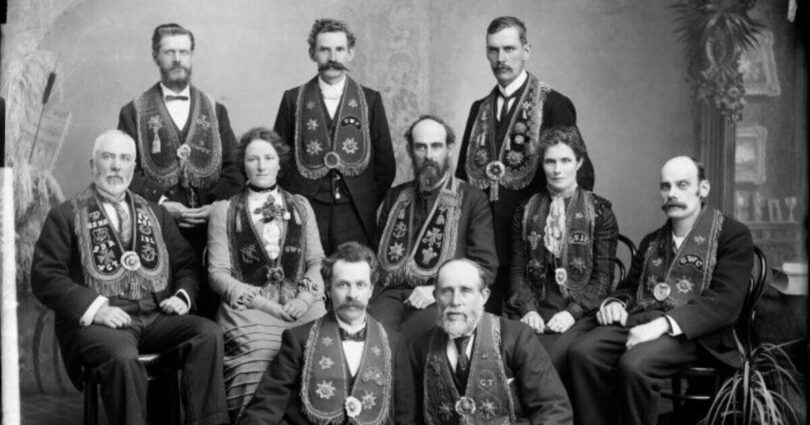
IOGT Executive committee Wanganui 1903 (Image: Frank J Denton)
It began with a candle, some fancy regalia and a solemn vow never to touch a drop of alcohol. Now more than 170 years later, the movement that grew from that flickering flame in a small American town stands accused of quietly shaping the way the world drinks, and campaigners fear British pubgoers could one day pay the price.
That organisation is Movendi International, yet for most of its curious existence it went by another name: the International Organisation of Good Templars, a teetotal order steeped in Victorian moral fervour.
This bizarre story begins in 1851 in upstate New York, where a temperance campaigner named Daniel Cady set out to build a brotherhood dedicated to stamping out the demon drink.
Modelled on the Freemasons, the new order came complete with a requirement to proclaim your faith in God, stick on a collar and an apron, and set about the good work of banishing booze.
Members even lit a candle at their meetings to symbolise warmth, friendship and the hope of a life free from alcohol.
They took their name from the medieval Knights Templar, inspired by a legend that they drank only sour milk and waged what was described as a “crusade” against the “vice” of drink.
For all its mystical trappings, the order was strikingly progressive for its age.
Unlike many such societies of the era, it admitted men and women on equal terms and welcomed members regardless of race.
And it spread with staggering speed. In 1868 it reached Britain, when an Englishman established a lodge in Birmingham, and from there it fanned out across the Empire.
By the late 1970s the order had hundreds of thousands of members worldwide.
It was around then that it began shedding its more eccentric habits, abandoning the secret rituals and dropping the word “Order” from its title.
And then at last in 2020 it rebranded once more, emerging as Movendi International, headquartered in Stockholm, with member groups in more than 60 countries.
But while the robes and rituals have gone, critics say the mission has not.
Dr Christopher Snowdon, of the free-market Institute of Economic Affairs, believes the modern temperance movement has swapped candlelit lodges for the corridors of global power, and gained an alarming say over international drinking policy.
“It is alarming that a teetotal pressure group that was originally formed to campaign for prohibition is pulling the strings at the World Health Organisation,” he said.
“The temperance movement is alive and well, but doing things differently this time.”
He accused the movement of a plot to “denormalise drinking through advertising bans and graphic warnings and to make alcohol unaffordable through tax rises and minimum pricing”.
His warning comes as the WHO prepares to launch a progress report on its SAFER initiative, the anti-alcohol programme it first rolled out in 2018.
SAFER urges governments to restrict the availability of alcohol, clamp down on marketing and push up prices, and the report takes stock of how far countries have gone in doing so.

They even once handed out membership ceriticates (Image: GETTY)
In a move that raised eyebrows, registration for the launch was reserved only for those “free from conflicts of interest with the alcohol, tobacco and arms industries” – lumping brewers in with weapons dealers and Big Tobacco.
Movendi has been a vocal champion of SAFER since it began, working hand in hand with the WHO. And the report showcases Uganda, Nepal and Sri Lanka as success stories, the very nations where Movendi has run alcohol-policy campaigns.
In Sri Lanka, the movement helped produce an alcohol “investment case” whose recommendations mirrored the WHO’s call for higher taxes and advertising bans. In Nepal, the WHO itself named Movendi as a civil-society partner, while the group says it worked on “industry counter-action”.
Critics argue that advocacy shaped by the movement is quietly being converted into official-looking, WHO-branded evidence of “what works”.
“Drinkers should not be at the mercy of unaccountable NGOs like Movendi,” Dr Snowdon said.
A spokesman for the WHO said it had evidence showing “pricing, controls on availability” and “restrictions on marketing” would reduce alcohol harm.
Movendi International did not respond to a request for comment.