TWO PARALLEL Middle Easts exist. One is a hopeful realm of diplomacy. America and Iran are planning talks to implement the memorandum of understanding (MoU) signed on June 17th. J.D. Vance, America’s vice-president, is eager to set up a hotline through which the Pentagon can talk to the Islamic Revolutionary Guard Corps (IRGC), the regime’s elite defenders. Meanwhile Israel and Lebanon have signed their first formal diplomatic agreement in 43 years, which commits them to work toward a lasting peace.
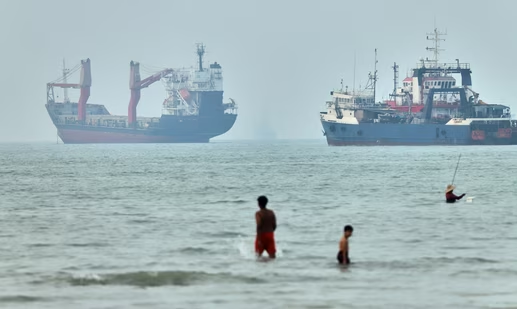
The latest dust-up between America and Iran began on June 25th, when the IRGC attacked a Singapore-flagged container ship, the Ever Lovely, as it exited the Strait of Hormuz. (AP)
Then there is the real world. Iran is still attacking commercial ships in the Strait of Hormuz and trading fire with America and its allies. Israel is still bombing Lebanon, despite a nominal ceasefire, and occupying a swath of its territory. Hizbullah, an Iranian-backed Lebanese militia, is threatening a new civil war.
For now, these two regions uneasily coexist: there will be both more jaw-jaw and more war-war. But the past few days underscore how little progress has actually been made through diplomacy. Months of talks have produced a pair of 14-point plans that, so far, do not solve any of the region’s underlying issues.
The latest dust-up between America and Iran began on June 25th, when the IRGC attacked a Singapore-flagged container ship, the Ever Lovely, as it exited the Strait of Hormuz. The next day America bombed military targets in southern Iran which, over the weekend, then fired missiles and drones at Bahrain and Kuwait. On June 28th, shortly before markets opened in Asia, the Americans signalled that the fighting was over and that vessels could “move freely” through the strait.
Iran did not offer its own assurances. Still, the first part of the American claim is probably true. The tit-for-tat strikes were limited in size and scope—a violation of the ceasefire, yes, but a modest one. Neither side has an interest in returning to all-out war, at least for now.
The second part looks more dubious. With the usual shipping lanes through Hormuz blocked by mines, vessels are forced to take one of two alternative routes. Iran demands that they use the northern passage through its territorial waters, which requires co-ordination with the IRGC. Last week, however, Oman and the International Maritime Organisation, a UN agency, started an effort to evacuate some 600 stranded vessels from the Persian Gulf that also uses the southern route, which goes through Omani waters.
Though the MoU called for Hormuz to be reopened within 30 days, Iran is determined to maintain its chokehold over the strait, which it sees as a key source of leverage. The southern route threatens that control; hence the attack on the Ever Lovely, which was using it. A hotline would not have prevented conflict: there is little to discuss when America and Iran have incompatible goals in Hormuz.
Oil markets shrugged off the incident. The price of Brent crude held steady at around $73 a barrel, roughly its pre-war level. But traffic through Hormuz has dropped. At least 62 ships transited the day before the attack on the Ever Lovely, according to Windward, a shipping-analytics firm. That number fell to 40 on June 27th (and most used the northern route).
While all of this was happening, Israel and Lebanon announced their deal on June 26th. It came after more than two months of talks in Washington. On paper, it looks ambitious. It commits the Lebanese government to disarming Hizbullah. If it does, the Israeli army will conduct phased withdrawals from territory it occupies in southern Lebanon. Two “pilot zones” are meant to provide proof of concept.
It also seems at odds with the MoU, which, at least in Iran’s reading,calls for a ceasefire and a full Israeli pullout. America insists it does not—and the language is sufficiently vague as to support both claims.
Seen from Jerusalem, the deal solves three immediate problems. First, it separates the two wars: Israel’s actions in Lebanon will be governed by this agreement, not the MoU. Second, withdrawing some troops would ease the strain on the Israeli army, which has nearly all of its regular units deployed in Lebanon, along with a number of reserve brigades. Third, it helps Binyamin Netanyahu, the prime minister, who faces a tough election this autumn. The accord does not specify a deadline for Israeli withdrawal, and the process will probably take years. Mr Netanyahu can tell voters that Israel will maintain its presence in Lebanon for the time being.
The deal is far more controversial in Lebanon. Critics raise numerous objections. The lack of a timetable means it may wind up legitimising another prolonged Israeli occupation. It also bars the Lebanese government from undertaking “hostile or adverse actions” against Israel at the UN or other international bodies, a remarkable concession from a sovereign state (the same restriction applies to Israel). Supporters argue that direct talks with Israel are long overdue, and that the alternative is to allow Iran to intercede on behalf of a militia—also an infringement on Lebanese sovereignty.
Almost everyone is sceptical that the agreement will be implemented in full. This is hardly the first time conflict between Israel and Hizbullah has led to talk of disarming the militia. Similar language featured in UN Resolution 1701, which ended their 2006 war, and the ceasefire that ended their previous fight in November 2024. Hizbullah remains more powerful than the Lebanese army and is fond of threatening violence against anyone who tries to defang it.
After the deal was signed Hassan Fadlallah, a Hizbullah MP, warned that the Lebanese government could not enforce it “unless they go, with American support, to civil war”. Such threats resonate in a country that endured a ruinous sectarian conflict from 1975 until 1990. The group has a history of assassinating its foes, including a former prime minister.
All of this will complicate negotiations between America and Iran, which are meant to reach a comprehensive nuclear deal within 60 days. On June 29th Esmail Baghaei, a spokesman for Iran’s foreign ministry, said there could be no direct talks until the MoU is fully implemented—including the part about Lebanon. The next round of discussions, intended to start today, is likely to be indirect. Envoys from the two countries will sit in separate rooms and pass messages via Pakistani and Qatari intermediaries, a poor format for discussing complicated and contentious issues such as uranium stockpiles and sanctions.
When the MoU was signed, American officials were ebullient about a new era in relations between America and Iran. Two weeks on, it looks much like the old one.
Sign up to the Middle East Dispatch, a weekly newsletter that keeps you in the loop on a fascinating, complex and consequential part of the world.