
There are few places that expose your sporting delusions quite as ruthlessly as a tennis court.
Watching Wimbledon from the sofa every summer, it’s remarkably easy to convince yourself you’d at least make contact with one of those thunderous serves.
You watch the professionals return them rally after rally and, somewhere in the back of your mind, a dangerous little voice whispers: I’d probably get one back.
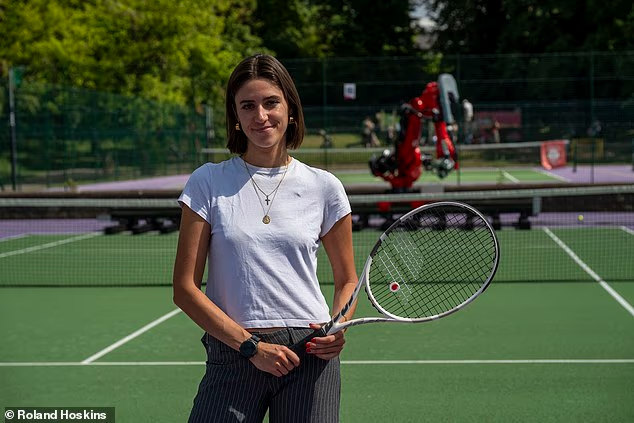
That illusion lasted until I found myself staring down a giant robotic arm in Wimbledon Park.
It wasn’t the sort of robot that politely hands you a coffee or vacuums your living room.
This industrial-looking machine had a single purpose: to recreate some of the fastest serves in tennis using live data from The Championships.
Standing opposite it with a racket in my hand suddenly felt rather less like a fun technology demonstration and rather more like volunteering to stand in front of a cannon.
Vodafone had invited me to try its new AI-powered 5G+ Serve experience, which captures the exact speed, direction and angle of serves hit on Centre Court before reproducing them almost instantly.
It sounds brilliantly futuristic. It also means that when the world’s best players unleash a serve at well over 100mph, you’re expected to deal with exactly the same thing a few moments later.
Lettice Bromovsky tries to return serve against the vodafone tennis ball serving machine

Daily Mail reporter Lettice Bromovsky returns a serve hit by a robot that emulates those by tennis legends

Jannik Sinner serves during an exhibition match at the Hurlingham Club in June
My confidence, admittedly, exceeded my ability.
The first ball came from Emma Raducanu. Perhaps it was the cameras. Perhaps it was the knowledge that everyone watching would see whether I made an utter fool of myself.
Whatever the reason, I sent my return sailing embarrassingly beyond the baseline. If there were style points for looking flustered, I’d have been seeded.
Thankfully, things improved.
Next up was Serena Williams. Even saying I’d returned a Serena Williams serve feels faintly absurd because, of course, I wasn’t facing Serena herself.
But the robot reproduced one of her serves with startling accuracy, flying at me at around 122mph, and somehow I managed to get enough racket on the ball to send it back over the net.
It wasn’t exactly the sort of return that would trouble a 23-time Grand Slam champion, but that’s beside the point. It counted in my head.
Then came Jannik Sinner.
You can spend years hearing commentators describe a 143mph serve, but television simply doesn’t prepare you for the reality.
The ball doesn’t so much travel towards you as materialise in your personal space before you’ve properly decided where to put your feet.

Emma Raducanu throws the ball to serve against Romania’s Sorana Cirstea during their round of 16 match at Queens

Oliver Kibblewhite is behind the vodafone tennis ball serving machine
Returning it isn’t about having quick hands; it’s about making decisions before your brain has fully caught up with what’s happening.
By some miracle – or perhaps blind luck – I managed to return one of his too.
It’s only when you’re standing there that you appreciate quite how extraordinary professional tennis players are.
We tend to talk about power, but what’s even more impressive is their anticipation. They’re already reading body position, racket angle and movement long before the ball has left the strings. I, meanwhile, was mostly hoping not to swing at fresh air.
The technology deserves plenty of credit too. This wasn’t a glorified ball machine firing random deliveries in my direction.
Every serve had been recreated using live broadcast data transmitted over Vodafone’s dedicated 5G network, producing something remarkably close to the real thing.
It’s an ingenious way of giving ordinary people a fleeting taste of elite sport – while simultaneously reminding them that they are nowhere near as talented as they imagine.
I left Wimbledon Park with two successful returns, a bruised ego and a considerably healthier respect for everyone competing just down the road at the All England Club.
The next time I catch myself wondering whether I could cope with a professional serve, I’ll remember the giant red robot that politely, efficiently and very publicly proved otherwise.