IF Sir Keir Starmer is hoping that the long-awaited and bitterly contested defence investment plan (DIP) that finally broke cover on June 30th will be seen as a lasting legacy, he is likely to be disappointed. The document, which commits £15bn ($20bn) of new funding to the armed forces over the next four years and sets out spending plans for the next decade, contains much that is sensible and even bold. But at a time when European allies are rapidly rearming and in the face of increased global threats, the goal of allocating 2.7% of GDP to defence by 2029, an increase of just 0.1 percentage points over next year’s level, looks paltry.
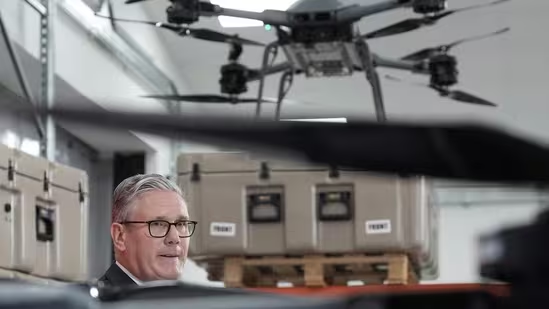
Over £5bn is going into a “drone transformation” of the armed forces. (AFP)
At NATO’s summit in Ankara next week, Sir Keir’s last hurrah as prime minister, otherwise sympathetic fellow leaders will ask some hard questions about Britain’s path to meeting its pledge of core defence spending reaching 3.5% of GDP by 2035. The new defence secretary, Dan Jarvis—who stepped in after John Healey resigned two weeks ago over Sir Keir’s inability “to commit the resources that the nation needs to defend the country”—says that in the next spending review defence “will be the number-one priority”. But there is nothing to bind the hands of Sir Keir’s successor, Andy Burnham.
Indeed, Mr Burnham will inherit a problem. To make space for the DIP, there are to be cuts in energy and transport schemes—not great for a government that stresses the importance for growth of infrastructure. And an unidentified £4.7bn shortfall in the DIP’s funding will still need to be found at the next budget.
One “untouchable” (some say “unaccountable”) programme, the Defence Nuclear Enterprise (DNE), will take about half of the equipment budget over the next decade. The modernisation of the nuclear deterrent, which involves building four ballistic-missile submarines and designing a new nuclear warhead, has become a money pit. Funding for the DNE, including the AUKUS submarine pact with America and Australia, over the next four years will be nearly £64bn, an increase of £20bn over the previous four-year period.
Another big item is the £8bn over four years that will go into the Global Combat Air Programme (GCAP) to build a sixth-generation fighter jet with Japan and Italy, which it is hoped will enter service by 2035. Much to the delight of Britain’s biggest defence firm, BAE Systems, which is leading the project, for diplomatic and industrial reasons that programme is also now deemed in effect ring-fenced.
To compensate for the hollowing out of Britain’s conventional armed forces over the past 20 years and the tightness of the budget now, the government is betting heavily on investment in what has become known as “affordable mass”. Over £5bn is going into a “drone transformation” of the armed forces. The army will get inexpensive attack drones and uncrewed ground vehicles of the kind that have changed the battlefield in Ukraine as well as new armoured vehicles, with AI-enabled digital targeting. The DIP claims all this will increase “lethality” by a factor of ten.
The air force’s Typhoon jets will have their service lives extended into the 2040s with the help of a £300m investment in autonomous Collaborative Combat Aircraft, or “loyal wingmen”. They can act as sensor nodes and fly ahead of the Typhoon into danger to suppress air defences.
The most daring—and controversial—project is the idea, developed in last year’s strategic defence review, of a “Hybrid Navy”: networks of crewed and uncrewed autonomous vessels carrying weapons, sensors and anti-submarine systems. The expensive Type 83 air-defence destroyer is cancelled. Instead, six new Common Combat Vessels (CCVs) are to join 13 new Type 26 and five cheaper Type 31 frigates as the backbone of the surface fleet. The CCVs will be a command hub controlling a dispersed group of large (up to 90-metre) autonomous warships. Some will carry missiles, others will be used for anti-submarine warfare or as sensor platforms.
Even senior officers involved in visualising the hybrid navy admit that its radicalism will shock traditionalists and that it is certainly not without risk. Nick Childs, a seapower expert at the International Institute for Strategic Studies, a think-tank, says it is a calculated gamble which partly reflects how far the navy has fallen behind with its conventional platforms and the difficulty it has recruiting crews.
Matthew Savill, director of military sciences at RUSI, another think-tank, says the emphasis on autonomy and uncrewed systems is “a bold bet on technological solutions with no margin for error if procurement is not speedy and implementation rapid.” What could possibly go wrong?