

The group stage of the FIFA World Cup 2026 has concluded, and the knockout rounds are now upon us. Beyond the great goals, tactical battles, and a few surprise results, one talking point has refused to go away. The mandatory hydration breaks introduced by FIFA have sparked fierce debate among fans, players, pundits, analysts and coaches alike. The question around every stoppage has been the same: Are these breaks changing the course of matches by causing momentum shifts?
The discussion has become more noticeable because football is a sport built on rhythm. Teams often dominate possession for several minutes before creating a chance, while others rely on sustained pressure to pin opponents inside their own half. A classic example is Algeria’s third goal against Austria in their final group game. The Fennecs sustained possession and built up play from the 84th minute until they finally got Riyad Mahrez in-behind for a goal in the 93rd minute after 110 passes!
When play stops for a minute or two, it is easy to believe that one team’s momentum has disappeared and another has been handed an opportunity to regroup. Several matches during the tournament appeared to follow that pattern, even if proving a direct connection through data remains a challenge.
In this piece, Completesports.com‘s ALLI FESOMADE examines the debate surrounding hydration breaks at the FIFA Club World Cup, using data to separate perception from the measurable impact of these breaks as the knockout rounds begin.
Players, Coaches And Fans Divided Over FIFA’s Mandatory Hydration Breaks
FIFA’s decision to mandate these breaks in all fixtures regardless of weather conditions has drawn severe criticism from across the footballing world. The rule was announced in December with a sense of finality, with FIFA claiming that players would benefit from three-minute hydration breaks in each half of games as FIFA prioritises player welfare. President Gianni Infantino has reiterated this since the start of the tournament. However, just one week into the tournament, it became obvious that many players were not keen on the inaugural, compulsory, non-negotiable amendment.
Speaking to The Athletic, Netherlands defender Virgil van Dijk led the charge against the hydration breaks. According to him, if it’s really hot, obviously it will be good to put the hydration breaks in. But in his opinion, he believes you have to look at it in every game separately. Van Dijk also voiced frustration that commercial interruptions are not really something he likes in football.
Also Read: World Cup 2026: Ibrahimovic Blames Koeman For Netherlands Defeat To Morocco
Belgium’s Youri Tielemans agreed, saying the rule was inconsistently applied in cooler cities, but if it was used in some venues, it should be used in all. His comments align with FIFA’s stated reasoning that there would be no weather or temperature condition in place, with the breaks being called by the referee in all games, to ensure equal conditions for all teams in all matches. Ghana defender Gideon Mensah provided a clear example of the situation when he questioned why the breaks were used during a rainy match in Toronto.
U.S. defender Antonee Robinson admitted the pauses had been an adjustment, describing how during the Americans’ opener, players gathered around a laptop to review tactics before being told to wait because commercials were still running. He felt the experience took fans out of the match. Canadian right-back Alistair Johnston offered a more cynical take, suggesting the breaks were likely generating additional revenue for FIFA. He made these comments ahead of Canada’s 6-0 thumping of Asian side and previous host Qatar.
The coaching society is also deeply split on the issue. Croatia manager Zlatko Dalić added that while the stoppages can help struggling teams regroup, they also break the momentum of the game. The argument here is that if the break can change the match tactically, then it is not just a safety measure anymore.
Mauricio Pochettino, head coach of the United States men’s national team, has been one of the most vocal critics. As Tom Bogert shared, Pochettino said he does not support FIFA’s hydration breaks being used automatically at this World Cup unless the conditions are extreme, but when the conditions are good, it is completely unnecessary. Pochettino accepts the need for protection when heat becomes a genuine player-safety issue but objects to the blanket nature of the rule.
Uruguay manager Marcelo Bielsa argued that splitting matches into four periods alters the fundamental nature of football, stating it adds nothing and takes away a lot. France coach Didier Deschamps complained that the structure now feels like four quarters rather than two halves, which hinders the free-flowing nature of the sport. This idea had reportedly been proposed before in the history of the sport.
England head coach Thomas Tuchel also admitted that the breaks change the identity of a match and make it difficult to build or maintain momentum. However, he also said the pauses give teams a chance to reset physically and mentally. Like Pochettino, Spain’s Luis de la Fuente questioned the necessity of breaks in cooled stadiums, while Norway’s Ståle Solbakken slammed them as unnecessary outside of extreme heat.
Also Read: World Cup 2026: We Deserved To Be Eliminated —Germany Captain Kimmich On Shock Defeat To Paraguay
Despite these commentaries, not every manager wants the breaks to disappear. Portugal’s Roberto Martinez called the extra coaching time revolutionary, while Austria’s Ralf Rangnick even suggested hydration breaks could eventually become part of domestic football. Belgium coach Rudi Garcia also embraced the tactical opportunity, calling it a coaching break as opposed to a cooling break. He added a caveat, saying he understands that if his team were having a good moment and were in a good flow, the breaks could interrupt but so far it was interesting to give some information tactically to the team.
Commercial Debate Adds Fuel To The Hydration Break Controversy
Before we go into whether or not the data supports these claims, let us also examine the criticisms from the commercial angle. Much of the criticism has been aimed at the commercial benefits of these three-minute pauses seemingly masquerading as hydration breaks. A 30-second World Cup advertisement slot on Fox Sports reportedly costs between $200,000 and $300,000, and can go as high as $750,000 during USA matches and later stages of the tournament, per BBC Sport. In the US alone, advertising during hydration breaks could generate more than $250 million.
While some broadcasters stuck with the live feed featuring players, others cut to commercials, disrupting the match-viewing experience for fans watching on TV. Viewers in the United States were frustrated after broadcaster Fox cut away to full-screen commercials, missing some live action during the second half of the Mexico vs South Africa opening match.
FIFA President Gianni Infantino has rejected claims that the breaks are meant to generate extra advertising revenue, saying FIFA receives absolutely nothing financially from the additional stoppages. The public perception nonetheless remains that commercial interests are driving the decision because, according to weather expert and senior meteorologist Everton Fox, from a weather perspective, very few games have actually met the level required to need a hydration break, making it hard to see it as anything other than a commercial venture worth millions of dollars in advertising to the US TV channels, if not billions, globally.
What The Data Says About Momentum Shifts After Hydration Breaks
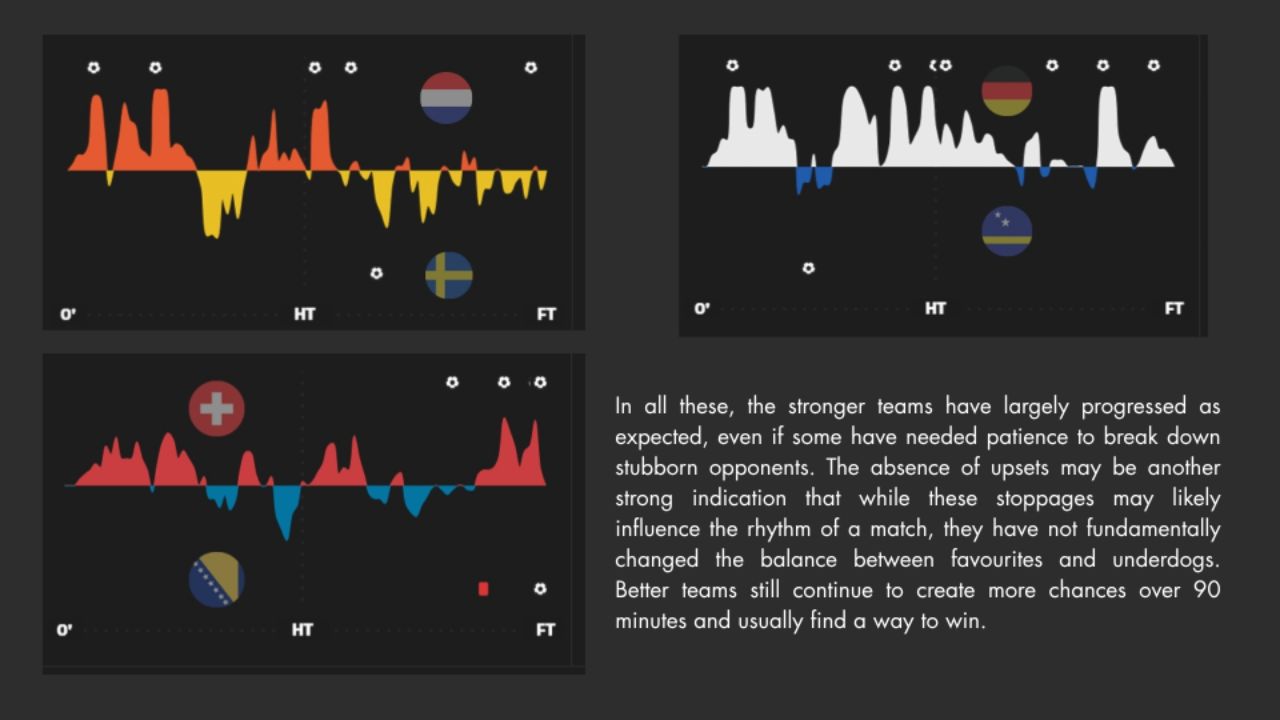
Now we get to the part where data actually weighs in. From a sporting perspective, some have argued that the hydration breaks are momentum killers in matches, and that becomes an interest, especially now that the stakes are all-or-nothing in the knockout stages. To cite a few instances, World Cup debutants Curaçao were in dreamland when Livano Comenencia equalised against Germany in their group opener in the 21st minute, only for the referee to signal a hydration break shortly after, allowing Germany coach Julian Nagelsmann to rally his troops to a 7-1 victory.
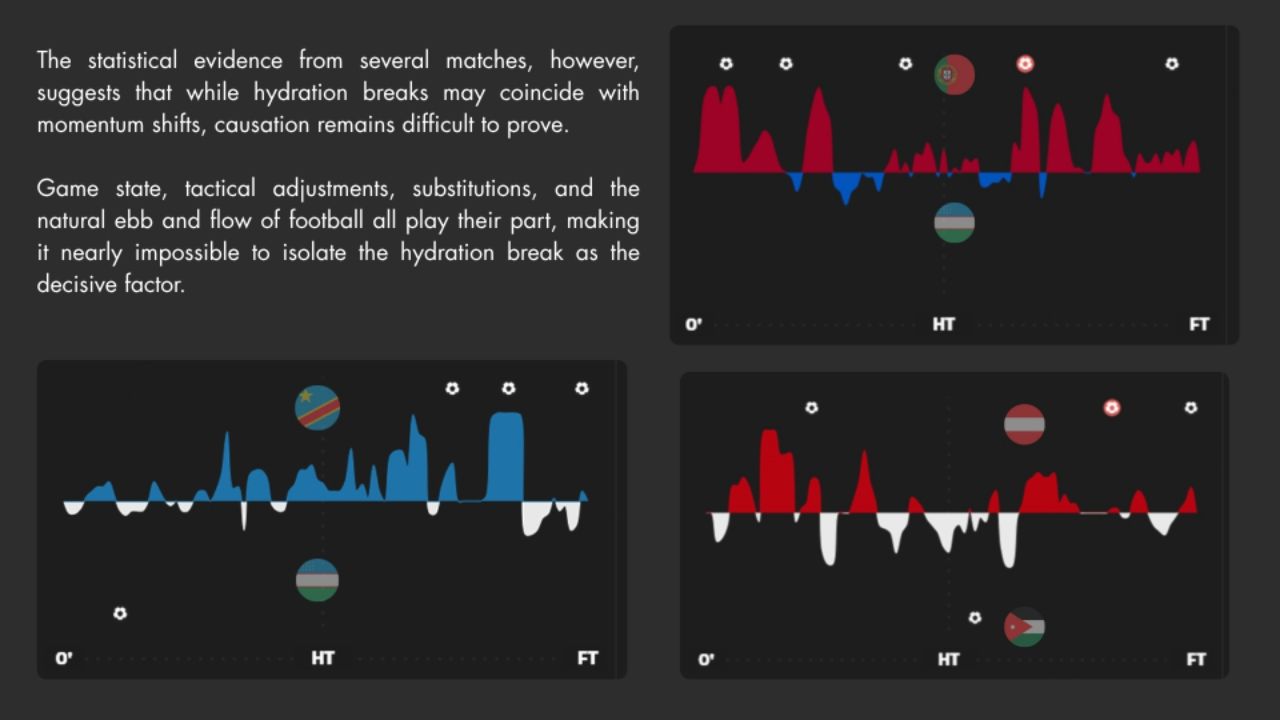
Other examples include Bosnia and Herzegovina losing momentum during the hydration pause, allowing Switzerland to swoop past them. Uzbekistan also had a shift in momentum after the first-half hydration break against Portugal, scoring a disallowed goal shortly after the break after Roberto Martinez’s side looked to have had them pinned down. It remains unsolved how events would have unfolded had that goal stood.
Group stage matches allow teams some room for recovery after a disappointing result, but knockout football offers no second chance. A single goal can decide an entire campaign and every tactical decision carries greater weight. If a team is protecting a narrow lead or desperately searching for an equaliser, even a brief stoppage could provide valuable time for players to regain composure and coaches to deliver instructions that might influence the closing stages. If the claims about the hydration breaks and the momentum of games are entirely true, then the knockout rounds could make those moments even more significant.
Also Read: World Cup 2026: Rapper Drake Wins N1.3 Billion After Staking On Canada To Beat South Africa
Data published by Opta Analyst examined whether hydration breaks have consistently influenced the flow of games. The study found examples where momentum appeared to change immediately after the stoppages, but the overall numbers did not provide enough evidence to conclude that hydration breaks are responsible for those swings. Instead, the data suggested that football naturally becomes more open as each half progresses, with tired legs, tactical adjustments and substitutions already creating the conditions for dramatic momentum changes.
The data gives no conclusive evidence for the “Momentum Killer” accusations. There have been games where it has appeared as though momentum changed, and if a goal was scored shortly after these breaks, as it was in the game between Uzbekistan and Congo DR, it is believed that the breaks are playing a role. The statistical evidence from several matches, however, suggests that while hydration breaks may coincide with momentum shifts, causation remains difficult to prove.
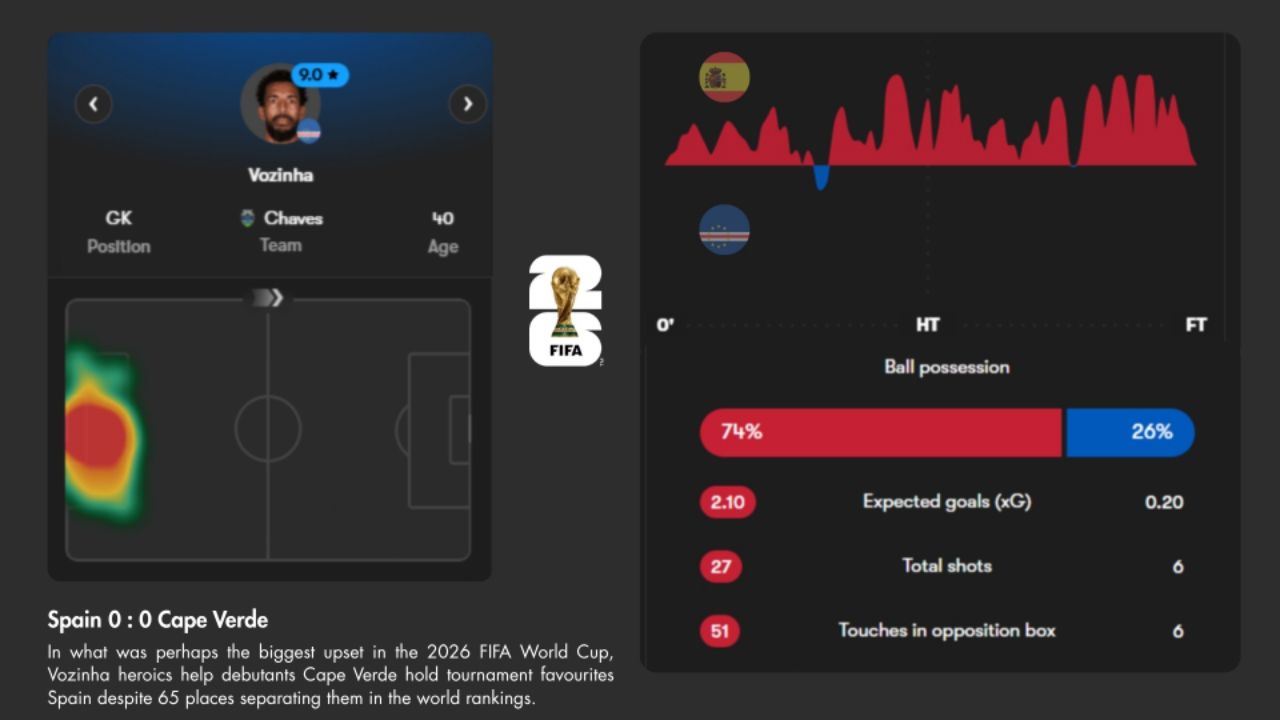
In addition to that, the 2026 FIFA World Cup has not produced many shocking results despite the attention given to hydration breaks. In what was perhaps the biggest upset in the tournament so far, Vozinha’s heroics helped debutants Cape Verde hold tournament favourites Spain despite 65 places separating them in the world rankings. This goalless draw also saw a brief burst in momentum from Cape Verde after the first hydration break but in that game, the Spaniards were both dominant and somewhat prodigal.
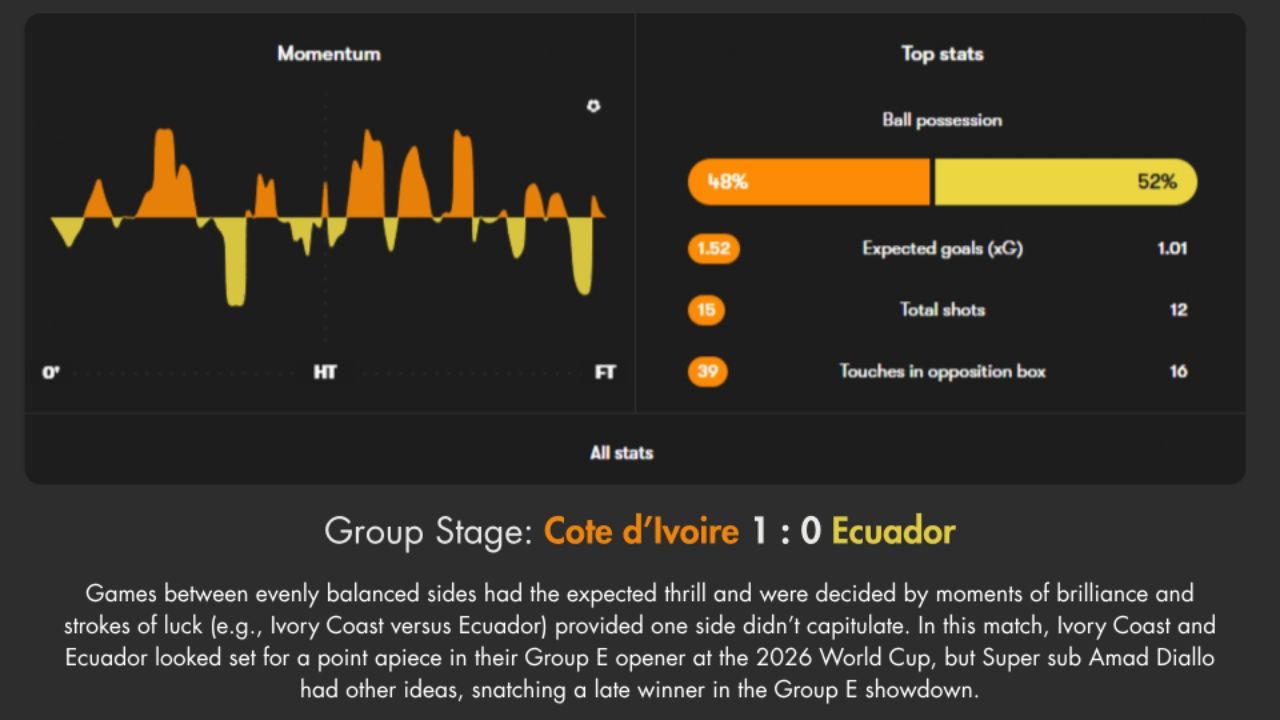
In all these, the stronger teams have largely progressed as expected, even if some have needed patience to break down stubborn opponents. The absence of upsets may be another strong indication that while these stoppages may likely influence the rhythm of a match, they have not fundamentally changed the balance between favourites and underdogs. Better teams still continue to create more chances over 90 minutes and usually find a way to win. Games between evenly balanced sides also had the expected thrill and were decided by moments of brilliance and strokes of luck (e.g., Ivory Coast versus Ecuador) provided one side didn’t capitulate.
Case Studies: Do Match Statistics Support The Momentum Theory?
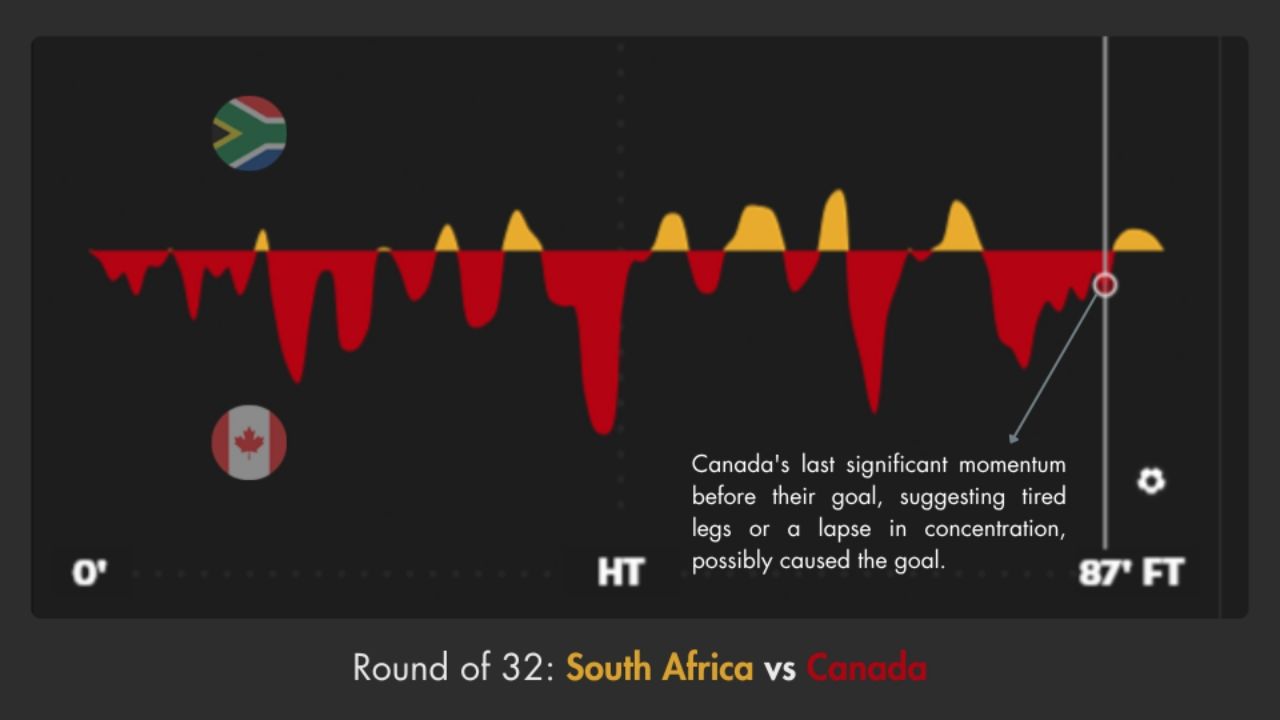
In South Africa’s 1-0 loss to Canada in the Round of 32, the co-hosts were largely the more threatening side of the two and the late goal could be credited to a brief lapse in concentration from Hugo Broos’ side. In the Netherlands’ 5-1 win over Sweden, the Dutch (4 shots and 1.34 xG) dominated Sweden (1 shot and 0.03 xG) before the first hydration break. During the break, Graham Potter switched Sweden from five at the back to four and the Swiss, on resumption of play, took eight times more shots than the Dutch, accumulating 0.44 xG compared to the Netherlands’ 0.03 xG between the break and half-time.
As obvious and measurable as that instance was, game-state mechanics could easily have made up for the shift as we saw it. This is because Sweden was already 2-0 down before the hydration break and their desperate push for a route back into the game combined with Potter’s tactical adjustment might easily have produced similar momentum without the enforced pause.
The largely referenced 7-1 demolition of Curaçao by Germany also offered another intriguing example when the details are critically examined. Julian Nagelsmann admitted he used the first-half hydration break to clarify instructions against an unfamiliar diamond midfield shape that Curaçao were playing, and Germany’s xG jumped from 0.64 before the break to 1.82 after it, turning a 1-1 scoreline into a 3-1 half-time lead. Nevertheless, in football folklore, Germany is clearly a superior side to Curaçao, so to pin the shift and eventual lead entirely on the hydration break would barely even be a half-truth.
Other cases were less convincing. Jordan midfielder Amer Jamous for instance, claimed his side was controlling the game before conceding twice after the second-half hydration break against Austria, but the numbers told a different story. Austria (0.3) had double the xG of Jordan (0.15) before the stoppage.
Similarly, Bosnia enjoyed their best spell of the game against Switzerland just before the second-half hydration break with 34 final-third touches, per Opta records. Switzerland coach Murat Yakin openly acknowledged using a hydration break strategically, making a triple substitution at the stoppage because, according to him, that way the opponent can’t react immediately.
Also Read: Okocha, 4 Other African Stars Who Hold FIFA World Cup Records
When play resumed, Switzerland generated 1.67 xG after the hydration break compared to just 0.31 xG before it, winning 4-1 in the end. One of the substitutes scored twice and another got a goal and an assist. Again, those changes might have been just as effective if made during normal play without the hydration breaks. This goes to suggest that Switzerland’s dominance after the break owed as much to Yakin’s triple substitution as to the pause itself.
Why Tactical Changes Matter More Than The Break Itself
Across all these examples, one thing that’s clear is that momentum often shifts after hydration breaks, but there is not enough evidence from the data to conclude that these breaks are the sole or even the primary cause of these shifts in momentum. Game state, tactical adjustments, substitutions, and the natural ebb and flow of football all play their part, making it nearly impossible to isolate the hydration break as the decisive factor.
That does not mean the breaks are totally irrelevant. The coaches themselves have embraced them as short tactical meetings during live matches. Instead of waiting until half-time, managers now have another opportunity to reorganise their shape, adjust pressing instructions or calm players down after a difficult spell. Defenders as well can recover after prolonged pressure, while set-piece coaches and attacking teams may use the hydration breaks to discuss new movements or set-piece routines. These conversations may not always lead to immediate goals, but they introduce another tactical layer into modern football.
That conclusion may disappoint fans looking for a simple answer, but it also speaks to the unpredictable nature of football. Some of the game’s greatest comebacks happened without any enforced stoppages. One of the clearest examples remains Real Madrid’s remarkable UEFA Champions League semi-final comeback against Manchester City in 2022, when Rodrygo scored twice within minutes late in normal time to turn the tie around. There were no hydration breaks that night. The momentum simply changed because football has always been capable of producing extraordinary moments in an instant.
UEFA’s Different Approach Keeps The Debate Alive
In contrast, UEFA has explicitly ruled out adopting similar breaks for Euro 2028 and the Champions League, maintaining that cooling stops should only occur if specific heat thresholds are exceeded. This stark contrast to FIFA’s blanket approach also further fuels the debate about whether the breaks are genuinely about player welfare or something else entirely.
FIFA’s ability to use football as a unifying factor has arguably never been more straightforward than the collective distaste for its decision to introduce hydration breaks in all fixtures, with fans, players, coaches, and everyone in between criticising, debating, and challenging the decision.
What To Expect As The Knockout Stage Intensifies
Looking ahead to the knockout phase, the conversation is unlikely to disappear. Fatigue will also become a bigger factor as the tournament progresses but it is expected that every knockout match will be examined more closely, particularly if a goal follows one of these mandatory stoppages. Analysts will continue searching for patterns, while supporters will trust what they believe they have seen with their own eyes. Both viewpoints add to the intrigue surrounding a competition already.
To conclude, whether hydration breaks truly alter momentum may only become clearer after more tournaments and a larger body of data is studied. For now, the data suggests they should not be viewed as the main reason matches change direction because football has always been defined by moments of inspiration, mistakes, tactical adjustments and individual brilliance.