
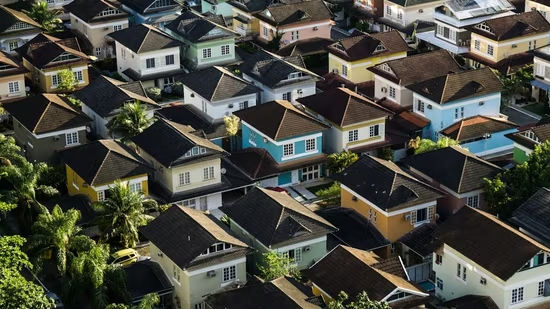
A new housing report shows that many Americans are finding it hard to afford housing. The report was released on June 17 by Harvard University’s Joint Center for Housing Studies in its 2026 State of the Nation’s Housing report. It says housing costs have gone up across the United States. Families are paying more for homes and also spending more on everyday needs.
Homeowners are also facing higher property taxes and insurance costs. According to Harvard’s data, the average property tax in the country went up by 31% between 2019 and 2025. Home insurance costs have risen even faster. Average monthly insurance premiums jumped by 72% during the same period.
Buying a home is becoming harder for first-time buyers. Many people already struggle to save for a down payment, and now the long-term costs of owning a home are also increasing. Americans are moving less than ever before. Only 11.2% of households changed homes in 2024, the lowest relocation rate ever recorded, as per Business Insider. High mortgage rates are keeping homeowners stuck in place. Mortgage rates have remained high because inflation has stayed elevated
Renters are also facing serious financial pressure. About half of all renter households spent at least 30% of their income on housing in 2024. Many renters are spending extremely large portions of their income on housing. The report says 26% of renters spent more than half of their income on housing costs. Lower-income renters are being hit the hardest. About 83% of renters earning less than $30,000 per year were considered cost-burdened.
Even though more homes and apartments were built after the pandemic, many people still cannot afford to move. The report says high rents continue to make housing unaffordable for many households. The weak economy is reducing housing demand. Recent years have seen a slow job market, stubborn inflation, and weak consumer confidence. Because money is tight, fewer Americans are making major purchases. The report says people are delaying big financial decisions such as buying a home.
Also read: VA Mortgage Partial Claim 2026 explained: Eligibility, rules, limits and how veterans can avoid foreclosure
Housing available but still too expensive
More homes are becoming available in some places, but affordability remains a major problem. The report says housing supply and affordability are not improving at the same pace. High construction costs are making new homes expensive. Many newly built homes are priced beyond the reach of low- and middle-income families.
Some homes are sitting unsold because buyers cannot afford them. National unsold housing inventory reached 127,000 homes in January 2026, the highest level since 2009. Some cities are seeing a large increase in apartment vacancies. Austin experienced a 5% increase in apartment vacancy rates between 2021 and 2025.
More empty apartments in Austin helped lower rents. The report says rents in Austin fell about 7% annually as landlords reduced prices to attract tenants. Not every city is seeing the same trend. Housing markets differ widely across the country. Chicago’s market moved in a different direction.
Local governments face growing pressure
The report says local and state governments will need to play a bigger role in housing. As builders slow construction because of weaker demand and higher costs, governments may need to step in. Federal spending cuts have increased the challenge. The report says housing pressures have become worse because of spending reductions under the Trump administration.
Cities and states are trying different solutions. Some governments are changing zoning and land-use rules to encourage more housing construction. Minneapolis is being highlighted as a successful example. Business Insider reported that the city’s 2040 housing plan removed single-family-only zoning restrictions.
Minneapolis’ reforms helped increase affordable housing supply. Business Insider cited the city’s zoning changes as a key factor. New York is also pursuing major housing reforms. Zohran Mamdani’s housing plan aims to build 200,000 new homes.
Federal help still needed
The report says local efforts alone will not solve the problem. Federal funding remains essential for creating deeply affordable housing. The report concludes that the US faces several housing crises at the same time. Researchers cited affordability problems, homelessness, climate change impacts, and housing discrimination.
Harvard researchers say all levels of government and private organizations must work together. The report states that federal, state, local, private, and nonprofit groups need coordinated action to address America’s growing housing challenges.