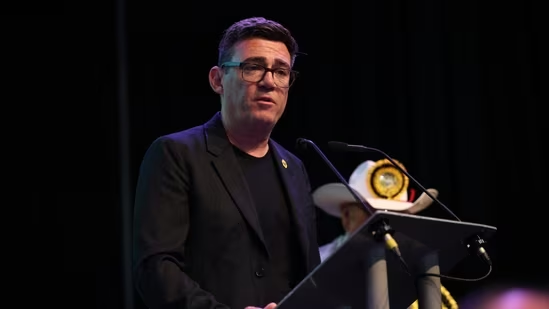
Sir Keir Starmer’s days as prime minister are numbered. The triumph of his Labour colleague and rival Andy Burnham in a by-election in the northern constituency of Makerfield on June 18th means that Sir Keir will soon face a formal challenge to his leadership—one he is very likely to lose.
Andy Burnham will return to the House of Commons next week after comfortably winning the Makerfield contest with 55% of the vote, well ahead of the candidate for Reform UK, a right-wing populist party, who won 35%.
Mr Burnham had been out of Parliament for nearly a decade while serving as mayor of Greater Manchester. He will return to the House of Commons next week after comfortably winning the Makerfield contest with 55% of the vote, well ahead of the candidate for Reform UK, a right-wing populist party, who won 35%.
Labour’s victory might seem like cheering news for Sir Keir, a rare by-election triumph for his party, which has slumped in the polls and took a battering in local elections last month. It is not. After that debacle in May nearly 100 Labour MPs called for the prime minister to resign, and Wes Streeting, his centrist health secretary, quit the cabinet promising to challenge him. The wrangling was paused only after Makerfield’s previous MP stood down in order to give Mr Burnham a chance to get back into Parliament (a leadership contender must be an MP) and join the looming contest.
In recent days Sir Keir has put on a brave face: he insisted he would be delighted to see Mr Burnham back, while vowing to face down any threat to his own position. But few believe the prime minister can hold out for long. If either Mr Burnham or Mr Streeting—or both—shows he has the support of 20% of Labour MPs, a leadership election will be triggered. The incumbent would automatically be on the ballot, with party members getting the final say on who is their leader and therefore the prime minister.
What happens immediately will depend on the three men fighting for the job. Mr Burnham promised a “turning-point” for Labour after his win, saying he had “unfinished business”; but his camp has briefed the press that he will not get involved in leadership manoeuvring for at least a few days. His preference, it seems, is for Sir Keir to quit of his own accord and set out a timetable for an orderly leadership transition taking just a few weeks. But Mr Streeting may force the issue by publishing his list of backers and starting the formal election process; or Sir Keir himself could issue a “back me or sack me” ultimatum.
Mr Burnham has the advantage of starting as Labour’s most popular politician among both party members and Britons at large. His time running Greater Manchester is widely seen as a success. But two previous leadership bids were flops and he has sometimes struggled in the spotlight of national politics, sending out mixed messages on big issues such as whether the government needs to balance the books.
Unless both Sir Keir and Mr Streeting back down—which would be uncharacteristic—Britain’s government faces weeks of uncertainty which may not be resolved before Labour’s annual conference in September. With his position under threat, Sir Keir will at best limp to a NATO summit in early July, and to an important summit with the EU shortly afterwards.
While Labour turns on itself, Reform campaigners are licking their wounds. Makerfield should have been fertile territory for the populists. They failed to overcome Mr Burnham’s star power and were also hurt by a robust showing from Restore Britain, a new far-right party which picked up 7% of the vote by promising to deport millions of migrants living legally in Britain. Already Nigel Farage, Reform’s leader, is adopting a harder edge to his rhetoric in an effort to see off the new threat to his right.
Farther north, the Conservatives showed promising signs of life by winning a separate by-election, in the Scottish seat of Aberdeen South, ousting the Scottish National Party in a seat they had targeted as a chance to regain momentum. It was the Scottish Conservatives’ first by-election gain in more than half a century. It was also another sign of trouble for Reform, which risks being squeezed from all sides.
Perhaps the most relieved group will be the voters of Makerfield. For five weeks, they have been inundated with campaigners (and journalists) as Labour MPs from across the party’s factions rushed to the area to curry favour with Mr Burnham. Labour and Reform claim between them to have knocked on every door in the constituency at least ten times. The message posted outside one house in the village of Platt Bridge the day before the by-election was clear: “Knock on door, lose our vote”.
The irony is that, even as Westminster has obsessed over “Makerfield”, there is really no such community. A ten-mile walk through the constituency reveals a disconnected cluster of suburbs, towns, villages and fields around the edge of Wigan with no collective identity. Britain’s political future has been determined by a place that does not exist.
For more expert analysis of the biggest stories in Britain, sign up to Blighty, our weekly subscriber-only newsletter.