It has been a grim 12 days for English cricket, and the bad news is that things may get worse before they get better.
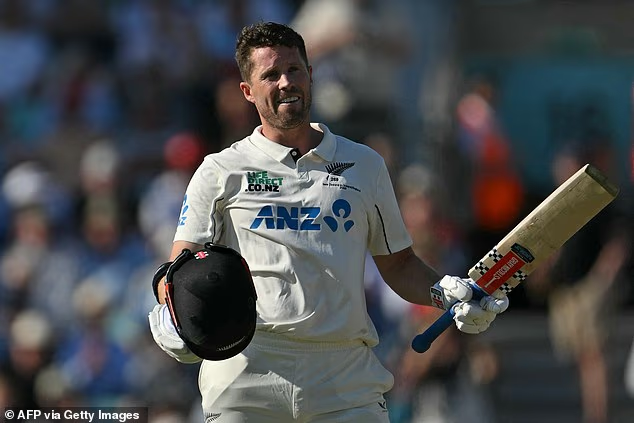
As Henry Nicholls, with his 11th Test hundred, and the elegant Rachin Ravindra ground England’s bowlers into the Oval dirt, it seemed improbable that New Zealand will not now win this second Test and set up a decider next week at Trent Bridge.
By then, of course, the Ben Stokes psychodrama will still be rumbling on, even if – as expected – he does return as captain. Try as the ECB might, his first press conference back in the saddle will be a feeding frenzy, when what England need right now is to focus on runs and wickets.
Stokes’s reported state of mind, his moods and deliberations, have hung over this Test like a rain cloud ready to burst. Even in his absence, he remains the English game’s dominant personality. England have had a crack at life without him, and it hasn’t worked.
Assuming they don’t escape this game with a draw, the pressure on managing director Rob Key and head coach Brendon McCullum will be immense, barely a fortnight after the summer began so encouragingly with a fighting win on a bad pitch at Lord’s. A home defeat by New Zealand so soon after the Ashes would be unthinkable. Truly, it was not meant to be like this.
The mood in the boardroom is that England’s struggles here should not be held against Key and McCullum, since it was Stokes’s decision to break the curfew that kickstarted this mess.
Henry Nicholls scored a century for New Zealand on day three of the second Test against England at The Oval
Even so, it felt in keeping with a narrative spiralling out of control that, on the day Joe Root was trying to win a Test match with plainly inadequate resources, Stokes was charging in for Durham up at Chester-le-Street, while Gus Atkinson – his fellow Rex Rooms rebel – was taking two quick wickets for Surrey over at Cardiff.
In other words, two of England’s best bowlers were giving it their all, just not for England in a Test which might, in a parallel universe, have led to a restorative series win. When historians come to write the definitive work on self-inflicted wounds, there is material here for an entire chapter.
The third day at The Oval served up more fodder. Resuming on 222 for six, still 169 behind, England had little choice but to make New Zealand work hard for their last four wickets.
Instead, in successive overs from Matt Henry, Jordan Cox worked tamely to midwicket, Jofra Archer edged an ambitious cut and Josh Tongue was caught by Nathan Smith – spectacularly, it must be said – as he tried to clear mid-on. The crowd had barely settled into their seats when Henry was celebrating a five-for.
Without a last-wicket stand of 53 between Matthew Fisher, who marked a dogged unbeaten 50 with a glance skywards in memory of his late father, and Sonny Baker, whose contribution was four, the deficit would have been well over 100. But the damage had already been done.
After a bright start, England’s bowlers then spent the rest of the day underlining the need for urgent change come Nottingham. Archer induced a loose poke from the out-of-form Tom Latham to James Rew behind the stumps, before Devon Conway drove Tongue’s first ball to Harry Brook at second slip.
But New Zealand’s lead was such that only perfect cricket from England would do, and there never seemed much danger of that.
With the total on 48, Rew made a mess of a chance low to his left as Ravindra edged Tongue – a mistake that brought into sharper focus first-choice wicketkeeper Jamie Smith’s decision to miss this Test following the birth of his second child.

England have had a crack at life without captain Ben Stokes, and it hasn’t worked out
Later, Rew overshot a high but gettable leg-side chance as Nicholls, on 42, flapped at a short one from Archer. With Nicholls, drafted in after the surprise retirement of Kane Williamson, reaching stumps on 119, those two mistakes alone have cost England 146 – and counting. For Rew, all too easily bounced out late on Thursday evening, it has been a chastening Test debut.
Fisher looked as anodyne as he did during his only previous Test, in Barbados four years ago, while the debutant Baker ran in gamely but artlessly. It will be a surprise if either player features in Nottingham, even with Ollie Robinson uncertain to return from knee trouble in time for the third Test, and Brydon Carse still unfit because of a hand injury.
Worryingly for England, their most successful bowler in this Test has been Jacob Bethell, whose left-arm spin ought to be little more than a place holder.
To his first-innings haul of three he added the wicket of Ravindra, who missed a sweep and was leg-before for 76. And, by the end of the day, with New Zealand 352 ahead and only three down, Bethell had match figures of four for 59, while the four main seamers had nine for 489.
In retrospect, England might have been better off picking Rehan Ahmed for his leg-spin and greater batting depth, instead of one of the seamers.
They spent the build-up to this game putting a brave face on their plight, and expressing excitement at their new-look team’s youthful vigour.
But this game has been a reminder that Test cricket can be a merciless business. If and when Stokes returns to the fray, his task will be to put right the chaos he helped create. Frankly, it’s a good job he likes a challenge.