WARNING: DISTRESSING CONTENT. At 16 years old, Maiwand Banayee was preparing to become a suicide bomber. Then he saw the true horrors of the Taliban first hand
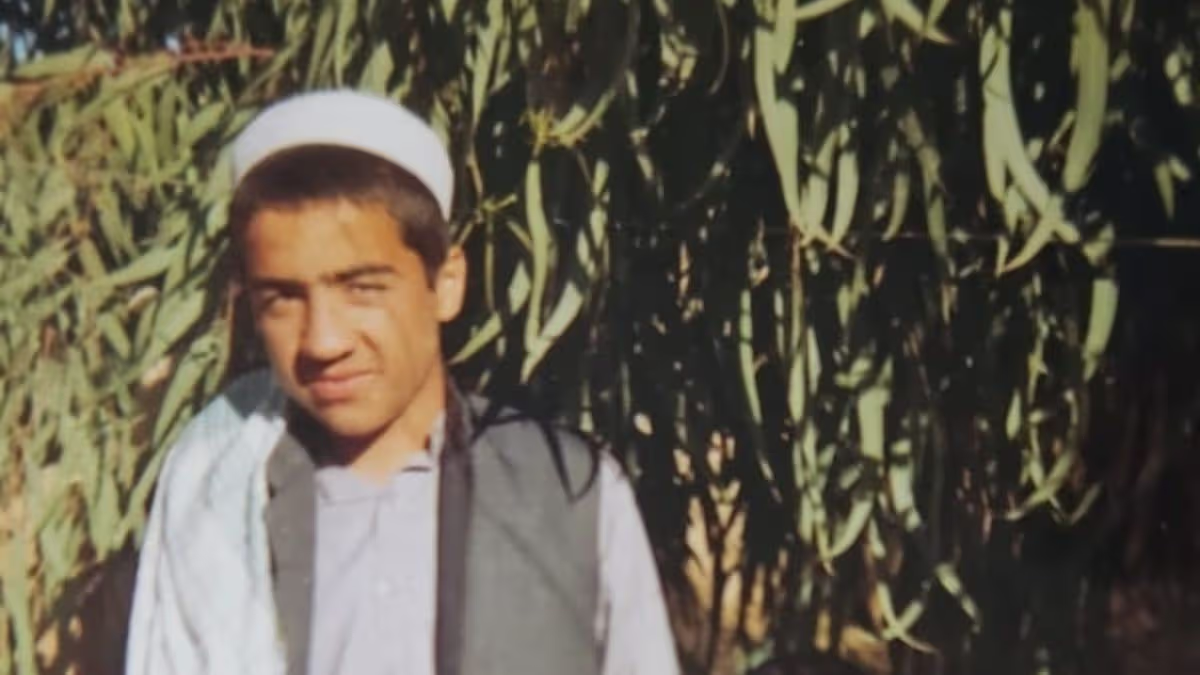
Maiwand Banayee still vividly remembers the moment he entered a Pakistani refugee camp as a traumatised 14-year-old.
The air was thick with the call to prayer echoing from some 40 mosques, blasting so loudly that the teenager’s ears “nearly burst”. He felt he’d stepped through a portal into “seventh-century Saudi Arabia”. Alongside his family, Maiwand, then 14, had fled Afghanistan as the violent wars ravaged his homeland.
They had hoped the camp would offer them the sanctuary they had lost, but instead, they walked straight into the lion’s den. In this isolated world, extreme religious doctrine dictated every second of existence. There was no music, no films, no women’s voices, and absolutely no outside influences to shape Maiwand’s developing, bookish mind.
By the time he turned 16, trapped in a state of what he calls “religious psychosis”, he was ready to lay down his life as a suicide bomber. Now 46, Maiwand has captured his harrowing journey in his book, Delusions of Paradise: Escaping the Life of a Taliban Fighter, released in paperback on Thursday.
This coincides with Refugee Week, which sheds light on the plight of those who’ve had to flee their homes under often devastating circumstances, with many forced to find shelter at refugee camps. Speaking with the Mirror, Maiwand described education at the camp he once called home as “ideological echo chambers of the past” where vulnerable, abused boys were methodically groomed for holy war.
In the camp, there were no schools in the traditional sense. Instead, young boys were funnelled into religious seminaries known as madrassas. Zealots weaponised the boys’ existing trauma, feeding them a frightening distortion of the Western World, which they were taught to loathe.
Maiwand – a “sensitive, bookish” boy routinely beaten by his father for his “softness” – was shown hellish images of “kids with their heads blown off” and demolished mosques.
“They were feeding us a lot of conspiracy theories, presenting the Western world as savage, cruel, inhumane and degraded,” Maiwand recalls.
With no secular education to offer a counter-narrative, the boys accepted the local folklore, as they were told tales of bodies so holy they didn’t decay, and wild dogs who would feast on the flesh of infidels but leave the corpses of Jihadists untouched.
When faced with such a supposedly monstrous enemy, the boys were led to believe that jihadism was the ultimate religious honour, which would immortalise them as martyrs.
This was mixed in with tempting details about the heavenly rewards that awaited them. Paradise was painted as the exact polar opposite of the heartbreak, hunger and sexual repression that the boys endured daily.
By day, Maiwand saw only fully covered women who were legally barred from visiting a shop without a male guardian. By night, he dreamed of the “beautiful virgins” awaiting him in the afterlife, awaking in a state of “euphoria”.
“They would just lionise this martyrdom and then glorify their afterlife,” Maiwand says. “It was a life of comfort, filled with beautiful virgins and enough food as well.”
“When you’re living in an environment that is riddled with extreme poverty, no women, hunger and constant sexual repression, you’re only left at the mercy of your imagination. You say to yourself, ‘If I can’t have it here, I can have it somewhere else. The only thing that stands between me and that good life is my life.”
Maiwand’s existence was a robotic cycle of eating, sleeping, praying and “dreaming of an afterlife”. After morning prayer, it was time for the madrassa, where his young imagination was stirred by stories of Jihad, and of the Prophet Muhammad “fighting bravely” against Jewish and Christian people.
He said: “I would imagine myself in the midst of war with the infidel, achieving martyrdom.” Utterly detached from the outside world, he began to view himself as “the spiritual James Bond”, treating his physical life as “transitory”.
In 1996, when the Taliban seized power in Afghanistan, a radicalised Maiwand headed north to join the frontlines and learned to shoot. His grim ambitions were cut short when his father tracked him down following a family dispute.
Still, the boy wouldn’t be stopped. Fleeing again, Maiwand attempted to join another madrassa in Akora Khattak, known as the Taliban’s biggest endorser.
Admissions for that year were closed, but still, Maiwand persisted, signing up for the following year. After returning home once more, Maiwand proceeded to Afghanistan with the intention of joining a battalion directly.
But the seeds of his eventual defection were sown during a bus journey into Kabul. Taliban militants intercepted the vehicle and aggressively ordered those onboard to pray, even though they had already done so.
“I said, ‘That is not the way you preach Islam’,” Maiwand recalls. “He told me, if I didn’t shut my mouth, he would just bury 30 bullets in my stomach. That really hurt my ego. It didn’t resonate well with me.”
When he arrived in Kabul, the reality of life under the regime turned out to be far more stomach-churning than the utopia he had envisioned. He was taken by relatives to a public execution before a football game.
“The gun was given to a man to kill his brother. He was shooting him really close. I closed my eyes. Another two people who were brought, they chopped their hands off at the wrist.”
Daily life under the Taliban was claustrophobically “micromanaged”. Maiwand witnessed an older man being publicly checked to ensure his armpits had been shaved in line with strict interpretations of Islamic teachings. Another time, when his hat was blown off by the wind, he was accused of “imitating infidels” and threatened with a humiliating public head shaving in the village square.
As seeds of doubt took root, Maiwand returned to his family at the camp. Because the madrassa had closed its admissions for the year, he was enrolled in a secular school 20 minutes away in Peshawar. This move saved his life.
For the first time, he was exposed to a completely “different outlook on life”. He began reading literature beyond the Jihad and watching Indian movies. Though he initially resisted, inconsistencies began to niggle away at his naturally scientific mind.
For example, having been taught that semen was produced between the backbone and ribs, a biology class clarified that it was, in fact, produced in the testes.
He also learned the Earth was round, not flat. Realising he was stuck between two worlds, and knowing it wasn’t safe to stay, he plotted his escape.
Arriving in England, he felt like a “newborn baby”, faced with new people and a new language to learn.
After his initial asylum application was refused, he spent almost two years living illegally in the UK. Unable to work, open a bank account, or legally rent a room, he frequently had to sleep in the park.
He eventually moved over to Ireland, where he survived on €16 a week as his status was denied again.
Once his papers were finally accepted, Maiwand poured his energy into studying. He successfully earned a degree in athletic therapy and sports rehabilitation, a postgraduate qualification in neuromuscular therapy, and a Master of Science in physiotherapy.
Today, he works as a successful physiotherapist and nutrition coach. He is a father to an 18-year-old daughter and credits critical thinking with saving him from a violent end.
Tragically, many of the boys he grew up with at the camp didn’t escape and went on to carry out devastating suicide attacks. They weren’t, he insists, “inherently bad people”, just boys who were “misled by a bunch of lies”.
He recalls one boy who was relentlessly bullied for his “feminine features”. Prior to the 9/11 attacks, the boy was taken to Kashmir for training. He detonated a pressure bomb in Kabul in 2008, killing himself and a wave of innocent civilians, before he reached the NATO jeep he was targeting.
Maiwand watches the ongoing situation in Afghanistan with a heavy heart. Under the current regime, women have once again been denied an education and a voice in society, and the number of radical madrassas has reportedly increased fourfold, housing an estimated nine million pupils
“I was lucky enough through circumstances that I was able to come out of that mentality,” Maiwand says. “That’s why I see this as my responsibility.”
Delusions of Paradise: Escaping the Life of a Taliban Fighter will be available in paperback from June 18.
Do you have a story to share? Email me at julia.banim@reachplc.com