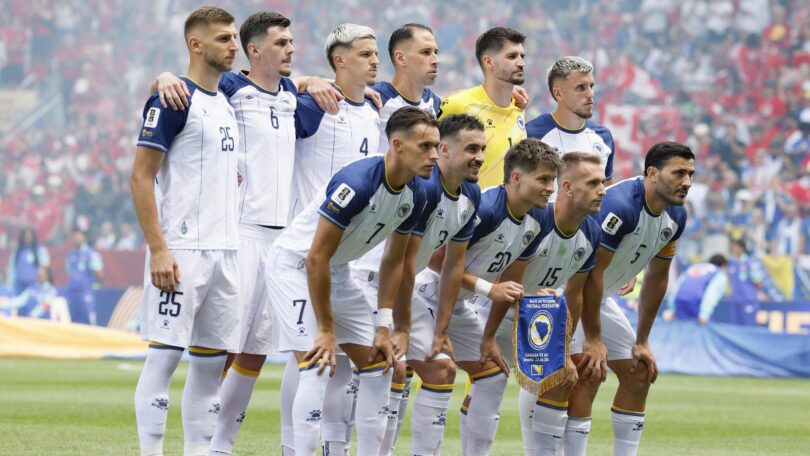
After training with the Bosnian national team on a hot, humid afternoon ahead of their match against Canada, 40-year-old veteran Edin Dzeko strolled over to a metal fence lined with dozens of fans calling out for a photo or autograph.
As he made his way along the line of cheering young supporters, his humble, shy smile seemed at odds with his status as a legendary striker and arguably Bosnia and Herzegovina’s greatest ever footballer.
This year, Bosnia is making its second appearance at the World Cup and, for a small European country still recovering from war and grappling with limited resources, it’s a moment of immense significance.
“It means everything,” 22-year-old Ammar Brezovic told Middle East Eye at Centennial Park, where the team had been training.
He travelled from Chicago to attend the match in Toronto, while creating social media content around the tournament and filming a documentary about Bosnia’s team.
CLICK FOLLOW: TO FOLLOW US
Sign up to get the latest insights and analysis on
Israel-Palestine, alongside Turkey Unpacked and other eSPORTY
“To see a country so small, that’s been through so much to qualify for the World Cup with other big countries, it’s truly inspirational – not only to Bosnia, but to other people,” he said.
“The fact that we have people that aren’t Bosnian rooting for us, it shows something,” he added.
Bosnia’s journey to the World Cup came as a surprise to many. The team had endured a miserable run, losing all five playoff campaigns and winning only four of their previous 19 matches across two qualification cycles.
Between 2022 and 2024 alone, Bosnia changed coaches five times. The country’s deep political divisions and complex administrative system, established under the Dayton Peace Accords that ended the 1992-1995 war, also hampered football development.
But when former Bosnia captain Sergej Barbarez took over as coach in April 2024 – after waiting 15 years for the job and despite having no coaching experience – he rebuilt the squad with 16 new players, and results came faster than expected.
‘We’re underdogs. We’ve got nothing to lose and everything to give’
– Ammar Brezovic, Bosnian fan
This spring, Bosnia defeated Wales in the playoffs before overcoming four-time champions Italy.
In that dramatic match, 21-year-old Wisconsin-born winger Esmir Bajraktarevic scored the winning penalty to send Bosnia to the World Cup.
Raised in the US by refugee parents who survived the genocide in Srebrenica, Bajraktarevic had represented the US at U-19 and U-23 levels. But when the time came to choose a senior national team, he opted for Bosnia.
“The decision for me was very easy,” Bajraktarevic told media at the time.
“It was something I knew I wanted to do since I was little. It was just a process that took a while.
“There was no dilemma: It had to be Bosnia.”
Some 100,000 people flooded the streets of Sarajevo to celebrate after the victory over Italy.
More than a football team
For many Bosnians, having their country compete at the World Cup means far more than football.
Emir Suljagic, the head of the Srebrenica Memorial Center, wrote on X: “There was a plan for this boy never to be born, for my own children never to be born, for any of our children never to be born. Their laughter is our greatest revenge.”
Bosnian sports journalist Sasa Ibrulj told MEE that the new team is closely connected and approaches representing the country with a positivity that was missing just a few years ago.
“You can feel that they are driven with motivation to play for the national team, something we haven’t had for a long time,” Ibrulj said.
“I think the most important factor is their love towards the national team, their love towards the country that they play for, and the fact that this is now a positive source of motivation for them.”
World Cup 2026: For some fans, the tournament ends at the US border
Read More »
Brezovic said the passion of Bosnian players and supporters is what sets them apart.
“We’re underdogs. We’ve got nothing to lose and everything to give… we’re here to give it our all,” he said.
It’s a team that truly started from the bottom.
Dzeko was only six years old when war broke out in Bosnia. He grew up playing football on the streets of besieged Sarajevo amid shelling and sniper fire from Serb forces surrounding the city.
He has previously recounted how he once wanted to go outside to play football with friends, but his mother would not allow him. Minutes later, a shell fired by Serb forces struck the area where his friends were playing, killing them instantly.
Today, Dzeko is a legendary striker. His life could easily have taken a different path.
He now captains the third-youngest squad at the World Cup, with most of the players born and raised in the diaspora. Like Bajraktarevic, many are children of war refugees who grew up watching Dzeko play and later chose to represent the country their parents once fled.


Anisa Dzumhur, 19, from Toronto, said Bosnia’s team never gives up.
“Our fan base is so strong, and football has been the most popular sport in Bosnia for years and years. Us being strong as a community is what pushed us to go further,” she told MEE.
“There are so many new, young players that have joined the team that are 18, 19, 20 and Dzeko has been such a good mentor for all of them, just being able to connect everyone together. It’s the culture that really ties the whole sport together.”
A team without borders
At this World Cup, Bosnia has also been identified as the team with the most diverse group of players, drawn from a record 19 different leagues.
“One of our strengths is that we have a diverse team in terms of football culture, football philosophy, and the types of players who have developed in different countries,” Ibrulj said.
“I definitely think that the fact that 16 or 17 of them [come from abroad], is in itself, proof that we are not doing a good enough job of developing young players in our domestic clubs, and that the Bosnian diaspora remains strongly connected to their homeland.”
Following Bosnia’s opening match against Canada on June 12, which ended in a 1-1 draw, several players have already attracted the attention of football analysts and commentators.
Fox Sports described 23-year-old Tarik Muharemovic as the tournament’s most underrated centre-back: “composed in possession, ruthless in the duels, never hurried”.
For Denis Pasalic, 45, Bosnia’s participation at the World Cup will also raise the country’s international profile, something he believes is important for the small southeastern European nation. Bosnia is the third-smallest country competing in the tournament.
‘A lot of people haven’t heard of Bosnia, and now they will’
– Denis Pasalic, Bosnian fan
“For example, no one knew about Croatia until they won third place in the World Cup,” Pasalic told MEE.
“A lot of people haven’t heard of Bosnia, and now they will. And of course tourism, our traditions, will become much better known to people worldwide. The higher we rank, the better,” he said.
“And it’s good for our federation too; they’ll get more money, new players – it’s all positive.”
Whatever happens in Bosnia’s remaining group-stage matches against Switzerland and Qatar, Ibrulj believes the team has already achieved something significant.
“I believe this is the beginning of something that has yet to reach its peak – if not at this World Cup, then at one of the future major tournaments,” he said.
“There’s no doubt that, with the group that is currently gathered around Sergej Barbarez and his coaching staff, we have a bright and positive future ahead of us.”