
For a nation making its FIFA World Cup return after over 50 years, DR Congo arrives with reasons for optimism. Their victory over the Super Eagles still has reverberating echoes in their minds. Some of their key players, however, did not have the best seasons in their respective club sides but the World Cup 2026 offers a chance to put all that behind them for six weeks.
They are drawn against Portugal, Colombia and Uzbekistan in a tournament that only keeps promises to the top two finishers in the group. On paper, finishing a considerable third would require some work for a debutant in this kind of group. A second-place finish might also mean a difficult Round of 32 fixture. But once and again, African teams have formed a habit of stunning the world at the FIFA World Cup. France will not forget Bouba Diop in 2002 during their unsuccessful title defense in Asia.
Turning to data, performance metrics suggest that “The Leopards” are entering the tournament as a side capable of creating chances, progressing the ball effectively, and competing with established international opponents. The bigger question, now, is whether they can turn those encouraging numbers into goals, points and measurable value on football’s biggest stage.
In this piece, Completesports.com‘s ALLI FESOMADE examines what Portugal, Colombia and Uzbekistan can expect from DR Congo in Group K, using data from Twelve Football’s Earpiece.
How DR Congo Advance Possession And Build Attacks
One of the clearest indicators .of DR Congo’s attacking intent is their ability to progress possession into advanced areas. The Leopards rank high in Africa for possessions reaching the final third, recording a 42.8% progression rate. That suggests a team capable of moving the ball through midfield and establishing territory in dangerous areas rather than relying solely on direct transitions.
Their expected threat (xT) figure of 1.56, ranking sixth among African nations, further reinforces the idea that the DR Congo consistently moves possession into zones that increase the likelihood of creating scoring opportunities.
Also Read: 2026 World Cup: DR Congo Will Be Difficult To Beat –Kalulu
For opponents at this World Cup, this means DR Congo cannot simply be dismissed as an underdog who would be content to just defend deep. They have shown the ability to advance possession and apply sustained pressure.
DR Congo’s attacking play centers around width, utilizing crosses to penetrate defenses while maintaining a structured build-up from goal kicks. They prefer to progress with forward passes from midfield, giving priority to positioning and teamwork over individual dribbling. This creates a cohesive style that relies on collective movement to exploit crossing opportunities rather than depending on individual creative flair.
Their lower long ball proportion and pass tempo suggest a preference for a more deliberate build-up rather than a fast-paced offensive style, which indicates a team that thinks carefully about when and how to attack.
In transition, DR Congo demonstrates a balanced approach, maintaining a typical rate of box and final third entries after winning back possession. They combine quick forward passes with exceptional retention, allowing them to control the game while efficiently transitioning from defense to attack.
Their ability to engage quickly in both halves allows them to disrupt buildup plays, reacting swiftly to turnovers to mitigate opposition threats. This proactive defensive transition style has been a characteristic feature of their approach in the CAF Africa Cup of Nations.
In attacking phases, they balance between build-up play and long passes, frequently looking to counter-attack swiftly but struggle to retain possession long after regaining the ball. They also utilise a varied approach in penetration methods, combining carries and crosses effectively to create chances. However, when adjusting their style of play in specific matches, they leaned towards quicker transitions and made more direct offensive moves.
The Numbers Behind DR Congo’s Attacking Threat
This is perhaps the most encouraging aspect of the DR Congo’s profile. The quality of chances they generate compared to other African football teams is impressive. Their non-penalty expected goals (1.43 per match) rank fifth overall amongst elite African nations, placing them among the stronger attacking sides on the continent.
They also rank:
- Sixth for high-opportunity shots (3.0 per match)
- Eighth for non-penalty shots (11.7 per match)
- Eighth for touches inside the opposition box (17.8 per match)
- Fourth for non-penalty xG per shot (0.12)
Taken together, those numbers indicate tendencies to generally shoot from good locations. The ranking for xG per shot is particularly noteworthy because it implies DR Congo creates relatively high-quality chances when opportunities arise, a trait that could prove valuable in tournament football where matches are often decided by a handful of moments.
Also Read: DR Congo Announce Squad For 2026 World Cup
They maintain a cautious, calculative attacking approach with a typical rate of shots and opportunities created. DR Congo favor a more aggressive and swift attacking style, frequently waiting for opponents to make mistakes and opting for direct attacks to take maximum advantage of defensive lapses. They mix their approach with sustained build-ups, showing ability to adapt in how they create goal-scoring opportunities without relying heavily on long-range efforts.
Can The Leopards Turn Chances Into Goals?
Despite strong overall attacking metrics, there is a noticeable gap between their chance creation and actual goal output. DR Congo ranks fifth in non-penalty xG but only twelfth in non-penalty goals. That discrepancy could indicate weak finishing, poor shot execution, or simply a run of bad luck in front of goal. They manage to craft a significant number of chances through methodical buildup, but their shot volume per final-third pass indicates a more cautious approach once in advanced positions. This blend of aggression in attack with patience in the final third sets a reputation that could be difficult to maintain against top teams in the world.
They have been without Yoanne Wissa for quite some time, but the Newcastle star is expected to don the sky blue of the leopards in the US. For neutral observers, it creates one of the tournament’s most intriguing questions. If their finishing improves and begins to match their chance creation numbers, DR Congo could become one of the surprise packages of the group stage. If not, they may find themselves producing encouraging performances without receiving adequate rewards.
A Disciplined Defensive Structure Built On Organisation
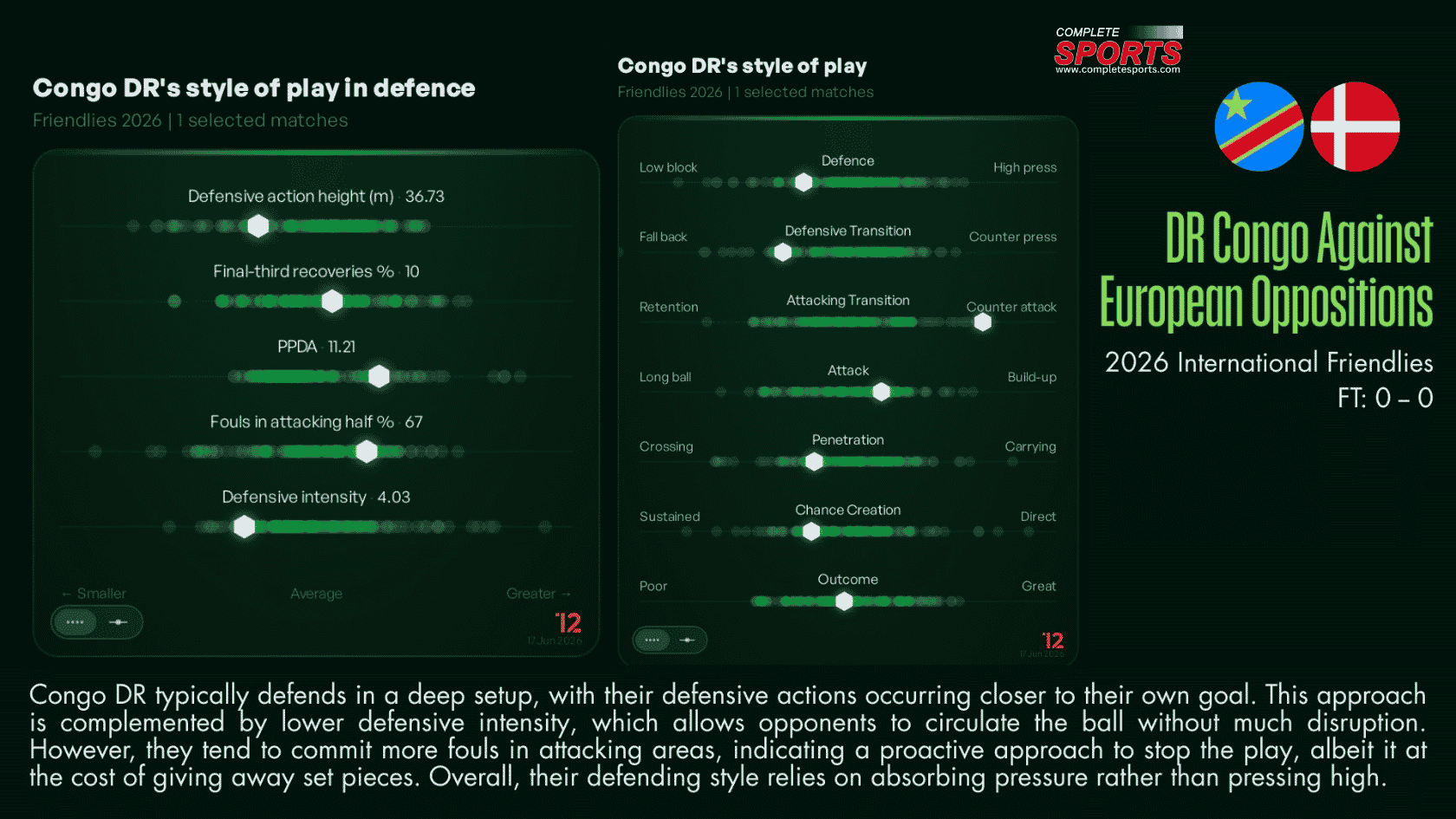
DR Congo typically employs a low block in defense, featuring lower intensity and making defensive plays further back, which invites more passes from opponents. Their defensive intensity is lower, leading to more patient play from opponents, and they often allow teams to make more passes per defensive action. This lack of urgency in defense may have diluted their overall effectiveness against stronger attacking teams. However, they are not afraid to commit fouls in the attacking half to disrupt play, relying on compactness and strategic positioning to recover the ball at typical heights.
DR Congo performed well in defensive transition during the Africa Cup of Nations. They gave the ball away less frequently, allowing them to maintain stability in their defensive structure, while their quick response times helped them limit the opponent’s attacking threat. Notably, they lost possession closer to the opponent’s goal, which suggests a more aggressive approach, but this was balanced by a solid defensive organization that prevented their opponents from generating many high-quality chances. Their ability to engage quickly in both halves allows them to disrupt buildup plays, maintaining a competitive edge characteristic of their approach.
They effectively limited their opponents’ ability to generate high-quality chances and goals, which is evident in the low number of high opportunity shots and overall scoring output. This strong defensive stance allowed them to control matches while securing an above-average points tally in the tournament. Their defending style relies on absorbing pressure rather than pressing high, which has proven effective in limiting opposition scoring opportunities.
Where DR Congo Could Be Exposed In Group K
While DR Congo are effective at reaching the final third, their progression becomes less efficient as they move closer to goal. Their ranking drops to 14th for converting final-third possessions into penalty-box entries. This suggests that although the Leopards can move the ball into advanced areas, breaking down compact defensive structures remains a challenge.
Against Portugal in particular, that weakness could become significant. Portugal are likely to dominate possession and limit space between defensive lines. If DR Congo struggle to transform territorial advances into penalty-box access, they may be forced into lower-quality attempts from less dangerous positions.
Their lower defensive intensity allows opponents to build pressure without much disruption, which could be exploited by technically superior teams like Portugal and Colombia. The significantly lower intensity in their defensive approach may have diluted their overall effectiveness against stronger attacking teams.
Also Read: West Ham Lodge Complaint To FIFA Against DR Congo
With only four matches played in the CAF Africa Cup of Nations, there is insufficient data to draw any meaningful conclusions about their defensive performance, making it difficult to fully assess how they will cope with World Cup opposition.
Twelve Football’s numbers indicate DR Congo may actually be stronger than many casual observers expect. At the AFCON, they rank sixth for expected points (1.80 xPoints per match) while sitting eighth in actual points earned. That difference suggests performances have generally been slightly better than results. In tournament football, teams like that often become dangerous opponents.
Portugal will enter Group K as favourites, while Colombia are widely expected to challenge for top spot. Nevertheless, DR Congo’s statistical profile suggests they are unlikely to be passive participants.
However, it must be noted that a good portion of the data used to evaluate the DR Congo comes from the African Cup of Nations and that in itself is not a very large dataset. Having played only four matches in the competition, they haven’t accumulated enough data to assess any meaningful trends.
Consequently, it may be too early to draw any meaningful conclusions overall. Any analysis must be approached with caution due to the limited sample size, though the early signs are promising. This creates an intriguing paradox because DR Congo might be better than their results suggest, but we also cannot be entirely certain about their true level given the limited competitive evidence available. Even so, from an observatory pov, comparing the squad selections pound for pound, it is tempting to think the data might have just eyeballed their tournament.
What Portugal Should Expect From DR Congo
Portugal have arguably the best midfield in the World Cup. Their regulars, Joao Neves, Bruno Fernandes and Vitinha, can walk into just about any team in the world and get a starting shirt. It is therefore not expected that the Africans will come all out against them, especially seeing how they are traditionally a counterattacking team.
This becomes layered if you consider how they played against Nigeria, who were also significantly better stacked than they were and Denmark in the international friendly. Denmark dominated possession (601 passes to DR Congo’s 444) and hit the woodwork three times, but DR Congo’s defense held firm.
From an opposition-analysis perspective, Portugal should prepare for a side that
- Can be hard to break down
- Is unpredictable because not much is known for now.
- Does its best work by pouncing on other teams’ errors.
- Mixes Attacking Threats but does more from wide plays and crosses a lot.
- Progresses possession effectively through midfield.
- Generates a healthy volume of quality chances.
- Creates dangerous shooting opportunities from good locations.
- May not always convert those opportunities efficiently.
- Can struggle to consistently penetrate well-organised defensive blocks.
The challenge for Portugal will be preventing DR Congo from establishing meaningful attacking strides and forcing them into low-value shots. If the Leopards are allowed repeated access to the final third, their chance-creation numbers suggest they possess enough attacking quality to punish mistakes.
H2 Participation Summary: Can DR Congo Defy Expectations At World Cup 2026?
DR Congo enter their first World Cup campaign with the profile of a dangerous outsider. The numbers suggest a team capable of competing. Their ability to progress possession, generate expected threats and create quality chances gives them a platform to challenge more established nations.
Whether that translates into a historic run may ultimately depend on one factor: turning promising attacking metrics into actual goals. If they solve that problem, Group K could become far more competitive than many expect. If they do not, DR Congo may leave the tournament wondering how performances that looked so encouraging on paper failed to produce the results they deserved.