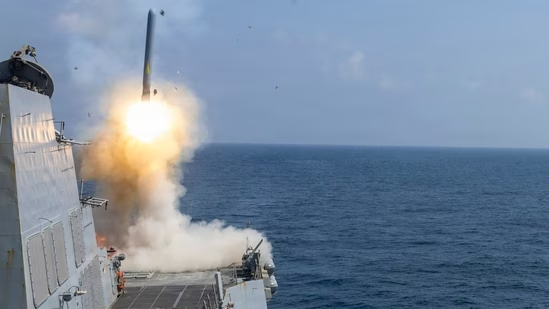
The Pentagon is shooting expensive missiles faster than it can replace them. Its solution: cheaper missiles.
The U.S. military is using nonstandard contracts and tasking defense contractors to design new weapons from scratch to cut years of production time and hundreds of millions of dollars off their cost. Even before the Iran war cut into U.S. armament supplies, lawmakers and military brass worried that the U.S. can’t rearm itself fast enough to deter threats and respond to conflicts.
One Army initiative, known as the Low-Cost Containerized Missiles program, would amass thousands of missiles fired from containers that can be moved around on vehicles. A key requirement for producers: Each missile fired must cost less than $500,000.
Another Army project has asked companies to develop air-defense missiles that cost less than $250,000 apiece. The newest Patriot surface-to-air interceptors from Lockheed Martin take more than two years to make and cost about $4 million each.
A separate Air Force project aims to procure tens of thousands of less-costly missiles over the coming years.
Military officials have said the newer initiatives won’t soon replace top-shelf missiles from companies such as Lockheed and RTX, which U.S. forces have used and trained with for decades. But military leaders have said they want to rev up new production lines now so that they have more options available in the years ahead.
Delays and expense overruns
The less-expensive precision munitions address the U.S. military’s longer-running problem: the contract competitions, design debates and budget battles that have mired Pentagon weapons programs with yearslong delays and cost overruns.
The time and cost required to make everything from missiles to tanker jets has ballooned over the years. Defense contractors have outfitted strike weapons and interceptors with layers of sophisticated electronics to hit targets and thwart enemy countermeasures.
Industry experts say the slow and expensive production process owes to unpredictable congressional funding and indecisive Pentagon officials. But the system works for defense contractors, which generate billions of dollars in annual revenue from munitions sales. The companies also benefit from contracts that bring new revenue with each modification.
Government watchdogs have alleged that some defense contractors have overcharged the military for products and parts, and Republican and Democratic lawmakers have called for stricter oversight.
President Trump and Defense Secretary Pete Hegseth in recent months have pledged to scrutinize defense contractors’ performance, and penalize those that don’t improve. Officials have yet to publicly punish any underperforming companies.
Jerry McGinn, a defense-contracting expert at the nonpartisan Center for Strategic and International Studies, said that many high-end missiles are “essentially handmade munitions” even after years of investment in automation. Some plants that build their parts often share more in common with specialized workshops than factory assembly lines.
The U.S. has shot off more than 1,000 Tomahawk missiles this year in its war against Iran. The cost: at least $2.5 billion and climbing.
CSIS estimates that it takes RTX at least a year to make each cruise missile, which can be fired from ships, submarines and ground launchers, striking targets 1,000 miles away. That time factor adds to its cost.
RTX declined to comment.
Off-the-shelf gear
After a Navy career that included a stint as a Topgun instructor, Doug Denneny spent years working for defense giant Boeing and the U.S. unit of European weapons maker MBDA. In 2013 he launched a startup, CoAspire, to develop weapons that could reach the battlefield in months instead of years.
Denneny said the company’s pitch for a low-cost containerized missile, the Ghost, will start flight testing this year. CoAspire seeks to avoid delays by ordering off-the-shelf gear from commercial manufacturers and 3-D printing some parts, which he said enables significant savings when modifications are needed.
A nonstandard contract under the Pentagon’s “other transaction authority” gives CoAspire more flexibility to build a missile it can make today rather than delaying production months or longer to meet rigid program requirements.
“In the missile business, you are constantly having to make changes, to fix flight-test failures or improve capabilities,” Denneny said. An “open and frank dialogue” with customers such as the Army and Air Force speeds timelines and avoids delays and mounting costs, he said.
CoAspire is one of four companies competing to build less-costly missiles for the Army. Anduril Industries, Leidos Holdings and Kongsberg Gruppen subsidiary Zone 5 have pitched their own missile designs. The Army has set a high bar for the group, seeking more than 10,000 missiles by 2030.
Leidos said it plans to hit its goal of making 3,000 of those containerized cruise missiles over the coming three years by taking a weapon it already makes and adding a few basic features, like a booster rocket.
“Historically, a lot of our exquisite munitions are loaded with 15 features in addition to the warhead,” said Doug Jones, chief technology officer for Leidos’s defense segment. The Pentagon is pushing the companies to move quickly by demanding a few must-haves and leaving other capabilities optional.
“Instead of building one Cadillac, can I build 10 Honda Accords?” Jones asked. A mix of new weapons could also prove more effective, he added.
The U.S. military has for years explored middle-of-the road weapons and defenses that sit somewhere between less expensive guided artillery and top-of-the-line million-dollar missiles, according to Todd Harrison, a defense expert at the American Enterprise Institute. The biggest hurdle, he said, is overcoming the Pentagon’s habit of micromanaging the process.
“The idea is precision-guided weapons that you can field and use on a massive scale,” Harrison said. “They don’t need to be perfect.”
Write to Drew FitzGerald at andrew.fitzgerald@wsj.com