US President Donald Trump on Sunday played down Israeli strikes on Lebanon but said that Israel and Iran should refrain from such attacks with a deal to end the war in Iran potentially close.
“There should be no more attacks by Israel anywhere in Lebanon, but there should also be no more attacks by any other party, including Hezbollah, against Israel,” Mr Trump posted on his social media site.
“This could be the start of a long and beautiful peace – Let’s not blow it.”
https://x.com/RapidResponse47/status/2066170931576287678?ref_src=twsrc%5Etfw
Mr Trump previously suggested that a deal to end the war could be signed on Sunday, but has not provided further details on where things stand since.
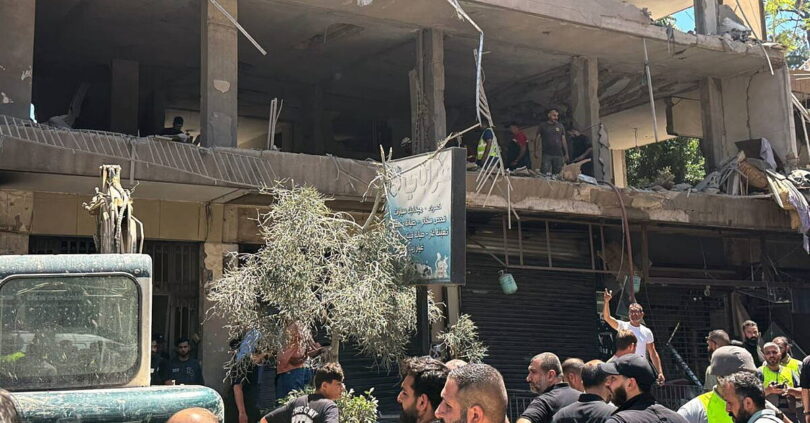
The Israeli military said on Sunday it had launched strikes on Beirut targeting Hezbollah infrastructure. Smoke could be seen rising over the Lebanese capital, and the Civil Defence said it retrieved three bodies and six wounded people from the rubble.
Iran threatened a military response.
The office of Israeli Prime Minister Benjamin Netanyahu said the strikes were in response to Hezbollah attacks in northern Israel.
When Israel last struck the Beirut suburbs a week ago, Iran responded with strikes on Israel.
Tehran, which is Hezbollah’s main backer, has insisted that any US-Iran ceasefire deal must also include an end to Israeli strikes in Lebanon.
Iran’s parliamentary speaker Mohammad Bagher Qalibaf said on X that Israel’s strikes on Beirut’s suburbs show that “America either lacks the will to fulfil its commitments or the ability to do so”, and the strikes could imperil the final stage of negotiations.
Hezbollah fired missiles into Israel on March 2, two days after the US and Israel attacked Iran, sparking war in the Middle East.
Iran and the US have been inching closer to a deal to end the Iran war, as Qatari mediators travelled to Tehran on Sunday to finalise the agreement, according to two regional officials.
The officials expressed cautious optimism that the US and Iran were finally approaching an agreement that could halt hostilities that have killed thousands of people, and reopen the Strait of Hormuz, whose closure has thrown world markets into disarray.
Mr Trump and Pakistani Prime Minister Shehbaz Sharif said on Saturday that the deal would be signed on Sunday, while Iran’s foreign ministry spokesman Esmail Baghaei said it could happen in the coming days.
Mr Trump said that the Strait of Hormuz would open immediately after the signing.

The deal is expected to be signed electronically, without an in-person ceremony, though it is unclear when or how the signing will take place.
The deal does not solve the thorniest issues between the US and Iran, including Iran’s nuclear programme or its frozen assets, but offers a 60-day framework for technical discussions on those issues, according to Pakistani and regional officials.
The officials described Pakistan’s months-long effort leading the negotiations, struggling to keep both sides from walking out of the room and a total collapse of the negotiations on multiple occasions.
Under the current deal being discussed, US and Israel appear to have fallen short of their original goals of destroying Iran’s missile and nuclear programmes and ending its support for proxies.
It is not clear how the deal will address these issues, or if they will be part of the final agreement.
Meanwhile, Mr Trump was expected to discuss demining the Strait of Hormuz during the Group of Seven summit that starts on Monday.
https://x.com/CENTCOM/status/2065921500746498384?ref_src=twsrc%5Etfw
The waterway is crucial to significant shipments of oil, natural gas and related products like fertiliser, and its effective closure rocked the global economy.
The apparent breakthrough came after Iran exchanged fire with the US and Israel earlier in the week, threatening to rupture the ceasefire and push the Middle East back into full-scale war.
A tenuous ceasefire has been in place since April 7.
Iran’s nuclear programme and highly enriched uranium have long been at the centre of tensions with the US and Israel and an international source of concern.
Mr Trump on social media said that “when all is calm” the US would go in and “downblend and destroy” the enriched uranium in Iran or in the US.
Iran has 440.9kg (972lbs) of uranium that is enriched up to 60% purity, a short, technical step from weapons-grade levels of 90%, according to the International Atomic Energy Agency.

Iran has long maintained its nuclear programme is peaceful and has not publicly committed to giving up the enriched uranium, which is believed to be buried under three nuclear sites that were badly damaged by US strikes last year.
Meanwhile, fighting has continued in Lebanon between Israel, which has pushed its invasion deeper than at any point in over a quarter-century, and the Iranian-backed Hezbollah militant group despite a ceasefire.
Iran has wanted a ceasefire deal to include the fighting in Lebanon. Tehran also has sought the release of billions of dollars in frozen funds.
The deal in its current form is a deep disappointment to Israel’s government, which has been sidelined in negotiations led by Pakistan and others.
Even critics in Mr Trump’s own Republican Party, struggling with an unpopular war ahead of the midterm elections, criticised the deal.
Some said it did not improve on the terms of the 2015 Iran nuclear deal from which Mr Trump withdrew the US during his first term and which he still describes as “bad”.