
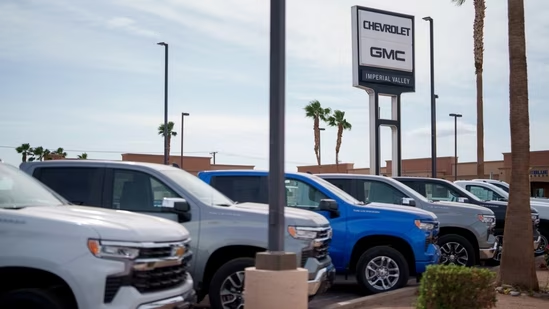
The U.S. auto industry faces sobering new math: Some one million prospective buyers have defected from the new-car market since the start of the decade—and they aren’t expected back soon.
Until recently, auto executives, analysts and economists believed that U.S. new-car sales were on a steady climb back to volumes last seen before the pandemic closed factories and scrambled global supply chains.
That’s no longer the case. General Motors, Ford Motor, Toyota and other automakers have said they are planning for sales of new cars to shrink or stagnate this year after consumers—stung by persistent inflation, rising fuel prices and high interest rates—are balking at prices that have risen to around $50,000 on average.
Americans were buying around 17 million cars and trucks a year before 2020; industry analysts don’t expect the market to return to that level until the end of the decade or later. They now forecast total annual sales of about 16 million vehicles or fewer this year and that outlook has grown even dimmer as the conflict in Iran keeps gas prices high.
“This is a real threat to the whole industry,” said Erik Severinson, Volvo’s chief commercial officer, noting the same dynamics are roiling the European auto market. “It’s a proof point of something more fundamental which is wrong in the general economy—that people are not able to buy new cars.”
While around one-quarter of models in the U.S. go for between $25,000 and $35,000, an even bigger share tops $55,000, according to data from the car-shopping website Edmunds.
Executives at the world’s biggest automakers say they recognize that a new car is out of reach for more Americans. Some have promised to bring out more affordable models. But no one predicts significant relief soon.
Historically, stagnating sales led automakers to juice demand by rolling out deals and incentives that eroded their profit margins. That isn’t the case this time, particularly as America’s automaking giants, GM and Ford, are making solid profits selling fewer vehicles.
“I don’t want to say automakers are OK with this level of sales, but they kind of are,” said Ivan Drury, an Edmunds automotive analyst. “It’s not like back in the day when they’d be hacking away at the price to lift sales.”
That’s because selling big trucks and SUVs that dominate those automakers’ lineups is more lucrative than selling larger volumes of cheaper cars.
“I don’t think there’s a dealer in this country who would say ‘I don’t want a more-affordable product to offer,’” said Patrick Manzi, chief economist of the National Automobile Dealers Association. “For now, things are going well. But what happens if we hit another recession?”
Buyers are left with few options. They could turn to used cars, but those are similarly climbing in price. Many choose to keep their old cars running longer. The average car on U.S. roads is now about 13 years old, a historic high, according to S&P Global.
Profits from more-expensive vehicles are helping offset the higher costs of doing business in the auto industry in the 2020s. Nearly every automaker is paying billions of dollars more each year to foot the bill for President Trump’s tariffs. Ford incurred about $2 billion on tariffs last year. Car companies are also erasing billions from their balance sheets as they walk back costly electric-vehicle investments.
But automakers face a balancing act. They stress the need for more affordable options, yet right now, their business is fine without them.
GM, for instance, is spending billions to upgrade factories that make lucrative pickups, SUVs and V8 engines. At the same time, the automaker just pumped $600 million into a South Korean unit that builds its lowest-cost U.S. models that are in hot demand and short supply. GM has said that, even with tariffs, those models—four compact SUVs that sell for less than $30,000—make money.
Yet introducing new cheap models isn’t part of GM’s plan. A spokesman said the company is “very comfortable” with its portfolio as it stands today, noting that developing a new vehicle is costly and money the company should spend only if a model will add value over time.
At Ford, many dealers are irate after the automaker scrubbed its lineup of all sedans and cheaper SUVs over the past few years. Last to go was the compact Escape SUV.
Ford CEO Jim Farley has said the company may get back into sedans, which Detroit automakers ceded almost entirely to foreign rivals over the past decade. But the company has grappled with how to make those lower-cost models cheaply enough so they don’t lose money.
Farley has promised a string of more-affordable models, including an electric pickup truck starting around $30,000. For now, the company is touting the success of some of its priciest models, like the Expedition and Bronco SUVs.
Stellantis, the parent of Jeep, Chrysler and other brands, last week told investors that it also is working on lower-priced offerings for the U.S. Those include seven new cars under $40,000, including a pair under $30,000, in coming years, executives said. Asian automakers like Toyota, Nissan and Hyundai still offer smaller, more budget-friendly cars, but they too have emphasized larger SUVs and trucks in recent years.
John Murphy, a longtime auto analyst and corporate adviser, for years had been certain that the auto market would return to its 17-million-a-year days. He doesn’t think that anymore.
Reaching that level would require a big surge in vehicles available for less than $40,000, which doesn’t appear in the cards.
“Automakers are more disciplined,” Murphy said. Covid-driven supply-chain shortages showed automakers that they could make a lot of money selling fewer vehicles at higher prices. Before then, companies would slash prices to outsell one another, afraid of losing market share.
“It’s great for investors, great for stock prices and good for cost of capital,” he said. “They’re actually running the business in a much more focused way.”
Jack Weidinger, a Long Island dealer selling Land Rovers, Cadillacs and GMC trucks, said he was unconcerned.
“It’s just a lot of noise,” he said, noting that he serves an affluent customer base. “I don’t think people are driving less or buying less.”
Sal Arevalo is less sanguine. A federal government employee living outside of Los Angeles, Arevalo recently set out to replace his fuel-thirsty Ford Explorer SUV. He hadn’t shopped for a new car in years and was stunned by the prices. “I’m looking at these numbers and could not even contemplate signing on the bottom line,” he said.
A lifelong car buff, he visited numerous dealerships and crunched numbers for all sorts of cars, sedans, EVs and hybrids. Nothing seemed manageable.
“The cold reality set in,” Arevalo said. “I may have to do what everybody else is doing and just hold on to my vehicle as long as I can.”
Write to Sharon Terlep at sharon.terlep@wsj.com