They emerge slowly, almost imperceptibly, from the mists of time. Their days of worldly glory stretch back almost a century but they are resurrected in words, photographs and newspaper clippings in a Glasgow hotel in the spring of 2026.
This is the story of the USA team that reached the semi-finals of the first World Cup, in Montevideo, Uruguay, in 1930. It is a Scottish tale.
A quintet of players of Caledonian origin has been dubbed The Forgotten Five, given that their participation in such a historic moment has been largely neglected. The Scottish Connection could, too, be expanded to be called The Magnificent Seven. Two men with West of Scotland accents were on the coaching staff.
It is a story of players Andy Auld, Sandy Wood, Jim Brown, Jimmy Gallacher and Bertie McGhee, and of coach Millar and trainer Jock Coll.
It is a story, obviously, of emigration from Scotland but one that has awe-inspiring, spell-binding moments. There is the World Cup medal that was lost and found on a sand dune in Troon. There is the Scots player who signed up for the First World War, aged only 15, and later fought at the Somme. His image is caught in a trench in Belgium. There is the pilgrimage from Cleveland to Kirkintilloch for a grandson determined to pay homage to his illustrious if shy forefather.
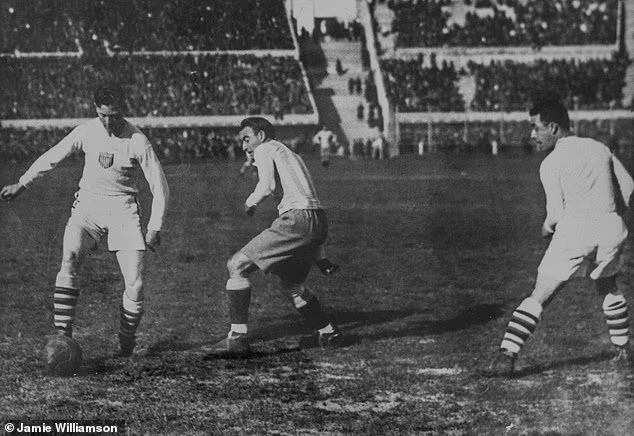
Andy Auld (far left) and Jimmy Gallagher (far right) were among the Scots who faced Argentina
The story is best told by the families of the heroes. This band of brothers is led by James Brown. His grandfather, Jim, is the only Scot to have scored in a World Cup semi-final, netting in the 6-1 defeat to Argentina in the Estadio Centenario. George, father of James, followed his dad into USA colours, playing in a World Cup qualifier against Mexico in 1957.
The quest of James is to celebrate the achievements of the Forgotten Five. His work has led to them being inducted in the USA soccer hall of fame. His dream is to see these prophets honoured in their homeland with induction to the Scottish Football Museum’s hall of fame.
He has contacted 16 of the 20 families whose forefathers were involved in the 1930 campaign. He has accumulated boxes of memorabilia, discovered forgotten facts and, perhaps most importantly, formed a bond with those whose fathers, grandfathers and great uncles were involved in the opening chapter of the greatest tournament in the world.
There are now moves to make a documentary film of the story and three families convened in Glasgow to share their memories. The Brown family was represented by James; Andrew ‘Dasher’ Auld by his great nephew, John Auld; and James Gallagher by his grandson, Scott Such, who travelled from Cleveland and was joined by his daughters, one of whom is studying in London.
‘It is the greatest story never told,’ said Brown. ‘This is unfortunately true in America but also here. But we are here to change that.’
He described himself as a ‘bloodhound and a bulldog’. He is always on the trail of new information and his determination is unlimited. He makes trips the length of the USA to retrieve material, once taking a van from the north-east down to the deep south to store 17 tubs of material,

James Brown, John Auld and Scott Such discuss their famous relatives who starred for the US
Brown, the vice-secretary of the Society for American Soccer History, concentrated his efforts 12 years ago and has since amassed knowledge and friends through his hunt.
‘There are so many stories around this group,’ he said. ‘I am excited by this project. Are there other relatives out there with information? I would say so. I have already had the most wondrous conversations with those who are related to this team.’
He talks to his father every day. George, now 90, a retired businessman who recalls his father vividly. He also remembers a moment when his world seemed to collapse.
World Cup hero Jim left Ayrshire for the USA in 1927 but returned to Scotland in 1932, before settling finally in America after the Second World War. The intermediary stint in Troon prompts a stunning memory from George.
Speaking on video call, he said: ‘I had my dad’s World Cup medal for third place hanging around my neck and I was tumbling in the sand dunes on the way to school. I discovered when I got home that I had lost it. I was in a panic.’
Fortunately, it was found and returned the next day. it is now on loan at the FIFA Museum in Zurich.

Jim Brown’s World Cup third-place medal from the inaugural tournament in Uruguay in 1930
The exploits of Jim live on in the memories of George, who describes his father as a highly skillful player. Indeed, when Jim first returned from the USA he was signed by Manchester United.
Father told son of that day in the Estadio Centenario. ‘He said it was a very rough game. The fellow he was up against spent half the match spitting at him and throwing dirt in his face.’
Jim died, aged 85, in 1995. His family ensures his story lives on.
The hotel conference room has a table strewn with photographs. One stands out. It shows a young, kilted man in a trench during the First World. ‘We don’t know where it was taken,’ says John Auld. ‘We think it was in Belgium, though we know that he fought at the Somme.’
He is referring to Andy ‘Dasher’ Auld, his great uncle who is one of the Forgotten Five.
‘The World Cup of 1930 was a story in my family for as long as I can remember,’ he said. ‘My grandpa has five brothers and they all played football at a good level. I didn’t meet my great uncle until 1966. He was back home from the USA and my dad and I went to meet him up at my grandpa’s in Saltcoats.
‘I was about 13 and the first thing I heard him talking about were the stadiums and the parks which were very wide. He also said the referees were shocking.’

The relatives of the 1930 heroes are determined to keep their memories alive
The football hero had signed up for the Seaforth Highlanders when he was just 15 and served at the front. ‘He survived the Somme and he came back home to be a miner. He also worked at the Nobel explosives in Stevenston and a foundry. He decided to move to the USA for a better life.’
However, in the 1920s the recession was worldwide and Andy Auld was considering returning home when he was playing in a ‘bounce game’ near Niagara Falls. He was spotted and signed for a professional team which also offered him work in a foundry.
He had, of course, been an excellent player in Scotland, playing for Ardeer Thistle before signing for the very strong Parkhead Junior side.
‘There was a funny story about when he signed for Thistle, who really wanted him,’ says Auld. ‘He held out for a good signing-on fee and a fur coat for his wife and then emigrated. The story has a happy ending because he later learned Thistle were in financial difficulties and donated money.’
He added: ‘There were once six Aulds in an Ardeer team and the joke was that the USA would have won the World Cup if there had been more Aulds in that side.’
John Auld also remembers his great uncle telling him about the intense training on the ship to Uruguay. ‘They believed they were in the tournament to win it,’ he says.
The heaviness of the 6-1 defeat in the semi-final was largely attributable to USA playing the second half with 10 men and an injured goalkeeper. ‘This was a good side,’ said Auld. ‘After the tournament, they went on a tour of South America and played Brazil at the home of Santos. USA won 4-3 but there was crowd trouble and the ref came in to say that the winning goal had been chalked off to appease the home support.’
Scott Such has no vivid memories of his grandfather. ‘I’m carrying a legacy but no real memories as I was only three when he died in 1971,’ he says of Jimmy Gallagher, who played for 11 seasons in the USA league.

Scott Such travelled from Cleveland with his daughters to learn more about his grandfather
‘My mother obviously talked about him. He was humble, very religious. He loved his family and he worked hard. I relive him through pictures. He lived a fascinating life and it is very moving when I come to Scotland.’
He was accompanied on his visit by his daughters, Madelyn and Kaitlyn, both students. The family visited the Scottish Football Museum’s Hall of Fame where the footballer’s memorabilia is kept.
It was obviously a visit that meant much to them all. ‘We are going back through time together,’ he says of his family and his conversations with James Brown.
They are all also discovering something new. ‘It has been very emotional. On a previous visit I went to the parish church in Kirkintilloch and spoke to the priest,’ said Such. ‘He told me many of the records had been burned in a fire but I returned the next day and he had my grandfather’s baptismal certificate. He also said he would say a mass in memory of my grandfather.’
The grandson is visibly moved. There is a silence and a glance at the photographs on the table. The Forgotten Five and The Magnificent Seven are formally remembered in their homeland as the filmmakers’ cameras roll.
It has taken almost a century but their time has come again.