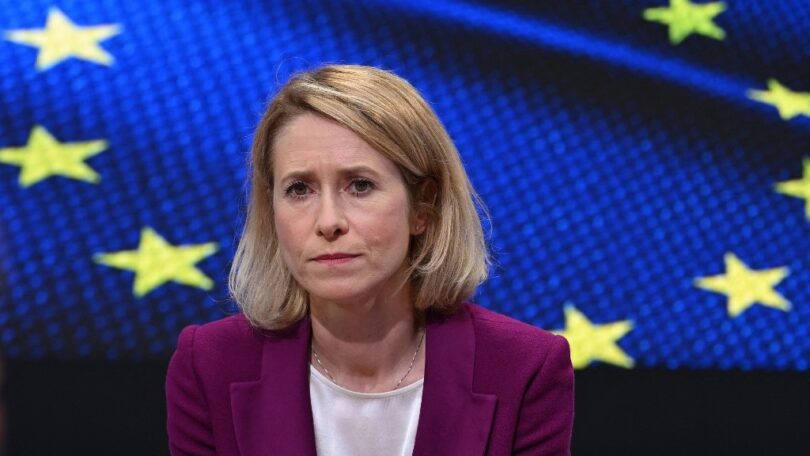
The EU foreign policy chief Kaja Kallas has privately compared Israel’s treatment of Palestinians to apartheid-era South Africa, exposing a sharp contrast between her closed-door remarks and her public support for Israel.
Euractiv reported that the EU foreign policy chief made the comparison during confidential talks with Mexican officials in Mexico City, where she travelled from May 20 to 22 as part of a senior EU delegation.
Officials and diplomats, including people present at the meeting, told Euractiv that Kallas spoke about a visit last year to South Africa and its apartheid museum in Johannesburg.
She reportedly linked Israel’s rule over Palestinians in Gaza and the occupied West Bank to South Africa’s system of racial segregation, which lasted from 1948 until the early 1990s.
The comparison is not new. The United Nations, the International Court of Justice, leading human rights groups, academics and legal experts have described Israel’s domination of Palestinians as apartheid. Ireland and Spain have also said Israel’s actions in occupied Palestine amount to apartheid.
CLICK FOLLOW: TO FOLLOW US
Sign up to get the latest insights and analysis on
Israel-Palestine, alongside Turkey Unpacked and other eSPORTY
‘Solidarity with Israel’
What makes Kallas’s remarks striking is her public record. She has often presented herself as a firm supporter of Israel, even as Israel expands its colonisation of Palestinian land and wages a devastating war on Gaza that many legal scholars, rights groups and states describe as genocide.
At a joint press conference in Israel in March 2025, Kallas said the EU stood “in solidarity with Israel and its people”. She added: “The security of Israel is extremely important to the European Union” and said Israelis must feel safe in their homes.
By failing to sanction Israel, the EU has confirmed once again its global irrelevance
Read More »
Critics have accused Kallas of applying international law selectively. She has taken a hard line on Russia’s invasion of Ukraine and pushed for sweeping sanctions on Moscow. But on Israel, she has repeatedly defended what she calls Israel’s “right to self-defense”, even as Palestinians face bombardment, siege, displacement and apartheid rule.
Progressive members of the European Parliament have also attacked the EU’s response to Gaza as weak and hypocritical compared with its response to Russia. They have demanded tougher sanctions, a suspension of the EU-Israel Association Agreement and an end to political cover for Israel.
The leak also lands amid a growing power struggle inside the EU. The Financial Times reported on June 11 that France and Germany were discussing proposals to overhaul the bloc’s diplomatic service in a move that could reduce Kallas’s influence.
Citing five senior officials briefed on the talks, the FT said the proposals included “stripping the powers” of the European External Action Service, which supports the EU’s foreign policy chief.
Any weakening of Kallas and the EEAS would strengthen European Commission President Ursula von der Leyen and national capitals. Von der Leyen has sought a greater role in EU foreign policy and is widely viewed as even more pro-Israel.