The 2022 World Cup was still around a year away when head coach Gregg Berhalter decided he needed some extra help with the US Men’s National Team.
He had enough assistants and training staff and men in branded blazers – the issue was interior design. So Berhalter hired some architects. Their task? Put together a lounge in Qatar that could keep Christian Pulisic and Co entertained for a few weeks.
‘It was a significant investment,’ Berhalter tells the Daily Mail. The finished product – inside the Marsa Malaz Kempinski, a five-star hotel on Doha’s Pearl – included baristas and pool tables and video games and table tennis.
There was also a putting green and a barber shop and a bar that served snacks at all hours of the day. Every World Cup game was streamed on a giant screen. All to ensure players did not go stale in their hotel rooms.
That lounge was the glistening result of four years of work under Berhalter – he took over after the USA failed to qualify in 2018 and his staff made a habit of noticing of what players enjoyed doing in their downtime. It was also a stark illustration of all the tiny details that go into preparing a team for the biggest stage of all.
Four years on, Mauricio Pochettino is tasked with leading the United States into a World Cup on home soil. The USMNT is training at the Great Park Sports Complex, a billion-dollar HQ outside Los Angeles. They are staying in a resort on the cliffs along the California coast. This time, more than ever before, the pressure to perform is immense.
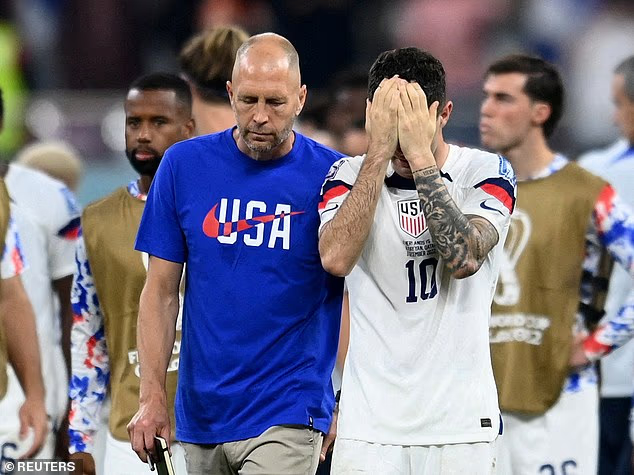
Gregg Berhalter (left) was the USMNT head coach at the 2022 World Cup in Qatar

Berhalter’s team reached the round of 16 before being knocked out by the Netherlands

Four years on, it is Mauricio Pochettino who will lead the USA into a World Cup on home soil
Pochettino was hired after Berhalter paid the price for a disastrous Copa America campaign in 2024. The Argentine is vastly experienced in club soccer but this will be his first ever World Cup as a coach.
So, just days out from the USA’s opening game against Paraguay, the Daily Mail spoke to Berhalter to discover what it really takes to coach America at the World Cup.
He knows this USMNT better than most. Not only did he lead them to the round of 16 in Qatar but Berhalter also helped bring through many of the current generation – including his son, Sebastian.
Four years ago, the midfielder travelled to Qatar as a fan. During a walk through a local street market, Sebastian Berhalter bought a mini-World Cup trophy. Now he has a chance to battle for the real thing.
Gregg Berhalter selected the second youngest roster of any nation at the 2022 World Cup. The USMNT had an average age of barely 25 years old.
‘We were laying the foundation for this World Cup,’ he explains. That involved more than tactics and formations and developing players. That meant forging connections off the pitch, too.
‘We wanted to create a very close-knit group that really enjoys spending time with each other,’ Berhalter explains. ‘Because you just don’t get to the World Cup and say, “Okay, now you guys become a team.”
‘We spent four years really creating deep bonds with the players [so] they really cared about each other.’ The final goal, Berhalter explains, was for players to consider their teammates ‘family.’
The evidence in Qatar and in California suggests that work was not in vain. Back in 2022, players hung out in the lounge throughout the tournament, with regular pool tournaments held between games.
This summer, they are relaxing on the beach, in the ocean… and in carefully-curated lounges. ‘Our little oasis away from home,’ is how goalkeeper Matt Turner put it.

Gio Reyna was almost sent home from Qatar for ‘clearly not meeting expectations’

Berhalter was the coach who brought through many of the current generation of USMNT stars
After the USA’s send-off game against Germany, meanwhile, Christian Pulisic was asked about the culture within this US team. ‘Honestly, it feels like a family,’ he said.
So perhaps Berhalter can sit back this summer and reflect on a job well done. Except FIFA don’t hand out medals for making friends or fancy lounges.
World Cups are judged on results and in Qatar, despite some positive performances, the USA lost to the Netherlands in the round of 16. And then came an uncomfortable revelation: despite all Berhalter’s work, midfielder Gio Reyna was almost sent home from Qatar for ‘clearly not meeting expectations on and off the field.’
Very soon, a feud had broken out between Reyna’s parents and Berhalter; all of a sudden, the coach’s job was in doubt and US soccer was engulfed in scandal. It was yet more proof of what can happen when tension and pressure are ratcheted up. A team is never more fragile than at a World Cup. Every nation teeters on the brink of chaos.
Pochettino has never coached in a World Cup and half of his roster have not been here, either. So what did Berhalter learn? What traps must they avoid falling into?
‘The focus and the intensity of matches is something to be aware of,’ he says. ‘I remember telling our young group: “These games are a different speed, a different intensity than we’ve been used to.” and when they played the first game, they realized that.’
With all the excitement and all the adrenaline, it is easy to push your body too far. ‘[But] even though there’s massive implications, you have to be calm, you have to be focused on executing. You can’t get caught up in the standings or where you are in the group.’
The proof was in the numbers. Berhalter’s players were putting their bodies through more strain than normal and they were not alone. After USA’s 0-0 draw with England in Qatar, Berhalter heard whispers that their rivals had racked up ‘the highest physical output in Gareth Southgate’s tenure… and we outran them.’

The USA held England to a 0-0 draw in an attritional, draining Group B clash in Qatar
A few days later, the USA faced Iran in a do-or-die battle – it was ‘high emotions’ and highly charged. They won 1-0 to reach the knockout stages. ‘[But] how do you turn that around quickly to now perform against [the Netherlands]?’ Berhalter asks.
He isn’t sure his team found the right answer. Berhalter believes the physical strain of the World Cup took its toll in that 3-1 loss, which taught the US a couple of valuable lessons.
One was tactical – the USMNT liked to be aggressive and physical, particularly without the ball. But against the Netherlands, Pulisic and Co fell 2-0 down in the first half and now the former head coach accepts that perhaps his team needed to temper their intensity in such a pivotal game. By being ‘more careful,’ they could stay in the fight until the final stages.
The other lesson relates to time and underlines, once more, how tiny details can impact the biggest games. ‘All our group games were at 10pm and the Holland game was at 6pm,’ Berhalter recalls. ‘That threw the schedule off a little bit.’
He is confident that this group will have ‘learned from that experience’ heading into a World Cup when, Berhalter says, reaching the quarterfinals would represent success. The USMNT has made it to the last eight only once since 1930.
Whatever happens, the 52-year-old – now in charge of MLS side Chicago Fire – will be watching. He is part of Coaches Corner, a new show on FanDuel, alongside two of his predecessors, Bob Bradley and Bruce Arena.
‘Fans typically hear analysis from former players,’ Berhalter says. ‘This show offers the perspective of people who have had to make the decisions, manage the pressure, and prepare teams for the world’s biggest stage.’
Coaches Corner is available to stream throughout the World Cup on FanDuel’s YouTube channel.