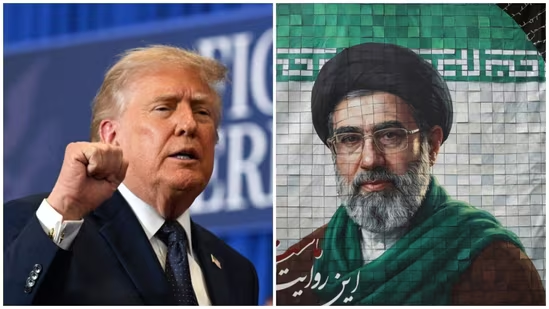
The path to peace grew significantly narrower on Wednesday after the US and Iran traded fresh strikes, leaving critical ceasefire talks hanging by a thread.
The latest flare-up followed US strikes on Qeshm Island and Iranian ports along the Strait of Hormuz after President Donald Trump accused Tehran of shooting down a US Apache helicopter. Track live updates
Fresh US-Iran strikes: Top points
1. Trump warned that Iran would “pay the price” for taking “too long to negotiate a deal”. He claimed Tehran missed an opportunity to secure a favourable agreement. In a series of Truth Social posts, Trump described Iran’s military as weak and accused the country of delaying diplomacy.
“Iran’s Military is a complete and total mess. Much of it, like their Navy and Air Force, doesn’t even exist anymore – They have been completely defeated. Iran is all talk and no action. The Bully of the Middle East is DEAD!!! They’ve taken too long to negotiate a deal that would have been great for them, now they will have to pay the price,” he wrote on Truth Social.
ALSO READ | ‘US must respond’, says Trump after claim of Iranian attack on Apache helicopter
2. The immediate trigger for the escalation was Iran allegedly having shot down a US Army Apache helicopter over the Strait of Hormuz on Tuesday, as per Donald Trump. Trump said two pilots aboard the aircraft were rescued by a US uncrewed naval drone boat and were “safe and uninjured”.
3. Trump said that the United States would “respond” to the attack. This was the first known loss of an Apache helicopter since the US-Israel war on Iran began on February 28.
4. This came only hours after Trump again claimed that negotiations to end the war were in their final stages. Speaking to ABC News after the helicopter incident, the US President said Washington’s response would be “very strong, very powerful”.
5. The US military launched strikes against Iranian targets claiming retaliation for shooting down their Army helicopter. US Central Command (CENTCOM) said, “American forces began launching self-defence strikes against Iran.” It added that the mission was “a proportional response to unjustified Iranian aggression.”
6. Explosions were heard in three strategic locations around the Strait of Hormuz. Iran’s state-run broadcaster reported that two water reservoirs were hit by the US which cut water supplies in the area. Iranian media later reported that the situation was “now reported to be calm”. Axios reported that US forces targeted several Iranian air-defence systems and radar installations around the Strait of Hormuz.
ALSO READ | ‘Bibi, you better be careful’: Trump warned Netanyahu over strikes on Iran
7. Iran then said it launched retaliatory strikes against American targets across the region after coming under US fire. Tehran claimed it carried out missile and drone attacks on US military bases in Jordan, Kuwait and Bahrain. In Bahrain, video geolocated by CNN appeared to show a flash of light from the vicinity of a US base. Jordan and Kuwait said they intercepted incoming strikes.
8. Iranian foreign minister Abbas Araghchi posted on X, “Despite its defeats on the battlefield, the US opted to test our determination. Our Powerful Armed Forces will leave no attack or threat unanswered. Leave our region if you want to be safe.”
9. Following the strikes, Iran’s foreign ministry said it was “reviewing” negotiations in light of the American attacks, according to the Iranian Student News Network.
10. Iranian President Masoud Pezeshkian said Tehran and Washington must move beyond a state of “neither war nor peace”, according to the semi-official Mehr news agency.
Pezeshkian said former Supreme Leader Ali Khamenei, who was assassinated by the US and Israel in February 28, had long pushed for resolving the issue. He suggested negotiations remained the only viable path forward.
The fresh exchange of strikes has placed much pressure on a fragile ceasefire that has been in effect since April 8.
The US Energy Department’s forecasting arm, the Energy Information Administration (EIA), warned that oil prices are likely to remain elevated through at least July because the Strait of Hormuz remains effectively paralysed. The EIA said Brent crude is expected to average around $105 per barrel in June and July, compared with current levels of about $91 and pre-war prices of roughly $70.