Mikel Arteta has lifted the lid on how he has changed Arsenal’s ‘ugly’ culture into a winning one who are now Premier League champions.
Arsenal’s 22-year wait to win the top flight ended last week when Manchester City’s 1-1 draw at Bournemouth confirmed the Gunners’ place at the summit of the English football.
It’s been an arduous six-and-a-half year process for Arteta who took over the north London outfit in December 2019. At the time of his appointment Arsenal were 10th in the table – highlighting the rebuild the Spaniard has undergone.
And reflecting on what it has taken to succeed, Arteta was proud at how he has changed the mindset – labelling it the best part of his rebuild.
Telling The Overlap, brought to you by Sky Bet, he said: ‘When I came here on my first day, unfortunately that setup wasn’t like Liverpool or Manchester City who had already won a lot. This was a completely different animal and we knew that. I am very lucky that we have an ownership model that has experience in sports and they understood the picture is ugly at the moment and we have a lot of work to do and everyone was on board with that.
‘The best part was changing the culture, the culture inside the organisation. To actually understand what was happening inside the organisation. How the people were feeling about working in the organisation.
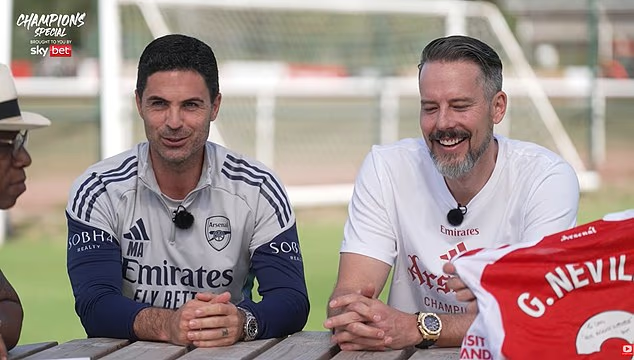
Mikel Arteta (left) and Josh Kroenke have revealed how they changed Arsenal’s culture

Arteta’s six-and-a-half year Arsenal rein peaked last week when they won the Premier League
‘And I did a very profound exercise to try to understand that. It’s actually to understand deeply how people feel about working in the organisation, and I wasn’t happy and I wasn’t impressed at all about the way they described it.
‘So I put my hands on that, and I needed a lot of support to change that. But I think that was the foundation that afterwards we used to build.
‘I was expecting something [work to change], but not as deep or as profound. And then you need time because this wasn’t about changing the identity of a team to make play them in a certain way or improve certain tactics. It was much deeper than that but I love the challenge and it was an incredible opportunity.
‘When things are not in the place that this club deserves, to help them and put them in a certain direction is the most fulfilling part.’
The 44-year-old has had to make some tough decisions along the way with the likes of then-captain Pierre-Emerick Aubameyang’s exit during the 2021-22 as an example.
And speaking of his principles, Arteta defended that he has a difficult job when making big calls.
‘Is it harsh [in making some of his decisions]? I mean, to be fair, in our job it’s very difficult. What is fair? Fair for you means that fair for [another] is not fair. But at least to stick to your principles.
‘I think you explain things and you agree as a team that there are certain behaviours that we expect and we want to promote. If somebody doesn’t do it, I mean, they cannot continue to be part of that. I think that’s clear. Obviously, yeah, we can put the best beautiful words here around the walls, but they mean nothing.’
As Arteta alluded to in his comments he needed support to change the culture with Arsenal owner and co-chair Josh Kroenke among those in his corner.
Arteta’s hiring came just months after Arsenal were thumped in 4-1 in the Europa League final by Chelsea at the end of the 2018-19 season when Unai Emery was in charge.
The after-effects of that defeat resulted in Kroenke realising something needed to change at the club and prompting an honest chat with his father, Stan.

Arteta holds the Premier League trophy with Kroenke and the latter’s dad and owner Stan
‘In the summer of 2019 that’s when it kind of settled in me and I remember talking to my father saying we probably had to maybe take a step back to eventually go forward.
‘And so when we arrived to that December and it’s kind of a transition period, we could really see that the club was in a place where we needed to really reinvent the culture.
‘And so when I sat with Mikel, you know, he had all of his football tactics, but the conversation that I really recall was one about culture. So to see where we are today is a testament to what Mikel and his staff have been able to do in the last six years on-and-off the pitch.
‘I think that if you’re going to make sound decisions, you have to take the emotion out of it at times. And so for me, I had already kind of come to my own conclusion, whether that was self-reflection or one of the directions that we needed to go, that no matter whose fault it is this is the situation and reality of where we are and how are we going to correct it going forward.’