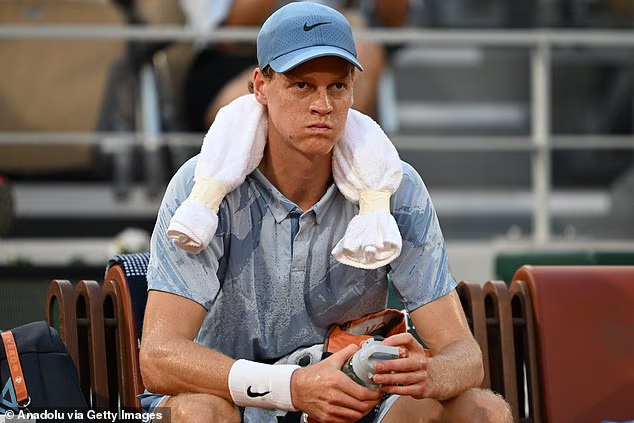
‘I don’t know what to do. I’m f****d.’
As temperatures soared towards 40 degrees on the Rod Laver Arena, a crooked Jannik Sinner turned to his team in despair. He clawed at both his cramping legs. His right hand went into spasm, then his left arm. Then everywhere. Nothing was working.
At the Australian Open in January, the best tennis player in the world looked broken. He was 3-1 down in the third set to Eliot Spizzirri, a young American playing in only his third Grand Slam and could barely walk. Only the sudden divine intervention of the heat rule and a 10-minute break allowed Sinner to cool down, stretch his legs and regain control.
It has become clear over recent months that Sinner may, in fact, be unbeatable by humans, and certainly ones not named Carlos Alcaraz. He’s won his last 30 matches. He’s won six ATP Masters titles in a row, en route to completing the ‘Golden Masters’, winning all nine of them, and doing so seven years quicker than the only other man to do it in Novak Djokovic.
Even he, though, is no match for Mother Nature when she is at her most fierce and in few places is she currently as indomitable as above the Parisian clay. She appears to be the one who could have his number.
Sinner’s escape in Melbourne was the second Australian Open in a row in which the conditions nearly toppled him. He almost melted against Casper Ruud only for an 11-minute off-court medical timeout to help come to his rescue. He went on to win the tournament. He retired at the Shanghai Masters last year due to severe cramps in the extreme heat and humidity. He wobbled against Daniil Medvedev in the semi-finals in Rome but came through and won that tournament too.
Jannik Sinner is going to have to come through challenges from the elements if he wants to win the French Open
The mercury at Roland Garros has been touching 33 degrees and beyond this week as the so-called ‘heat dome’, where the warm air from northern Africa gets trapped under high pressure over western Europe, continues to leave everyone scrambling for umbrellas, fans and ice packs.
It will do so once again when Sinner takes on Juan Manuel Cerundolo first up on Court Philippe-Chatrier on Thursday. Sinner cannot hide in the evening shadows as he did during his first-round procession against Clement Tabur. He will be under the midday sun.
‘I think the heat will affect him,’ seven-time Grand Slam champion Mats Wilander told Daily Mail Sport. ‘It’s probably everyone’s biggest opponent right now. The only way he can lose is if he plays a couple of guys in a row that keep him out there for four hours and then the recovery, combined with the heat, that’s the main issue with him.’
For all his dominance, Sinner does struggle if you take him the distance. He’s got to five sets 17 times in his Grand Slam career and lost 11 of them. He’s been defeated in his last four, including that epic here last year with Alcaraz, and seven of his last eight. Sinner has won none of his seven matches at Grand Slams that have gone longer than four hours.
The problem, though, is who out there can take him the distance? Alcaraz isn’t here, Daniil Medvedev, who beat him in four hours in the quarter-final at Wimbledon is out and so is German Daniel Altmaier who got the better of him at Roland Garros over five sets in 2023.
‘That’s the thing,’ says Wilander, the former fellow European champion, who is also a pundit for TNT Sports, who are showing every game live at Roland Garros. ‘It’s the guy that’s not playing to win the match, he’s just playing to stay out there as long as possible. The tendency when you play the best player in the world is to go for it a little too much and then you make mistakes. If you make mistakes, he’s not getting physically spent on the court. The reason why top players win so easily is often because the other guys are trying to play outside their limitations.
‘If they all get together in the locker room and say: “If one of us is going to beat Jannik Sinner, how are we going to do that? It’s going to be a collective thing we all have to do, we all have to take a chunk out of him”. I had this kind of meeting with John McEnroe once about how to beat Ivan Lendl. So, it does happen. I think that’s the only way they can beat him.
‘The history speaks for itself. Whether it’s cramping or whether he just gets really tired. He was struggling against Medvedev in Rome and somehow he pulled through. He could also run out of luck like in Australia, he was lucky as hell. Keep him out there because the only chance you have is to make him tired.’

Players may have to come together to take chunks out of him during the tournament
That’s what happened in Australia. After his lucky escape against Spizzirri in the third round, Sinner eventually lost in over four hours to Djokovic in the semi-final.
Sinner knows it’s a problem. ‘It’s an area where I would love to improve,’ he said after his Australian Open defeat.
Perhaps it’s not one he can improve. After that defeat, red-headed reporter Ben Rothenberg asked him, as a fellow ginger, whether his pale skin and hair colour – and the recessive MC1R genes that make him that way – were perhaps the reason why.
‘Every player has his own small problems,’ he said. ‘And maybe this is mine.’