
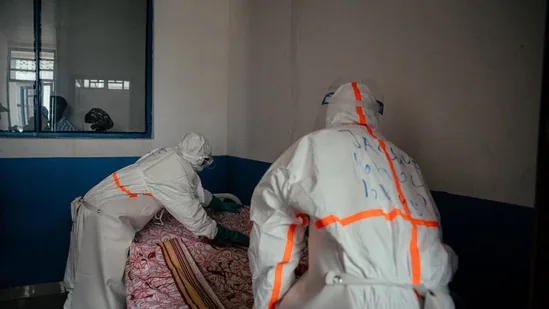
The World Health Organisation upgraded its risk assessment of the Ebola virus in Congo, saying the outbreak now poses a “very high” risk. This was raised from the earlier categorisation of “high”.
While the health agency has said that the chances of the global spread of the disease remain low, the virus, specifically its Bundibugyo strain, has now spread undetected for weeks in Congo’s Ituri Province, the Associated Press reported.
Global health authorities are making efforts to identify the medical options to help contain this outbreak, with there being no approved vaccines or treatments for the Bundibugyo strain, as opposed to the more common Zaire strain.
Also Read | How to stop the Ebola outbreak
The Bundibugyo virus has a fatality rate of up to 40%, Reuters news agency reported. WHO director-general Tedros Adhanom Ghebreyesus said seven deaths have been confirmed in Congo, and 82 cases in total. However, Ghebreyesus said the outbreak is believed to be “much larger”, according to the AP report. In total, there are 750 suspected cases and 177 suspected deaths.
No vaccines currently, to be ready for trial in months
The present Ebola outbreak has posed challenges and has no vaccines because it is caused by a rare species of the virus, according to a BBC report. While there are six species of the Ebola virus, only three cause large outbreaks.
The Bundibugyo strain has caused only two outbreaks in the past – in Uganda in 2007 and DR Congo in 2012. It has not recurred over the past decade. Therefore, while there is an Ebola vaccine for the more common Zaire strain, there is no proven vaccine yet for Bundibugyo.
Scientists at the Oxford University are working towards developing a new vaccine which would be ready for trial within a couple of months, BBC reported.
While there are no guarantees yet on whether this will work, and will take research on animals and trials on people to know if these are effective, scientists said they are working urgently in case the outbreak spirals.
Also Read | Is Ebola the next major pandemic? CDC chief sounds alarm as African countries battle outbreak
India issued advisory for high-risk nations, airports increase surveillance
The union health ministry issued an advisory directing travellers arriving from, or transiting through, Ebola-affected countries to immediately report to airport health authorities if they develop symptoms associated with the disease.
The advisory identified the Democratic Republic of Congo, Uganda and South Sudan as high-risk countries for Ebola Virus Disease (EVD). The ministry listed symptoms including fever, weakness or fatigue, headache, muscle pain, vomiting, diarrhoea, unexplained bleeding and sore throat.
Surveillance measures were stepped up at Delhi’s Indira Gandhi International (IGI) Airport and Cochin International Airport in Kerala’s Kochi. A meeting was chaired involving all stakeholders to brief them on directions issued by the ministry, with authorities introducing operational steps to improve screening and response measures.
Tense barriers have been installed to organise passenger movement from thermal screening areas at international arrival sections, according to an earlier HT report.