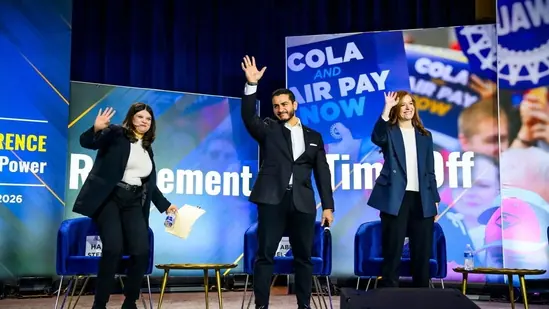
You can learn a lot from the type of campaign stops political candidates make. In early May The Economist went to Detroit to see the three Democratic candidates for Michigan’s open Senate seat campaign on the same day. It provided a welcome insight into three very different candidates.
Photograph: Pete Kiehart (Photograph: Pete Kiehart)
First was Mallory McMorrow (pictured, right), a state senator, who visited a state-backed industrial project in the city’s suburbs, where she peppered staff with earnest questions about 3d printing. Then, in a left-wing coffee shop in the city, came Abdul El-Sayed (pictured, centre), a former head of Wayne County’s health department, who spoke for half an hour to your correspondent before giving a speech to a hundred or so attendees at an event space nearby. The third is Haley Stevens (pictured, left), a congresswoman from the north Detroit suburbs. As far as can be told she did nothing at all.
Three months out from polling day, the race in Michigan is shaping up to be one of the most hotly contested Democratic primaries in the country. Gary Peters, the incumbent senator, is retiring. So unpopular is Donald Trump that our model gives Democrats a strong chance of taking the Senate, but to do so they will have to win Maine and then two Republican-held seats in states won comfortably by the president in 2024.
What they cannot afford to do is to lose Michigan, which plumped for Mr Trump by a margin of just 1.4%. Our model suggests they ought to win by seven points. But the choice of candidate could change that substantially. Each of the three candidates represents a different faction of the Democratic Party nationally. Who wins will reveal a lot about how the party’s voters want to approach the general election. The race is also a test of how much opposition to Israel, and to the war in Iran, will matter.
Start with Ms Stevens. Unlike the other two, she is already in Washington, representing a district covering Detroit’s northern suburbs. Her most prominent backer is Chuck Schumer, the Senate minority leader, and his machine. After that is aipac, America’s biggest pro-Israeli lobby group. Her list of endorsers is as long as Lake Michigan. But her campaign is deathly quiet—she has hosted at most a handful of open events this year—and she was booed at the state party convention last month.
Ms McMorrow is louder (she arrived at the same convention followed by a marching band). She first reached national attention in 2022 with a powerful speech responding to a Republican colleague who had called her a “groomer” over her support for gay and trans rights. These days she styles herself as a policy technocrat who will disdain partisan warfare. She argues that if maga Republicans can be beaten, “more sane, rational, traditional Republicans” will re-emerge like crocuses. Her backers are the sorts of Democrats who consider themselves sensible progressives, such as Elizabeth Warren.
Most boisterous of all is Mr El-Sayed. The son of Egyptian immigrants, he studied medicine at the University of Michigan, but instead of pursuing a residency went into public health (this has not stopped him misleadingly referring to himself as a “physician”). He wants to introduce universal health care, end all military aid to Israel and ban corporate political spending. The biggest problem with American politics, he says, is “the system that allows corporations and billionaires and special interests to buy and sell politicians.” His most prominent backer is Senator Bernie Sanders.
In past elections Democratic primary voters have been older, whiter and more female than the electorate in general, and have disdained radicals. In 2018 Mr El-Sayed ran for governor, and was defeated by 22 percentage points in the primary by Gretchen Whitmer, a more traditional Democrat. At the age of 41 he has served in political jobs for most of his career without ever winning an election.
But might the electorate have changed? Mr El-Sayed’s events, including one with Mr Sanders this month, are drawing big crowds. “I feel more angry at the Democratic Party than I do Trump”, says Annemarie Carlson, a 28-year-old charity worker at his Detroit rally. His fans reckon the party is too in hock to rich donors, out of touch and barely deserving of power. Ms McMorrow and Ms Stevens are clearly pinning their hopes on Democrats who are slightly less full of rage at their own side.
The wild card in the race is AIPAC. Ms McMorrow and Mr El-Sayed expect a wall of negative ads paid for by the group to hit them soon. After Ms Stevens, AIPAC’s preference ought to be obvious. Ms McMorrow, who has a Jewish husband, says what Israel has done in Gaza and Lebanon is “an abomination”. But she also worries that some voters are “not being anti Netanyahu, but anti-Jew.” Mr El-Sayed by contrast has happily campaigned with Hasan Piker, a Twitch streamer who has praised Hamas. (Mr El-Sayed says he disagrees with many of Mr Piker’s views).
And yet AIPAC’s influence is unpredictable. “They have a tonne of money and use it stupidly”, says one Democratic strategist in the state, speaking anonymously because of his (unrelated) campaign work. In a special election primary in New Jersey earlier this year, Analilia Mejia, another angry populist backed by Mr Sanders, beat a moderate critic of Israel attacked by AIPAC. Ms Mejia’s House seat however is a safe one. What the party’s stalwarts fear most in Michigan is that primary voters may be about to risk the Senate on a far-left, unelectable candidate.