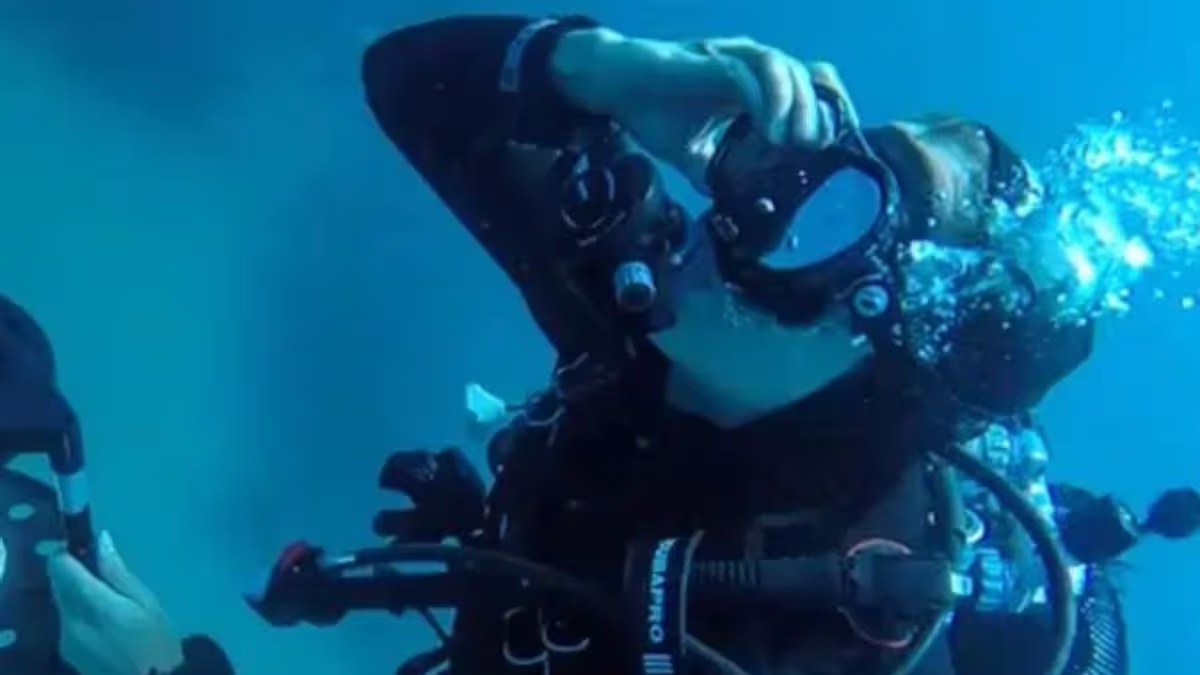
A diving expert has suggested that five Italian cave divers were sucked into a spawling network of caves beneath a Maldives atoll due to the unique properties of its entrance
Divers who lost their lives in a tragic undersea Maldives caving accident were sucked into the structure and pinned there until they ran out of oxygen, it has been suggested.
Bodies of the Italian divers, including mum Monica Montefalcone, her daughter Giorgia Sommacal, Muriel Oddenino, and Federico Gualtieri were discovered in the Maldives on Sunday. The group, led by dive instructor Gianluca Benedetti, whose body was recovered last week, had braved the rough waters south of the country’s capital, Malé, to explore a winding system of caves underneath the Vaavu Atoll.
A leading expert has suggested the divers died after they were sucked into the system’s unique entrance by a freak current while checking it for potential future dives.
READ MORE: Inside haunting Maldives ‘shark cave’ where five divers diedREAD MORE: Inside the ‘complex’ mission to recover divers’ bodies from murky Maldives ‘shark cave’
Speaking to Italian news outlet Adnkronos, Alfonso Bolognini, the president of the Italian Society of Underwater and Hyperbaric Medicine, suggested they were all caught in a strong water current. He said he believes the current was caused by the cave’s narrow entrance pathway.
The entrance caused a “Venturi effect”, the diving expert explained, in which fluid flow speeds up to remain constant, causing a knock-on pressure drop and subsequent vacuum. Mr Bolognini came to the conclusion, he said, after experts from Divers Alert Network (DAN) Europe divers – who conducted drone-led probes of the area – revealed the underwater conditions in the area where the group died.
He said: “They first sent a ROV (remotely operated vehicle) to the cave entrance. They couldn’t get it in due to the very strong currents, so they had to go there themselves.”
The expert said he came to the conclusion that a “formidable” Venturi effect was created after he was sent a cave diagram by the diving team. He offered two theories about what happened after the effect was triggered, both of which involve one or more divers being sucked into the pitch black cave system.
He said: “Two things could have happened after the suction. Either everyone was sucked in, or one was sucked in and the others attempted a rescue.”
Mr Bolognini suggested the group may have been exploring a reef and decided to visit the cave at the end of their trip. He said: “They decided tomake this dive a little deeper to view the entrance, they were sucked into a probably dark environment, with zero visibility even for finning, in a state of great disorientation, probably due to panic.
“In their desperate search for a way out, they probably also ran out of air. But that’s in, in my opion, a fairly reliable reconstruction of what happened.”
Italian authorities have only said that the group of divers “apparently died while attempting to explore caves at a depth of 50 meters (164 feet)”. Ms Montefalcone, a professor at Genoa University, along with Mr Gualtieri and Ms Oddenino, had been granted permission to conduct technical dives deeper than 30 metres as part of an approved research proposal to study soft corals near the atoll.
They were recovered by a crack team of Finnish divers, backed by specialist equipment from the UK and Australia. Officials have planned new dives to evaluate access to the usually off-limits area and the underwater cave, but they have so far been prevented from doing so due to prevailing rought weather conditions.