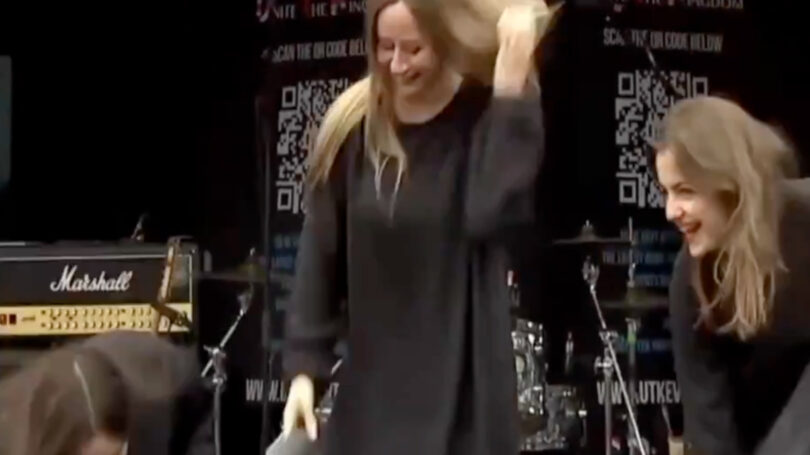
Three women take the stage. They are dressed in niqabs, draped head to toe in voluminous black fabric, their faces covered.
Motioning with their hands, the women egg on the crowd. Boos and jeers fill the air.
The woman in the centre leans into the microphone and chants: “Take it off!” The crowd joins in. One by one, the women tear off their head and face coverings and fling them to the ground. White faces emerge. Hair is tossed. The crowd goes wild.
The spectacle continues: off come the abayas. The women stand triumphant in body-con mini dresses, as Union Jacks wave overhead and cheers swell around them.
“We have come from France to support you,” one woman announces. A small gold cross hangs visibly around her neck.
CLICK FOLLOW: TO FOLLOW US
Sign up to get the latest insights and analysis on
Israel-Palestine, alongside Turkey Unpacked and other eSPORTY
The group is from the Nemesis Collective, a French feminist identitarian movement that mobilises around the racist trope that Muslim immigrants pose a sexual threat to white women.
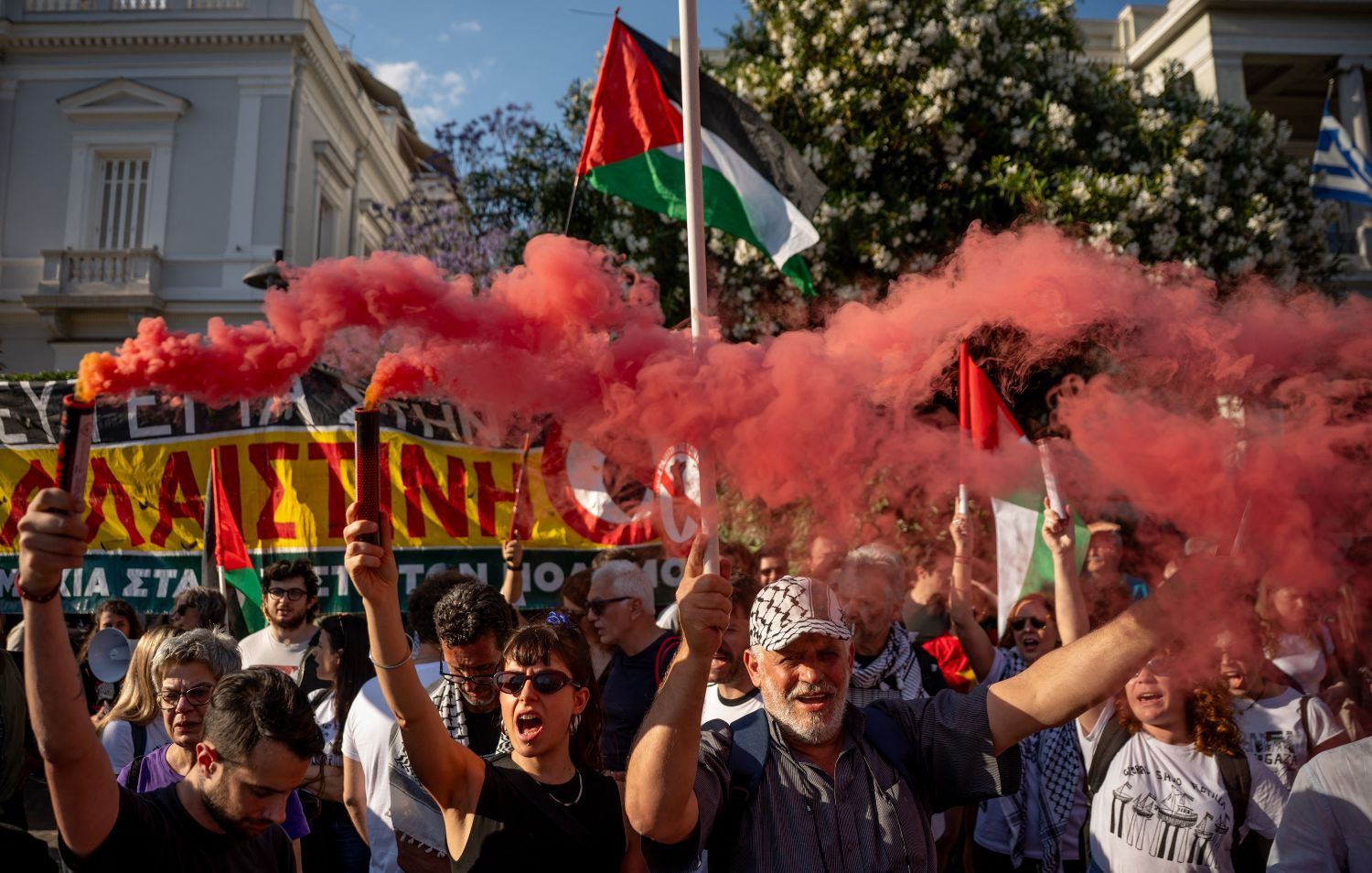
This is a scene from the Unite the Kingdom rally organised by far-right activist Tommy Robinson in London this past weekend, held simultaneously with the pro-Palestinian Nakba Day march.
Theatrical Islamophobia
The Unite the Kingdom rally was saturated with symbols, each communicating a different strand of the movement’s street politics: “Mega” (“Make England Great Again”) hats signalled support for a British-style protectionism and a “Britain First” political vision, while wooden crucifixes and Knights Templar imagery invoked the defence of Christian heartlands against a perceived Muslim invasion.
St George’s flags and Union Jacks affirmed restrictive and exclusionary notions of British national belonging. Meanwhile, Israeli flags and “Jews for Tommy” shirts pointed towards a supposed “Judeo-Christian” alliance, positioning support for Israel as evidence that the movement’s hostility is directed not at race, but at Islam.
Within this symbolic landscape, the niqab spectacle was not merely an act of Islamophobia. It condensed the far right’s political imagination into a single theatrical performance: the conquest of the Christian nation over Islam, the conquest of women by men, and the imagined reconquest of a sacred homeland.
‘We have to remove Islam’: Social media reacts to racist speeches at Unite the Kingdom rally
Read More »
The presence of women at a far-right rally appears, at first glance, contradictory. After all, the far-right movement is, at its core, a male-dominated movement underpinned by misogyny and the desire to punish women and girls, reverse gender equality, and restore gender roles that limit women to domesticity and motherhood. Yet the femininity it otherwise despises has political currency here.
These women incarnate the nation itself – its vulnerability, its precariousness, its threatened home and hearth.
Nations have long been personified as youthful women: Britannia, Marianne, the Statue of Liberty, Bharat Mata. Their presence therefore serves a symbolic purpose: it constructs the nation as feminine and endangered, and in doing so, summons a white masculinity imagined as its natural protector.
Masculinity is recast not merely as desirable, but as historically necessary; the force called upon to defend the imperilled nation.
Civilisation itself is cast as imperilled. It is worth noting that the three women at the Unite the Kingdom rally could have been dressed differently – in floral hijabs, coloured maxi skirts or structured jackets, as many Muslim women are seen to wear. Instead, they were enveloped in black fabric.
In public discourse, the niqab is frequently associated with extremism, terrorism, religious fundamentalism, and the subjugation of women. The choice of black niqabs is therefore not incidental: their darkness enfolds and dominates the women’s whiteness. And because whiteness has been made synonymous with the supposed markers of civilisation – beauty, culture, progress, freedom – the image suggests a civilisation under siege by a militant, puritanical vision of Islam.
Civilisational conquest
In this display, civilisational and feminine conquest are enacted simultaneously. The women remove their hijabs and fling them aside, staging a symbolic triumph of “civilisation” over “shariah law”. Yet beneath this spectacle lies a second conquest, one likely to escape the less discerning observer: the conquest of women by men.
Removing the niqab, the women reject a vision of flourishing that defines a woman’s value not by the desirability of her body, but by her intellectual and moral worth. In so doing, they reinstate the prevailing gender order – one in which women’s worth is tied to the visibility and availability of their bodies to the male gaze.
The spectacle therefore performs a double victory: the triumph of the West over Islam, and the reassertion of male authority over women’s bodies.
The stripping spectacle functions as more than a rejection of Islamic dress. It reenacts the colonial fantasy of unveiling Muslim women as a symbolic conquest of Islam’s sacred heartlands
The Holy Land is imagined as awaiting restoration to Christianity. In European colonial writing, the “Orient” was frequently feminised, depicted as a veiled woman who had to be unveiled, penetrated and made knowable.
The colonial project was therefore not only territorial, but epistemic: the Orient had to be studied, classified, mapped, and stripped of its mysteries. Veiled women became central to this imaginary, because their unveiling symbolised access to, and domination over, the Islamic world itself.
Seen in this light, the stripping spectacle functions as more than a rejection of Islamic dress. It reenacts the colonial fantasy of unveiling Muslim women as a symbolic conquest of Islam’s sacred heartlands.
The scene thus resonates with Christian Zionist fantasies – currents of which frequently overlap with the contemporary far right – in which the recovery of the Holy Land is imagined as both geopolitical conquest and civilisational redemption.
What unfolded on that stage was not simply Islamophobic provocation. It was a carefully choreographed political ritual. The unveiling spectacle condensed some of the central fantasies of the contemporary far right: the endangered white nation, the civilisational threat of Islam, the necessity of masculine protection, and the subordination of women in the name of their liberation.
The scene worked because it transformed ideology into theatre. It allowed the crowd not merely to hear the movement’s politics, but to watch them enacted before their eyes.
The views expressed in this article belong to the author and do not necessarily reflect the editorial policy of Middle East Eye.