Indonesia’s president, Prabowo Subianto, has seen his country explode before. It was in 1998, during the Asian financial crisis. Then, an economic collapse led to mass protests and the toppling of Mr Prabowo’s father-in-law, Suharto, a notoriously corrupt dictator. It also cast Mr Prabowo, who had hoped to succeed Suharto, into the political wilderness. It took him a quarter of a century to claw his way back, finally winning the top job in 2024. So you might think he would be extremely wary of another fiscal crisis. You would be wrong.
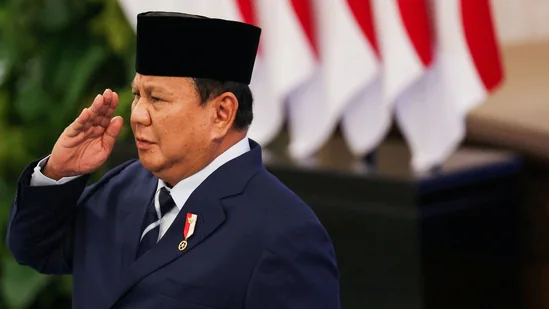
The leader of the world’s biggest Muslim-majority country has centralised power and surrounded himself with a flock of flatterers. (REUTERS)
The leader of the world’s biggest Muslim-majority country has centralised power and surrounded himself with a flock of flatterers. He dumped a respected finance minister and replaced her with Purbaya Yudhi Sadewa, who has called the IMF “stupid” and who told The Economist in April that the president need not worry about “developments in the global economy [or] in the global oil price”. Indonesian businessfolk are scared to speak out, perhaps because Mr Prabowo is a thin-skinned former general with a sketchy human-rights record, or perhaps because he has recently been bullying big business.
Dig deeper
Mr Prabowo appears to be insulating himself from reality. So he may not listen to sober advice. Nonetheless, here is some. His pet projects are unaffordable. Before the Iran war, spending a projected 10% of the budget on just two of them—free school meals and a network of 80,000 village co-operatives—was merely wasteful. Now, the energy crunch has wiped out any room for error. Mr Prabowo must change course or risk a crisis.
He must cut spending on his pet projects, or on Indonesia’s colossal fossil-fuel subsidies, or break a law that caps the budget deficit at 3% of GDP. Each option comes with risks. To cut his pet boondoggles would make him look weak. To let energy prices rise would invite unrest. So Mr Prabowo may take the third path: letting the deficit breach its legal limit.
That would be a mistake. True, the 3% limit is an arbitrary figure copy-and-pasted from Europe’s Maastricht treaty. But since the crisis of 1998 it has signalled that Indonesia’s government is serious about fiscal discipline. Now investors are jumpy. Interest payments as a share of government revenue are surging. Credit-rating agencies are eyeing a downgrade. On Mr Prabowo’s watch, $6bn in foreign capital has fled and the rupiah has sagged by 11% against the dollar to a record low. Busting the budget cap would push borrowing costs higher.
Even as he makes the economy more precarious, Mr Prabowo is eroding Indonesian democracy. Legislative opposition has been all but neutered, and proposals to end direct elections for provincial governors do not bode well. Civil society is intimidated. There are few avenues for dissent, and little creative struggle between competing ideas. Far too much depends on the instincts of a single, badly advised ex-soldier.
He needs to hear unpalatable truths. Yes, cheap fuel is popular. But it encourages consumption at a time of shortages. Yes, people like free school lunches. But giving them to everyone is wasteful. Wiser to focus on pregnant mothers and toddlers in poor families, who need better nutrition to avoid stunting. Yes, Indonesian farmers were being ripped off by middlemen when buying fertiliser. But there are cheaper ways to tackle this than creating those 80,000 village co-operatives, which are likely to be graft-prone. And yes, the 3% deficit limit could well be lifted some day. But first Mr Prabowo must convince markets that Indonesia’s finances are in safe hands.
A new crossroads
Indonesia has made great advances in the past quarter-century. Under a succession of reasonably pragmatic governments, income per person has more than doubled and democracy has put down roots. Mr Prabowo is not a kleptocratic despot like his late father-in-law, but he is chipping away at the progress his country has made since the bad old days.
The president must stop trying to squelch opposition in the legislature, media and civil society. Dissent that cannot find an outlet in politics will spill onto the streets, as it did during riots last year. His insistence that opposition should be “polite” is a recipe for it one day turning violent.
There is hope. Mr Prabowo cares about his legacy. So he needs to realise that a huge, sprawling multi-ethnic archipelago like Indonesia cannot simply be given orders as if it were an army unit. It needs a commander-in-chief who listens to many voices, rather than surrounding himself with yes-men.
Correction (May 14th 2026): An earlier version of this article misspelt the name of Indonesia’s finance minister. Sorry.
Subscribers to The Economist can sign up to our Opinion newsletter, which brings together the best of our leaders, columns, guest essays and reader correspondence.