
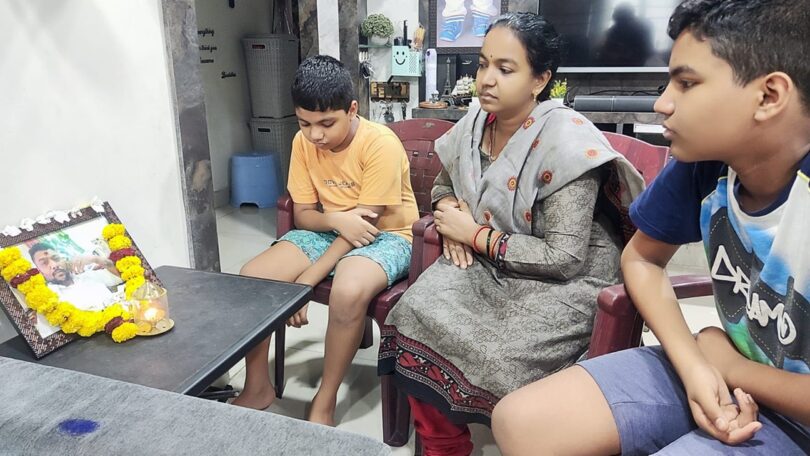
Bhargavi Suresh, 36, from Visakhapatnam in the Indian state of Andhra Pradesh, spends hours sitting before a framed photograph of her husband, Patnala Suresh. She wipes the glass clean, kisses the picture, hugs it tightly and places it back on the table, only to reach for it again moments later.
Looking at the photograph, she breaks down in tears.
“Look at my husband. Isn’t he handsome? Isn’t he young?” she cries. “Come back. How can I live without you? How will I raise our children alone? They need you. I need you.”
Overwhelmed by grief, Bhargavi nearly faints before relatives help her recover. Moments later, she is clutching the photograph once again.
Soon, her two sons, aged 13 and 10, sit beside her. Together, they stare silently at the image of their father, their “superhero”.
CLICK FOLLOW: TO FOLLOW US
Sign up to get the latest insights and analysis on
Israel-Palestine, alongside Turkey Unpacked and other eSPORTY
For 14 years, Patnala Suresh served in the merchant navy. Most recently, he was working as chief engineer aboard the commercial oil tanker MT Settebello. To his sons, he was a man who braved storms and rough seas to keep global trade moving.
“He was my children’s superhero,” Bhargavi says softly. “Everything they admired, they saw in him.”
Suresh was among three Indian crew members killed when the US military struck the MT Settebello in the Gulf of Oman near the Strait of Hormuz on 10 June. American authorities later said the tanker had failed to comply with repeated instructions issued by US forces.
Bhargavi rejects that justification.
“My husband was not a soldier,” she told MEE. “They could have stopped or detained the ship if they wanted to. Why fire a missile at a vessel carrying civilians?”
Calling the strike unjustified, she said the United States should be held accountable for what she described as a violation of international law.
Volatile corridor
India is the world’s third-largest supplier of seafarers, with more than 300,000 Indians serving aboard merchant vessels, accounting for nearly 10-12 percent of the world’s seafaring workforce. But the US-Israeli war on Iran has turned Gulf waters into a dangerous workplace.
Since the start of the conflict on 28 February, more than 40 commercial vessels have been attacked and at least 14 non-Iranian and 44 Iranian maritime workers have been killed.
‘My son was a civilian seafarer, not a navy officer. There was no reason to attack a ship carrying unarmed sailors. The US must answer for what happened and be held accountable’
– Aditya Sharma
India has paid a heavy toll: at least seven Indian seafarers have been killed, while at least 37 Indian-flagged vessels carrying more than 1,100 Indian sailors remain caught in one of the world’s most volatile maritime corridors.
Rajesh Sharma, 60, from Himachal Pradesh’s Hamirpur district, still struggles to accept that his only son, Aditya Sharma, will never call home again. Aditya, a 23-year-old deck cadet on probation, was among the Indian sailors killed in the attack on the MT Settebello.
As relatives and neighbours gather at his home to offer condolences, Sharma fights back tears while remembering his son.
“He never started his day without calling us,” Sharma tells MEE. “He would call twice every day, once before work and once before going to sleep. He was our only child. We were so proud of him. He was one in a million.”
Breaking down, Rajesh shouts: “Oh my son, why did you leave us? How will we live with this grief?”
Sharma says the attack has shattered his family and demands accountability.
US attack kills three Indian sailors in Gulf of Oman
Read More »
“They destroyed families in a matter of seconds,” he says. “My son was a civilian seafarer, not a navy officer. There was no reason to attack a ship carrying unarmed sailors. The US must answer for what happened and be held accountable.”
He also says India’s response has not matched the gravity of the tragedy.
“Our prime minister should have spoken about this personally,” Sharma says.
“He should have addressed the families who lost their loved ones and spoken out against the attack himself. A diplomatic protest alone is not enough. We expected stronger intervention from the Indian government, but it did not come.”
Following the strike, India registered a diplomatic protest with Washington, but did not summon the US ambassador, while it had summoned Iran’s envoy for the death of four Indian seafarers killed in previous attacks that were attributed by the US to Iran, which Tehran denied.
While Prime Minister Narendra Modi reportedly raised concerns about the safety of seafarers during his meeting with US President Donald Trump on the sidelines of the G7 Summit in Evian, France, in mid-June, families of the deceased sailors point out that there was no separate public statement, formal press release or social media post from the prime minister’s office specifically condemning the attacks that killed Indian seafarers.
Hazardous conditions
Since the ceasefire deal signed on 17 June between the US and Iran, many vessels crossed the Strait of Hormuz. However, the agreement is more precarious than ever, as both sides traded fire near the Strait of Hormuz over the past days and accused each other of violating its terms.
Washington blamed Tehran for attacks on commercial vessels in the Strait of Hormuz, while Iran insisted that foreign ships had breached its navigation rules and accused the US of provoking the escalation. This brought the traffic under halt again.
As vessels remain stranded, maritime experts warn that commercial ships are designed to sail, not to remain anchored for weeks or months – a situation that exposes both the vessels and their crews to significant risks.


Manoj Yadav, general secretary of the Forward Seamen’s Union of India (FSUI), told MEE prolonged anchoring was causing ships to accumulate rust, barnacles, algae and jellyfish, while many were struggling to obtain critical spare parts, potentially affecting their ability to leave the region when tensions ease.
“Ships are meant to move, not remain idle for months,” Yadav said.
He added that extended inactivity can also create hazardous conditions onboard, including the build-up of harmful gases in confined spaces, posing risks to crew health and safety.
The human toll is already evident.
Nishanth Uirthanathan, a 35-year-old Indian seafarer, father of two and second officer aboard the MT Celestial tanker, died on 11 June after falling seriously ill while the vessel was docked at Duqm Port in Oman.
‘A few days before he died, he told his wife that conditions on the ship were not good’
– Prashant Uirthanathan
His brother, Prashant Uirthanathan, said Nishanth suffered from fever, vomiting and extreme fatigue for nearly a month. He added that prolonged anchoring caused by the regional conflict had led to deteriorating living conditions onboard, including poor sanitation and food quality.
“A few days before he died, he told his wife that conditions on the ship were not good,” Prashant told MEE.
The family also alleged delays in medical treatment by the shipping company.
“We were poor before Nishanth became a seafarer. He helped lift our family out of poverty,” Prashant said. “If the conflict had not delayed the voyage, he would have returned home months ago. We believe he would still be alive today.”
The dangers of prolonged confinement at sea are well documented.
The International Maritime Organisation reported in 2025 that since 1996, around 350 seafarers and maritime workers have died in incidents involving oxygen-deficient or toxic atmospheres in confined spaces aboard ships. Since 2022 alone, 43 such accidents have claimed about 70 lives.
Inadequate compensation
Indian seafarer unions say that while Indian seafarers have paid the highest price in the Gulf crisis, the government’s response has fallen short of expectations in terms of compensation.
India’s Director General of Shipping Shyam Jagannathan said 10 lakhs of rupees ($10,500) had been released to the families of the deceased sailors through the Seafarers’ Welfare Fund Society and that efforts were under way to secure additional assistance.
However, Yadav stressed that the money came from a welfare fund, not directly from the government.
“These were not accidental deaths. Civilian seafarers were killed in military attacks,” he said.
‘There was an expectation that the government would come out strongly in support of these families. Many feel that has not happened’
– Manoj Yadav, Forward Seamen’s Union of India
His union, FSUI, is demanding at least 1 crore rupees ($105,000) in compensation for each family and a government job for the next of kin. The union has also petitioned the United Nations, seeking $5m in compensation for the families of those killed.
“There was an expectation that the government would come out strongly in support of these families,” Yadav told MEE. “Many feel that has not happened.”
As uncertainty over the reopening of the Strait of Hormuz continues, hundreds of Indian seafarers remain trapped. The recent attacks have left many living with fear, anxiety, and psychological trauma.
According to the Indian government, the control room of the Directorate General of Shipping has handled more than 12,331 phone calls and 27,515 emails since the crisis began. The ministry has also facilitated the repatriation of 3,537 Indian seafarers from the Gulf region.
Yadav said the FSUI has received countless calls and messages from Indian seafarers pleading to be evacuated.
Bhumesh, an Indian seafarer who survived the 1 March attack on the tanker Skylight that killed one crew member after being rescued by the Omani military, said the memories continue to haunt him.
“When the ship was attacked, the only faces I could see were those of my parents,” he told MEE.
“I still live with that trauma. The images never leave me. Seafarers hardly sleep because of fear. Living at sea has become like living in hell.”