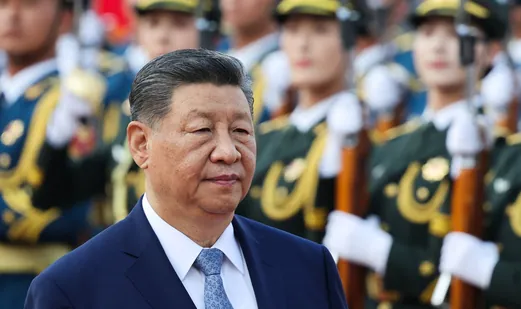
THE CHANCES of a trade war between the European Union and China are far higher than most Europeans realise. In the corridors of Brussels, insiders have theories to explain this calm. One involves a Trump effect: political and business leaders spend too much time reacting to provocations from Donald Trump and his team. Chinese bullying is discreet. If Xi Jinping shared his darkest thoughts on social media, more leaders might realise that, compared with America, China is a more urgent threat.
If Xi Jinping shared his darkest thoughts on social media, more leaders might realise that, compared with America, China is a more urgent threat. (AP)
There is complacency on China’s side, too. To prosper, Chinese exporters need the EU’s 450m consumers, especially as America walls itself off. Yet Chinese officials shrug off European pleas to tackle trade imbalances. Those now run at €1bn ($1.18bn) a day in China’s favour amid surging Chinese exports to Europe and slumping EU sales to China. A stream of visiting European leaders have warned Mr Xi that China’s state-backed manufacturing juggernaut poses an intolerable threat to industries in their home countries. Unless China changes course, Europe will have to close itself off, is their co-ordinated message.
So far, China’s reaction involves more cynicism than fear. Party high-ups are connoisseurs of power and coercion. That is how they become party bosses (at least until the next purge). It is why they respect and resent America, the one country with the financial, technological and military might to slow China’s rise. By contrast, they see Europe as an economic giant with puny geopolitical leverage, hobbled by its need for consensus among 27 members.
On a visit to Beijing and Shanghai, this columnist heard Europe discussed with scorn. A senior figure described Chinese leaders as exasperated by decades of European lectures about values, most recently over China’s support for Russia over Ukraine. What about Mr Trump’s contempt for values, Chinese bigwigs ask? Europe is missing a chance to embrace China as a partner.
Updating their divide-and-rule formula, Chinese officials and trade negotiators heap praise on selected national governments. (Spain is a current favourite.) National leaders are called refreshingly pragmatic by focusing on attracting Chinese high-tech investments. Conversely, EU officials in Brussels are scolded for being ideological and obsessed with achieving perfect economic security. Europeans should be realists as they negotiate, as Americans now are, is a frequent Chinese line of attack.
Brussels policy chiefs are not ready to back down. Fears of a looming China shock are leading EU officials to prepare stronger trade defences, including the more frequent use of safeguard measures involving high tariffs to shield whole industries. A get-tough package is set for debate by the European Commission, the EU’s executive, this month and by national leaders in June.
The Industrial Accelerator Act, a draft law, would oblige foreign investors with dominant positions in batteries, electric cars and other strategic industries (hello, China) to hire more European workers, buy lots of locally made components and transfer technologies to European partners as the price of access to the EU market. Another proposal would add buy-European conditions to big public contracts. The EU has moved to tighten customs rules on low-value imports, after Europe’s online shopping addicts ordered almost 6bn small packages last year, mainly from China.
Chinese officials and industrialists recognise a copy when they see one. They know that European proposals aim to reproduce technological and value-extraction techniques that China used with success on Western multinationals a generation ago. Instead of finding this imitation flattering, Chinese high-ups deride Europeans as lazy and chronically unwilling to invest in innovation.
China’s commerce ministry last month threatened unspecified counter-measures if the Industrial Accelerator Act becomes law. A Chinese business executive asks why Europeans suppose that his country’s high-tech investments might create lots of jobs. Recalling a European factory visit, he describes seeing photographs of long-serving employees, proudly hung on a wall. In our plants, those pictures would show a line of robots, he scoffs. It is a sharp joke, but bad politics. If China is blamed for destroying European steel or carmaking jobs, say, any German chancellor or French president will face demands to intervene.
Squeezed by a bullying America and a scary China
Maros Sefcovic, an EU commissioner from Slovakia who now holds the trade portfolio—making him the chief trade negotiator for 27 countries—is dubbed an unflappable Mr Fixit in Brussels. Still, in an interview for Inside Geopolitics, a video show produced by The Economist, he is blunt. He compares Europe’s dependency on rare earths and other critical minerals from China to its former reliance on Russian energy. Then there are surging exports driven by Chinese industrial overcapacity. If the EU does not defend itself and China fails to rebalance its economy, he avers, Europe risks losing “whole sectors of industry within a couple of years”. Against that, he has a mandate to avoid costly fights. “Not a single” business leader is urging him to start trade conflicts, he says. “It’s very easy to start a trade war, but it’s difficult to stop one.”
Even interventionists seek to pick their battles. Stéphane Séjourné is France’s EU commissioner, holding the “prosperity and industrial-strategy” portfolio. He advocates industrial policies and buy-Europe clauses. He worries about the security implications of Chinese-made electric cars and green technologies. But rather than slow Europe’s low-carbon transition, he wants to focus on components that a hostile power could use for ill: the inverters that connect solar panels to electricity grids, or the interface through which an autonomous car talks to its manufacturer.
Europe dreads a trade war with China. It also fears losing its industries. Only tough choices await.
Subscribers to The Economist can sign up to our Opinion newsletter, which brings together the best of our leaders, columns, guest essays and reader correspondence.