
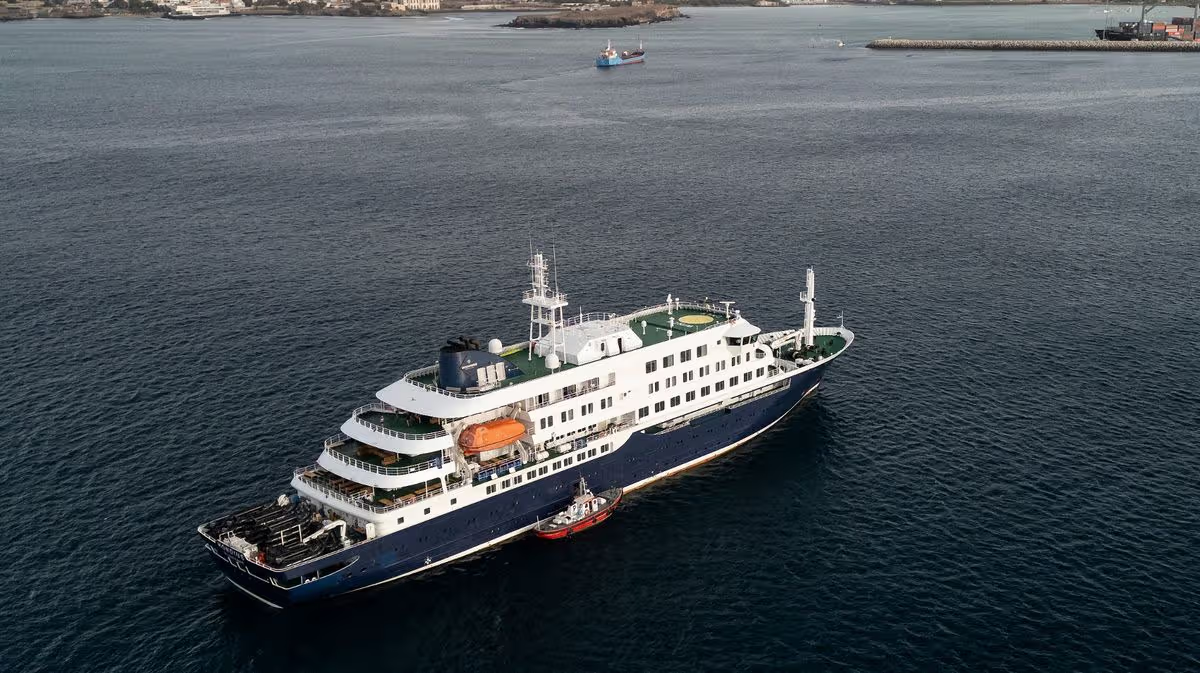
Hantavirus-stricken ship MV Hondius has eight reported cases and five confirmed, and Dr Stephen Kornfield, who is treating patients onboard the vessel, has revealed the big fear about the disease
A doctor on board the hantavirus-stricken cruise ship says there’s one big worry about the emerging disease.
American medic Dr Stephen Kornfeld boarded MV Hondius in Argentina, thinking he was going to have a relaxing holiday – but he ended up treating the hantavirus outbreak onboard.
Eight cases have been reported so far, including three deaths. Five of the cases have been confirmed as hantavirus, a group of viruses primarily carried by rodents and passed on by exposure to their urine, faeces and saliva. It is very rare for human-to-human transmission to occur.
The MV Hondius set sail from Argentina a month ago, where Dr Kornfeld boarded the ship. He joined CNN to talk about the big “fear” surrounding the disease.
He says he “sort of fell into the role of becoming the ship’s doctor” after the vessel’s medic was struck down by hantavirus.
Dr Kornfeld said: “There are three patients who seemed to be getting ill around the same time. One of them, very non-specific symptoms, a lot of confusion, and a lot of weakness. And she ultimately passed away relatively quickly.
“The two other gentlemen, quite a bit younger including the doc, just had a lot of viral symptoms, a lot of fever, fatigue, flushing, some GI issues, some shortness of breathe.
“At the time neither one of them looked critically ill but the fear with hantavirus is you can go from seriously ill to critically ill very quickly.
“The ability to treat someone here on the ship in that critical state is non-existent. Now they’ve been evacuated they’re getting magnificent care.
“What happens with hantavirus, ultimate survivability is really dependent on your ability to get critical care at the right time. On the boat, that would not be possible.”
The luxury cruise, which is operated by Oceanwide Expeditions, began its journey on April 1 in Ushuaia, on the southern tip of Argentina. It is expected to arrive in Spain’s Canary Islands on Sunday (May 10).
Around 150 passengers and crew from 28 countries were reported to have initially boarded the vessel, but dozens disembarked on April 24 on the island of St Helena, a British Overseas Territory in the South Atlantic Ocean.
All British passengers and crew on the ship are being asked to isolate for 45 days after they return to the UK, with close monitoring by health officials. Three Britons are confirmed or suspected to have contracted hantavirus. One is being treated in the Netherlands, another man is being treated in South Africa while a third is on the Atlantic island of Tristan da Cunha.
The governments in Singapore, Argentina, South Africa, the Netherlands and the UK have all said in recent days they were tracking people down connected to the ship.
The outbreak on the Hondius has caused international alarm as health agencies rush to trace the outbreak of the potentially deadly human-to-human strain.
World Health Organization (WHO) Director General Tedros Ghebreyesus said that the first two patients with confirmed cases of hantavirus had travelled through Argentina, Chile and Uruguay on a bird-watching trip. It included visits to sites where the species of rat known to carry the virus inhabits.
The incubation period of the virus can be up to six weeks so it is possible more cases will present in the coming weeks.
Dr Kornfeld opened up on whether he is nervous about contracting hantavirus given his close contact with patients and the potential long incubation period.
He told CNN: “Early on, we didn’t know it was hantavirus until maybe May 2, 3. We started treating people thinking, ‘this could be infectious.’ So in the beginning we were being careful with masks and gowns, and once we found out it was hantavirus and a second case happened, making it seem likely, I was able to find some aprons and some goggles. I did a lot of hand washing and clothes washing. I think hantavirus is hard to spread even though on this ship it seemed to spread.
“I may be in a different boat to the other passengers as I’ve had a lot of contact with the sufferers. We’ve been on this boat for five weeks and the original patient episode was many weeks ago.”