
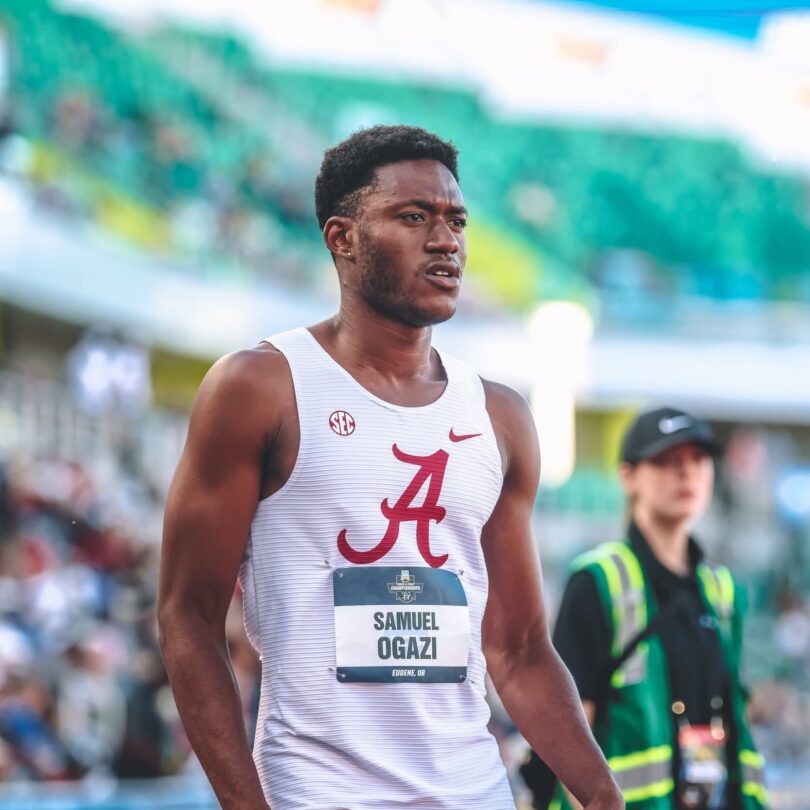
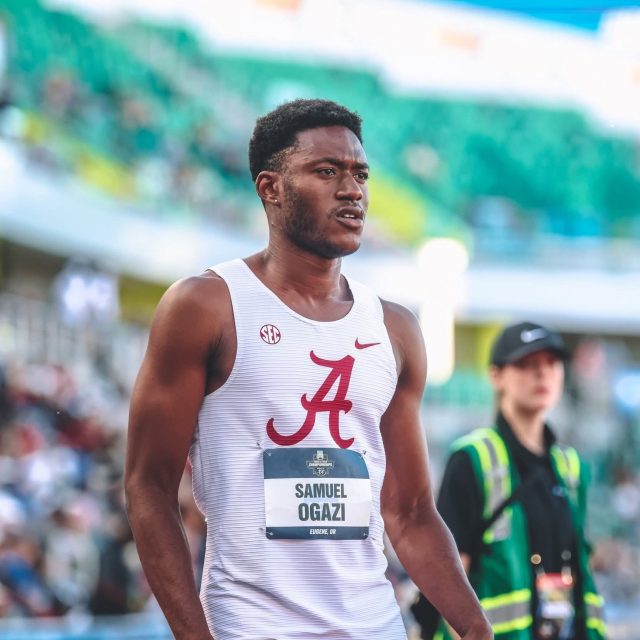
At the Torrin Lawrence Memorial in Athens, Samuel Ogazi stormed to a stunning 44.02 seconds, shattering the long-standing national record of 44.17 seconds set in 1987 by Innocent Egbunike.
For nearly four decades, one mark stood as a towering symbol of Nigerian excellence in the one-lap race.
It survived generations, transitions, and the evolution of sprinting itself.

Read Also: Beyond Portable vs Carter Efe: How Other Nigerians Fared at ‘Chaos in the Ring’ | Sports247 Nigeria
Then, in a moment as unexpected as it was historic, a 19-year-old rose to rewrite it.
It wasn’t just a record broken—it was a generational baton passed.
A Race That Defied Circumstance
What makes Ogazi’s performance even more compelling is the context behind it.
The teenager arrived at the meet under a cloud of doubt. Days before the race, he admitted he didn’t feel ready. Weeks earlier, he had battled illness.
By his own admission, expectations were modest.
Yet when the gun fired, hesitation vanished.
Running with remarkable composure and strength over the final bend, Ogazi produced a performance that now ranks him among the fastest Africans in history, moving into the top six all-time on the continent.
His 44.02s is also among the quickest times globally in recent seasons, placing him firmly in elite company alongside names like Busang Kebinatshipi and Muzala Samukonga.
The Rise Before the Record
Long before this historic run, Ogazi’s trajectory had already hinted at greatness.
African U18 Champion: He first announced himself on the continental stage as a dominant youth talent.
Sub-45 Breakthrough.
By 2024, he dipped under the elite 45-second barrier, a key milestone in 400m running.
Olympic Finalist:
At the Paris 2024 Olympics, he became the first Nigerian man in decades to reach the 400m final.
NCAA Champion:
Competing for the University of Alabama, he captured both outdoor and indoor NCAA titles, showcasing consistency across surfaces.
African Indoor Record Holder
His 44.57s indoors further underlined his versatility and elite endurance-speed blend.
These achievements painted the picture of a prodigy—but the national record confirmed him as a phenomenon.
The Record That Defined an Era
To fully grasp the magnitude of Ogazi’s feat, one must understand the weight of the name he surpassed.
Innocent Egbunike was not just a record holder—he was the standard.
In the 1980s, Egbunike dominated African sprinting with a blend of power and elegance that made him one of the finest quarter-milers of his time.
Egbunike’s Enduring Greatness
44.17 seconds (1987): A national record that stood for 39 years.
World Championships Silver Medalist (1987, Rome)
Olympic Finalist (1984, 1988)
Olympic Bronze Medalist (4x400m relay, 1984)
Multiple African and All-Africa Games Champion
His record was more than a number—it was a benchmark that resisted generations of challengers, through eras of changing track technology, training science, and global competition.
Even after retirement, Egbunike’s influence endured.
As a coach, he helped shape elite athletes, contributing to global sprinting excellence and mentoring future champions.
From Legacy to Leap
Records in athletics are often broken incrementally. But Ogazi’s run felt symbolic—almost poetic.
A teenager, barely two decades into life, surpassing a mark set before he was born.
A modern athlete rewriting history while standing on the shoulders of a pioneer.
Rather than diminishing Egbunike’s legacy, Ogazi’s achievement reinforces it. The longevity of that 44.17s speaks to its greatness; breaking it elevates both men in the same narrative.
A New Frontier for Nigerian Sprinting
With 44.02s, the conversation has shifted. The once-mythical sub-44-second barrier—never achieved by a Nigerian man—now feels within reach.
Ogazi is no longer chasing history. He is shaping it.
And as he continues his ascent toward future global championships and Olympic podiums, one thing is certain:
The era defined by Innocent Egbunike has not been replaced—it has been extended.
Through Samuel Ogazi, Nigeria’s 400m story has found its next great chapter.