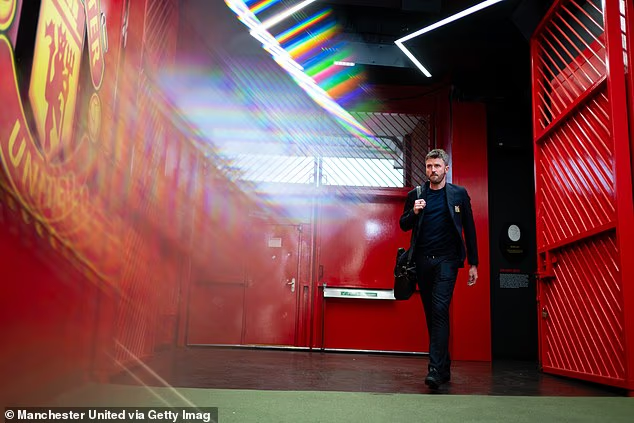
During recent media interviews, Bruno Fernandes said something telling about Manchester United and it could also be applied to their manager-in-waiting Michael Carrick.
‘Can we be the team who have been good in this spell, but for a full season?’ the United captain said. ‘Because anyone can be good in spells. Being good over a whole season is much more difficult. That’s something we haven’t done since I was here.’
Increasingly, Fernandes speaks for his football club and once again he struck the right tone. United have moved forwards incredibly well in the second half of this season. That they prepare to host Liverpool on Sunday ahead of them in the table but also on the brink of Champions League qualification is testimony to an improvement that nobody saw coming when Ruben Amorim was sacked in January.
Michael Carrick. He is the name on the lips of every United supporter now. He is also the question that hangs over the United executive team. Played 13, won nine, drawn two, lost two. Extrapolate that form over the course of a 38-game Premier League season and you have 85 points and a chance of winning the thing.
The case for the sixth interim coach since Sir Alex Ferguson left 13 years ago becoming the second after Ole Gunnar Solskjaer to get the permanent job is growing stronger. A win at Old Trafford this weekend and opinions harden further. But this is Manchester United, a club that needs a manager for the long term and to win the Premier League. We have seen short spells of progress before.
This is a job that has turned good men bad. David Moyes. Louis van Gaal. Jose Mourinho. None were the same walking out as they were walking in. As a football club, United grows ever more complicated. Is Carrick the man to walk this walk? Or is appointing a manager on the back of results built against a backdrop of no cup distractions and endless days of rest and training just another gamble that may one day be added to a long list of ones that simply didn’t work?
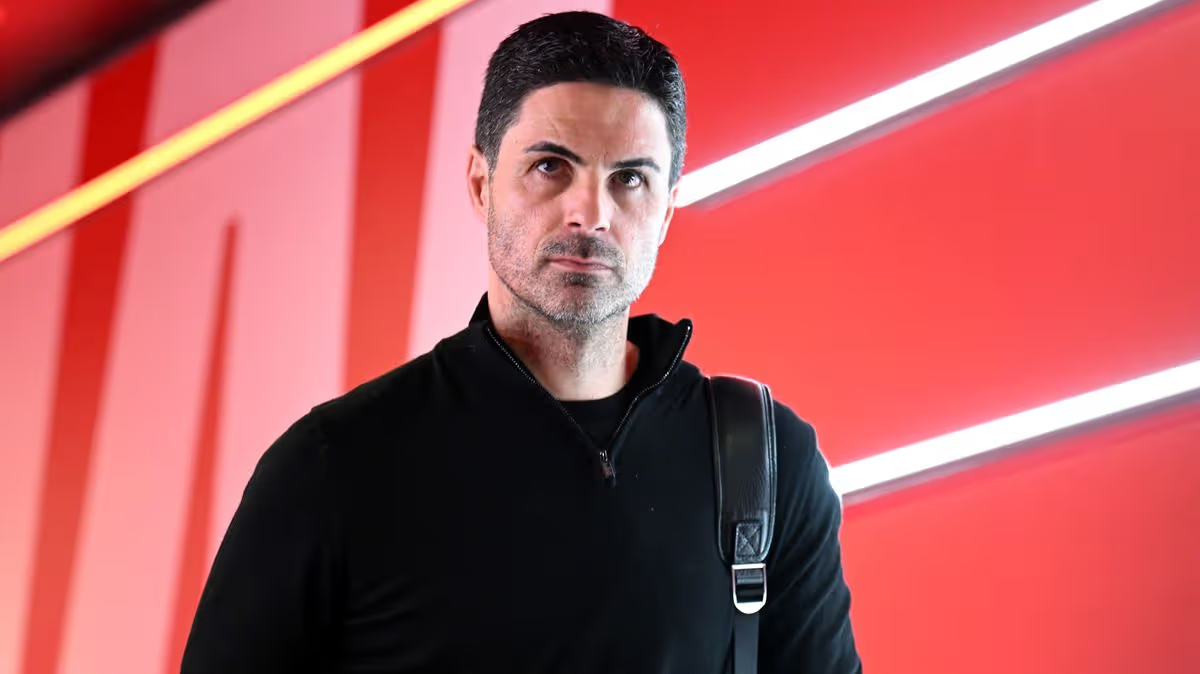
Michael Carrick is the name on the lips of every Manchester United supporter now. He is also the question that hangs over the United executive team

Carrick has brought the good times back to United – but is this a bounce? Or a long-term solution?
In the United dressing room, minds have largely been made up. Footballers crave consistency and simplicity and after Amorim’s strange system, tactics and stubbornness, Carrick has restored order and confidence to the minds of his players. That’s not always as easy as it sounds.
Fernandes was playing out of position under Amorim. Under Carrick he is a No 10 again and in with a good chance of being named Player of the Year.
‘That is Michael Carrick in a nutshell,’ says the agent of one prominent United star. ‘He has taken the players back to sound principles, the ones he used to understand as a player. Square pegs in square holes. A reliable formation. And he has built a spine through the team. United haven’t had one of those for years.
‘Now it goes: Senne Lammens, Harry Maguire, Kobbie Mainoo, Bruno and a centre forward. That sense of simplicity had got lost in Amorim’s chaos.’
All of this is important. One of the damning characteristics of Amorim’s latter months and the tenure of Erik ten Hag before him, was that United’s players barely looked coached. Carrick’s staff – led by Steve Holland and assisted by Jonny Evans and Jonathan Woodgate – have fixed all that. They have transformed this United team and Holland’s appointment in particular feels like a masterstroke.
The very first thing he said to the United squad after Carrick’s arrival was that they would beat Manchester City in game one and they did. It’s no coincidence that players like Mainoo and Maguire – successful for England when Holland was assistant to Gareth Southgate – have returned to prominence.
Carrick and his team have had lots of time. United have played 13 games since mid-January. Arsenal have played 25. They will play just 40 games in total this season with no European football and falling at the first hurdle in both cups. Forty games, for a Premier League club, is also known as the bare minimum in a campaign.
Time is nothing, though, if not used effectively. From Carrick, there have been no grand gestures. No elaborate new-age bonding sessions. He has quietly returned his United team to what many people think they should have been in the first place.

Carrick has restored order and confidence to the minds of his players. That’s not always as easy as it sounds

Before him, United’s players barely looked coached. Carrick’s staff – led by Steve Holland (centre) and assisted by Jonny Evans and Jonathan Woodgate (right) – have fixed all that
‘I think there is a simple question that needs to asked,’ says another agent close to the United team. ‘How much of this improvement is Carrick genius and how much of it has simply been cleaning up another bloke’s mess? Does this improvement reflect on Carrick’s talents or Amorim’s basic failings? Maybe it’s both.
‘I see it like this. Do the players like Michael? Yes. Has he made them feel good? Yes. Are they grateful? Yes. Do they think they are in the presence of the next great United manager? Maybe not.’
In the United boardroom they are also grateful. Grateful for the calm. Grateful for the Champions League money that will come and grateful for the absence of noise.
‘You have to remember what it was like before Michael arrived,’ says one source. ‘Gary Neville, Roy Keane, Paul Scholes, Nicky Butt and the rest. They were all at it. That’s a hell of a lot of caps and medals queuing up every week to have a pop. We all know what that was doing to the dressing room. It was toxic. Michael has got rid of all that. Performances have gone up and the aggro has gone down.’
Carrick was always calm. As a kid at Wallsend Boys Club in Newcastle. As a midfielder of great poise for West Ham, Tottenham, United and England. On the back of his autobiography, there is a quote from Neville which says watching Scholes and Carrick in midfield was like ‘going into a bar and hearing a piano playing’.
After the tension of Amorim’s arm’s-length style of coaching – some arms longer than others – a warmth has returned to Carrington to the degree that Carrick even has nicknames for some of his players. He has also been attending academy games, something that seemed beyond some of his predecessors. The optics have been good.
So much of what he has shown us since January, then, has played to what we know of the 44-year-old. United’s problem is all the stuff we don’t know.
Carrick is not a proven top-flight manager, in fact he’s not really a proven manager at all. His two-and-a-half-year spell at Middlesbrough ended like many do: a good start, some levelling out and then a drop-off. He is not unique there. It was a perfectly acceptable first effort. But nobody of note dashed to hire him thereafter and the truth is that United need a manager to win them the league quite soon.

After the tension of Ruben Amorim’s arm’s-length style of coaching – some arms longer than others – a warmth has returned to Carrington

From Carrick, there have been no grand gestures or elaborate new-age bonding sessions. He has quietly returned his United team to what many people think they should always have been
Is Carrick that man? What about managing up and the business of dealing with the kind of pressure that is unique to a job like this one? Moyes, for example, thought he knew what that was about until the minute he walked through the door.
Interim spells are unique in management in that they come with the very lightest of expectations. Solskjaer made his look like a work of art after replacing Mourinho in winter 2018. An opening sequence of 10 wins in 11 games jet-propelled him to the permanent job on a wave of relief, gratitude and supporter emotion. The fact he had previously been a disaster at Cardiff City didn’t seem to matter.
His two and a half years in the United post are seen by his advocates as progressive. They also say comparisons with Carrick are worthless but that’s ridiculous. The similarities thus far are very clear and so are the warnings attached. Indeed an alternative view of the Solskjaer tenure is that once the realities, demands and expectations of actual life at Old Trafford started to bite, a very modest manager indeed emerged.
A third-place finish – 33 points behind champions Liverpool – in 2020 and second place 12 adrift of Manchester City a year later sit on his CV. So too does the fact he rolled over once United signed Cristiano Ronaldo – something he now says he didn’t want – and watched his dressing room fall apart.
When he was sacked after a 4-1 thrashing at Watford followed a 5-0 home humbling by Liverpool, he cried on the way out. He is currently out of work after a spell at Besiktas in Turkey that lasted seven months.
They make a lot of ‘United DNA’ around Old Trafford. Equally, there is a school of thought – perpetuated not just by fans but also by pundits of note – that United need to appoint someone who ‘gets the club’. It can be a little hard to know what all this means. What exactly is United DNA?
If it’s about attacking football and glamour then all that does is put them alongside clubs like Liverpool, Tottenham, Newcastle, Chelsea and many, many others. Go back a while and you will find similar founding stones at clubs like West Ham and, in the 1950s, Wolverhampton Wanderers. In reality, it means absolutely nothing.
As for ‘understanding the club’, that’s a whole lot more complicated and depends on what version of United someone like Carrick is supposed to understand. After all, this isn’t the United of 2003, a place where Ferguson knew every member of cleaning staff by name and had his list of transfer targets written on a piece of scrap paper ready to hand to his brother and chief scout Martin.

Ole Gunnar Solskjaer waves goodbye to the United fans after a 4-1 thrashing at Watford in November 2021 sealed his fate. It is a cautionary tale for promoting Carrick to the top job

This is not the United of Ferguson’s era, when he earned and was afforded the right to run the place entirely as he saw fit
This is 2026. United are a huge football club playing catch-up and attempting to find sustained recovery. A club still mired in debt, a place of redundancies and cutbacks still owned predominantly by a family of American venture capitalists and playing in a stadium that no longer does the job it needs to. The sad truth is that the version of United that people cling to and talk about through the bottom of their pint glasses is no longer in play.
Therefore, for all that traditional values and cultures are important, managing United now is not about trying to take it back to what it used to be. It’s about accepting the stark reality of today. It’s about understanding a multi-layered structure set in place by Sir Jim Ratcliffe and his friends and fitting into it and thriving.
Amorim arrived in November 2024 and immediately talked up his ability to do that and failed. His relationship with director of football Jason Wilcox was good until the very moment it wasn’t, and then he was gone.
So this would be the challenge set before Carrick. This job is about more than being a good coach and while that’s the same at every club in the country – Carrick occasionally clashed with executives at Middlesbrough over recruitment – everything is magnified 10-fold and more at a club like United.
The field of other contenders is not particularly deep. Some, such as Andoni Iraola and Oliver Glasner, are untried at the exalted level, while others such as Eddie Howe are in need of a recharge. Unai Emery of Aston Villa is the outstanding Premier League candidate and was considered before Amorim. But the Spaniard would demand a level of control not likely to be granted by the modern United setup.
Lying beneath all of this is United’s responsibility to get it right. Mistakes have been made – particularly in their attempts to hire Thomas Tuchel two years ago – and we wonder if they have been learned.
Carrick’s greatest selling point is results. It’s a strong look. His own approach has been to not push the club for an answer. Equally, he knows his own worth. He will only sign the right deal for him.
‘He’s doing it like he did it as a player,’ said one onlooker with knowledge of the situation. ‘He is waiting for the ball to come to him. When it does, he will play.’

Oliver Glasner (left) and Andoni Iraola (right) will be free agents this summer, but they are untried at the very top level where United want to be

Unai Emery (left) is another top contender, but would demand a level of control that United have not been willing to hand out to their managers in recent years

It’s a huge job for a rookie Premier League manager, no matter what his win percentage says
Standing on the touchline as United lost at home to Leeds recently, Carrick was criticised for substitutions that didn’t arrive until the 70th minute. Some also said he needed to be more demonstrative. Towards the end of his time at Middlesbrough, similar was said of him. Five days after Leeds, Carrick’s United won at Chelsea and nobody was saying any of that anymore.
This is how it is at Old Trafford. Good or bad. Triumph or disaster. Up and down. Never any middle ground, no shades of grey.
As one agent says pithily: ‘At United, you can be a hero for finishing fourth and sacked for finishing seventh. This sounds harsh but are they really going to appoint a guy no other big club in the Premier League would have looked twice at?’
Next season will certainly look and feel very different. A schedule of European and domestic cup football will ask big questions of a manager and a squad still light on quality in depth. Cole Palmer would like to come but United already have a No 10 and he wears the captain’s armband.
For all their recent progress, United remain a puzzle to unpick. They are a club as likely to fall back as to push further forward. It’s a huge job for a rookie Premier League manager, no matter what his win percentage says.