In a scary world, comfort food can be a source of solace. Tasty Congee & Noodle Wantun Shop, a restaurant in Hong Kong, offers soothing rice porridge topped with scallions to locals, visitors from mainland China and any foreigners who have acquired the taste. The bill can be paid in Hong Kong dollars or the mainland’s currency, the yuan. The congee shop will even take the e-CNY, a digital currency issued by China’s central bank (although the maître d’ had never seen anyone use it before). Over 5,000 merchants in the city accept this novel form of money.
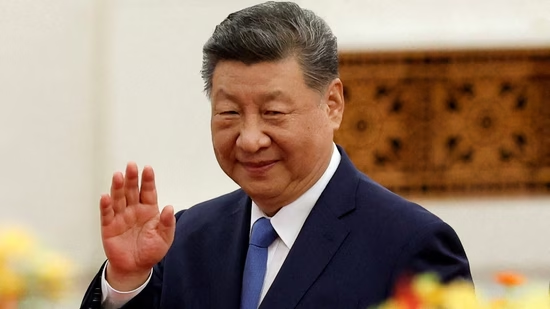
Xi Jinping, China’s leader, has said the country must have a “powerful” currency.
China’s leaders seem newly optimistic about the yuan’s prospects beyond the mainland. They have long been keen to ease their dependence on the American dollar for international transactions. Yet progress has been uneven. In recent years they have built their own conventional and digital payment rails, bypassing the main dollar-centric financial infrastructure. And thanks to a shortage of borrowers at home, China can offer soothing interest rates to those abroad. Xi Jinping, China’s leader, has said the country must have a “powerful” currency. The yuan is still far from that. But it is becoming something else: a source of comfort for countries and firms disconcerted by America’s haphazard stewardship of the truly powerful dollar.
In pursuing its ambitions for the yuan, China has sometimes let its rhetoric run ahead of reality, points out Josh Lipsky of the Atlantic Council, a think-tank in Washington. But the numbers are beginning to match the words. Some of the global yuan’s “best data points have come in the last six or seven weeks”. Look, he says, at China’s alternative payment rail, the Cross-Border Interbank Payment System (CIPS). In March it handled about 920bn yuan ($134bn) a day in transactions; last year’s daily average was only 680bn (see chart, top panel). On April 2nd the tally topped 1.2trn yuan.
Why this leap? Nobody knows for sure. New rules came into effect in February that made the system more flexible. But the timing suggests the Iran war was a factor. The eye-catching data “aligns exactly with the crisis”, says Mr Lipsky. “It can’t just be coincidental.” Iran has long been happy to be paid in yuan for its oil, much of which supplies independent “teapot” refiners in China. And although its crude exports have fallen in volume, each barrel has shot up in value. Iran may also be taking yuan in exchange for granting vessels passage through the Strait of Hormuz. Among the financial boffins and bigwigs at this month’s IMF meetings in Washington, the consensus was that most of the money brought in by Tehran’s “toll booth” is in yuan not crypto, Mr Lipsky says.
But the jump in CIPS activity is so large that oil and toll payments cannot account for all of it. The transactions may include capital, some of it Chinese, fleeing the Gulf. And they may capture some of the broader financial hurly-burly stirred up by the crisis. According to China’s banks, cross-border sales and purchases of bonds, stocks and other “portfolio” investments reached $712bn in March, 40% more than the monthly average for last year. Not all of these investments and divestments were settled in China’s currency. But the yuan’s share of China’s overall international transactions, including trade in goods, services and assets, rose to more than 56% in March, after plateauing for much of 2025 (see chart, lower panel).
CIPS is not the only payment rail carrying more traffic. Project mBridge, a more experimental platform for cross-border payments in digital currencies, is also getting busier. It has gone beyond the conceptual stage to become a viable commercial proposition, says Karen Ng of Standard Chartered, a bank. In November the deputy head of China’s central bank said that the equivalent of $55.5bn, spread over 4,047 transactions, had passed through the network. Although the central banks of Saudi Arabia, Thailand and the United Arab Emirates are also part of the project, over 95% of transactions are in e-CNY. They can be completed very quickly, Ms Ng points out. “Some people say ten seconds, [or] seven seconds.”
Small CIPS, supersized CHIPS
Both CIPS and mBridge are still dwarfed by standard dollar-dominated payment platforms. The CHIPS network, headquartered in America, handled over $2trn a day in 2025. SWIFT, a bank messaging network, spans over 11,500 institutions compared with 1,791 in CIPS. But since Russian banks were ejected from SWIFT in 2022 as punishment for the invasion of Ukraine, many countries have been forced to imagine something similar happening to them. Companies have decided “I need to diversify. I cannot rely on a single platform,” says one banker. Some of them had already taken preparatory steps to use the yuan before this year. The Iran crisis may have galvanised them to finally “press the button”.
The yuan’s other source of comfort to the world is low interest rates. Weak borrowing and spending in China has obliged the central bank to cut its policy rate to just 1.4%, more than two percentage points below the equivalent rate in America. The stubborn threat of deflation has also lowered longer-term yields on Chinese government bonds.
Foreign companies and governments have been keen to take advantage. Some have issued yuan-denominated “Panda” bonds in mainland China. Others (including Chinese multinationals) have instead been selling “dim sum” bonds in Hong Kong. Indonesia’s government, for example, raised over 9bn yuan in Hong Kong in February. This month Portugal became the first government in the euro area to sell a dim sum bond, raising almost 2bn yuan.
It is not just governments. Hedge funds in London and elsewhere need new funding currencies, says Alicia Garcia Herrero of Natixis, a French bank, now that Japan’s yen is beginning to look uncharacteristically dear at longer maturities. And manufacturers stitched into Chinese supply chains are also asking themselves whether they should borrow in the currency used by many of their customers and suppliers.
The Hong Kong Monetary Authority, which manages the city’s peg to the dollar and regulates its banks, now has a 200bn-yuan facility to help foreign companies borrow China’s currency, at low, benchmark rates, for trade finance or working capital for up to a year. Banks like Standard Chartered can “radiate” this liquidity to their branches far beyond Hong Kong, says Ms Ng. Such initiatives have boosted the yuan’s role in greasing the wheels of global commerce. Last month China’s currency accounted for over 8% of global trade finance, according to SWIFT, second (but a distant second) to the dollar, on over 80%.
Zhou Xiaochuan, a former governor of China’s central bank, who fretted about the dominance of the dollar as long ago as 2009, thinks China now has a “golden window of opportunity” to promote the yuan’s use beyond its shores, thanks to America’s tariffs, sanctions and geopolitical conflicts. China Merchants Securities, an investment firm, also sees a “historic opportunity” for the currency, thanks to the government’s renewed commitment, better infrastructure and low borrowing costs.
The reality, as Mr Lipsky warns, could fall some way short of the rhetoric. But the yuan does not have to eclipse or even rival the dollar to provide a hedge against it. And by providing an alternative, it can blunt the dollar’s edge as an economic weapon. For anyone who finds the dollar’s dominance hard to stomach, the yuan could provide an alternative.
For more expert analysis of the biggest stories in economics,finance and markets, sign up toMoney Talks, our weekly subscriber-only newsletter.