
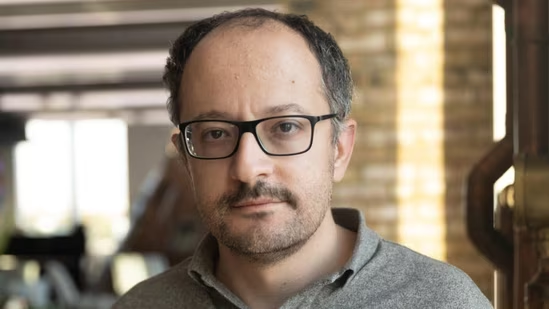
LONDON—Alex Gerko’s edge as a trader comes from a supercomputer powered by geothermal energy in Iceland.
Years before ChatGPT became a household name, his trading firm, XTX Markets, built an artificial-intelligence system aimed squarely at one goal: making money.
That bold bet on AI has made XTX one of the most profitable players in the secretive world of algorithmic trading and turned the 46-year-old Gerko into one of Britain’s wealthiest people, with a fortune estimated at $12 billion.
Now, he is doubling down. XTX is this year set to start operations at the first of five planned data centers in Finland, expanding the firm’s ability to crunch vast quantities of financial data and train models to forecast price moves.
XTX is building the $1 billion-plus complex itself, rather than renting computing power, the more typical approach in finance. The idea is to ensure XTX can keep training its models cheaply even as the AI boom gobbles up ever more data-center capacity worldwide.
The project is also aimed at establishing a wider moat around XTX’s business as rivals pursue their own AI-based strategies. Earlier this month, Jane Street invested $1 billion in CoreWeave and signed a $6 billion deal to use the company’s AI infrastructure. Other firms are also spending big on computing power to refine their quantitative-trading prowess.
It is a new arms race for a fiercely competitive industry. Years ago, electronic trading firms fought to build the fastest microwave networks so they could execute trades in milliseconds. Now, limited by physics from gaining meaningful new speed advantages, firms are fighting to be smarter.
Gerko was at the vanguard of the industry’s shift toward AI. He has long disparaged what he considers the wasteful, zero-sum speed race of high-frequency trading. XTX has lobbied for speed bumps—tiny delays to thwart ultrafast traders—angering some competitors.
“All these HFT firms…are trying to leapfrog each other by becoming faster and faster,” Gerko said in a 2019 discussion with students, a video of which was viewed by The Wall Street Journal. “We decided we’re just not a part of this game.”
Gerko often posts acerbic barbs on LinkedIn about XTX’s rivals, making him an unusually vocal figure in the hush-hush world of computerized traders.
Last year, after Indian regulators accused Jane Street of market manipulation, Gerko dissected the case in LinkedIn posts: “The whole thing appears to stink very badly,” he wrote. Jane Street has denied the allegations.
Born in Soviet-era Moscow, Gerko attended a school for gifted math students before earning his Ph.D. in mathematics. He began his career as a trader at Deutsche Bank.
Gerko moved to London in the early 2000s and founded XTX in 2015, naming the firm after a mathematical formula. He now holds a British passport. A critic of Vladimir Putin’s war in Ukraine, he renounced his Russian citizenship in 2022.
The next year, Gerko topped the Sunday Times’ annual ranking of Britain’s largest taxpayers. As a philanthropist, Gerko has backed astronomical research and math education.
One of his pet projects, the 1729 Maths School, is set to open in London in September. Geared toward mathematically gifted children, it is named after the Hardy-Ramanujan number, the smallest number that can be expressed as the sum of perfect cubes in different ways:
1,729 = 93 + 103 = 13 + 123
“I retained my interest in math education because this was the path from, let’s say, an underprivileged background to a very lucrative career,” Gerko told the Journal in 2023.
XTX is based in London’s so-called Knowledge Quarter, near tech companies such as Google and Meta Platforms. Its office features a replica of the Apollo 11 command module and an authentic Enigma encryption machine from 1943—the German device cracked by Allied codebreakers including celebrated British mathematician Alan Turing.
None of XTX’s employees are traders in the conventional sense, deciding what assets to buy to sell. Instead, they oversee an army of algorithms that rely on “deep learning” models that predict price moves that can be milliseconds, minutes or hours away.
Deep learning is a form of AI that uses layers of neural networks—computer programs that mimic structures in the brain—to solve complex problems.
Some XTX trades involve market making, the strategy of standing ready to either buy or sell an asset and collecting a spread between the bid and offer price. Other trades involve spotting deviations from standard market patterns and betting that prices will snap back to normal.
Overall, the firm trades an average of $250 billion daily across stocks, bonds, foreign exchange, derivatives and crypto. It recently expanded into electricity trading, people close to XTX said.
To train its models, the firm has amassed 25,000 AI chips, mostly from Nvidia. Its new Finland data center is the size of three football fields, while a second facility next door is largely built and set to go live in 2027. The site’s northern location helps keep systems from overheating.
“The approach they seem to be taking is kind of a big, all-in bet on deep learning,” said Agustin Lebron, senior researcher at EquiLibre Technologies, a trading firm in Prague.
Last year, revenue at XTX’s U.K. business climbed 44% to $5.3 billion, company filings show. Profit rose 33% to $2.3 billion. Those figures don’t include the firm’s Singapore unit, whose 2025 financials aren’t yet available, and which previously earned a comparable amount of revenue as the U.K. operations.
While competitors such as Citadel Securities and Jane Street make more money, XTX is leaner, with about 250 employees rather than thousands.
XTX doesn’t have outside investors, meaning profit flows to a small group of partners—above all Gerko, who owns at least 75% of the firm, filings show.
Former employees say Gerko is an exacting, hands-on manager. He is omnipresent on XTX’s Slack channels, where his avatar was previously a giant floating head from “Rick and Morty,” the animated science-fiction series, people familiar with the matter said.
More recently he changed it to Thanos, the cosmic supervillain from the “Avengers” movies.
Write to Alexander Osipovich at alexo@wsj.com