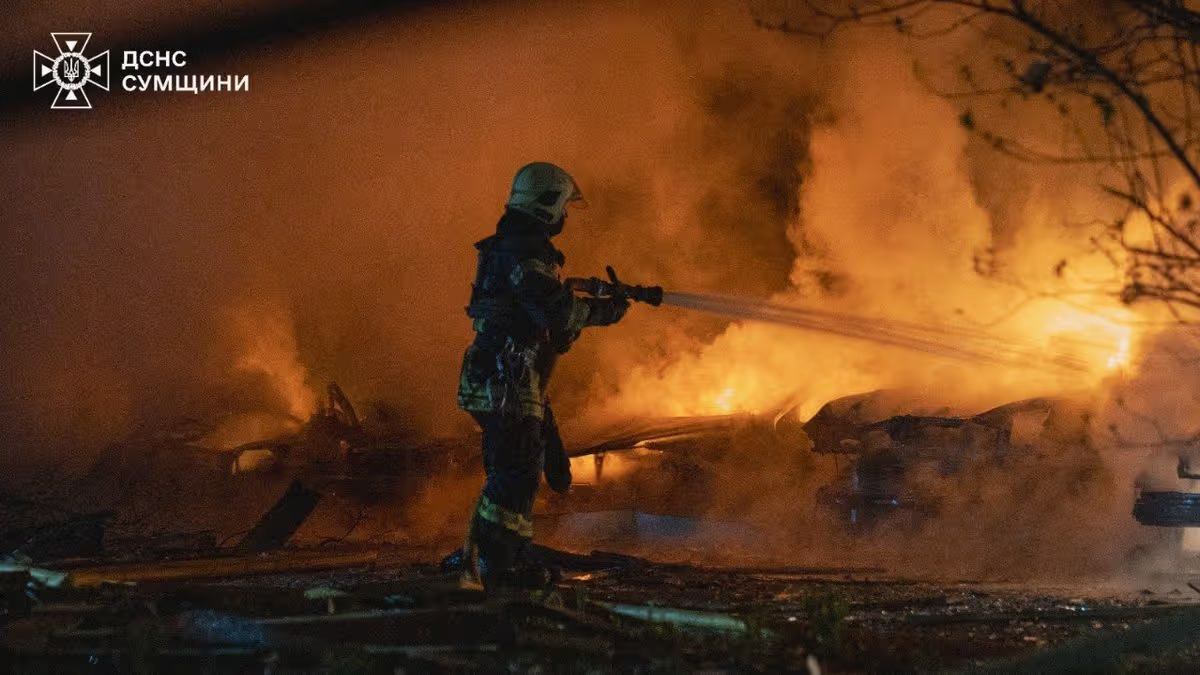
As Ukraine fights for survival against the Russian invasion its tech masterminds are developing devastating new drones – and the latest was inspired by a Brit fighting on the frontline
A British special forces operator has inspired one of Ukraine’s most sophisticated unmanned reconnaissance flying machines, as the frontline turns to deadly drone warfare.
And Ukraine is about to unleash the almost-silent SHADOX drone, a little over a pound in weight, and to be used by frontline covert reconnaissance troops against Russia.
Codenamed “Price,” the UK-born commando who is in Kyiv’s special forces helped Ukrainian-Estonian defence startup develop the SHADOX for the battlefield.
It costs just a few hundred pounds, travels ten yards per-second and performs short-range spying deployments or Kamikaze attacks aimed at killing Russian invasion troops.
Oleksandr Davydenko, CEO of Ukrainian-Estonian defence startup Black Forest Systems in Kyiv told the Mirror : “Unfortunately we were forced to build this technology.
“This is the nuclear weapon of the present day – it kills bad people, destroys buildings but it does not pollute anything. Absolutely it could win the war for us and we have to do this – we are doing this to protect our very existence and you have to understand that.
READ MORE: Robot wars come to Ukraine as unmanned vehicles take enemy position for first timeREAD MORE: Britain ‘likely’ to face Russian attack after warning with four targets named
“It was actually helped by a British guy who has become a friend of ours. He’s been fighting in Ukraine already for four years. I cannot tell you his name but his call-sign is “Price” and the idea came from him and then we developed it with our own special forces.
“I believe he was serving with the UK military before, and this was why he got here, because he was in the military. He has knowledge and understanding on what needs to be done. So he came here and and he’s still, he’s still a soldier here.
“It was he who was first to describe to us the exact problem we need to solve. And then we start working with special operation forces late 2025 we start working with them, and got much more insight of how the system should look and how it should work.” On a very basic level the drones need to weigh less, be more portable and to be more silent, with the capability of carrying a payload.
What is new about the SHADOX is that just half an hour of training can teach a soldier how to use it by plugging into smartphone technology.
Much of the componentry is secretive but it avoids months of training, is totally secure – and the drone can be left hovering in the air if an attack takes place.
It is also one of the stealthiest machines with no noise technology and it will be used by special forces and reconnaissance troops for short-range missions. Black Forest Systems is backed by Stockholm investment firm Front Ventures.
In the past year 80% of Russian casualties have been blown up by Ukrainian drones – a massive increase from just five per cent in the opening year of the full-scale invasion.
That compares with the first year of the war in 2022 during which 90% of casualties inflicted on Russian troops was done by artillery fire.
Sources told the Mirror a staggering 35,000 Russian troops have been killed by Ukrainian drones, every single attack recorded on film – and every death is being treated as data for the future AI weapons generation.
Oleksandr, one of Kyiv’s leading tech experts, told the Mirror: “Every single death has its own story, it is a piece of data that is being collected.”
Incredibly the date of drone attacks being collected will eventually be fed into a system to allow drone warfare to be fought almost independently of troops.
Asked if warfare can ever be fully automated and if it will save lives, Oleksandr said: “I don’t think so. Maybe in the future but we are not there- we are living reality and you need a person to take action.
“You need still need someone because drones are quite limited to what they can do, and you still need human to assess the situation, to do the decision making for our job.
“But the important thing is getting humans as far as possible from this front line. This saves lives. And for those who still need to go to the to those contact situations, we need to arm them with the best technology we can to mitigate the risk.
“I’m not a military tactician. I am just a tech guy who was building drones before the full scale invasion, and I start building drones for the military, because I do know how to build this.
“But the next step will be probably some level of automation. But I actually don’t believe that we will hop into full autonom. I’m not a huge believer in this, because I see that we are not still at this level of readiness of the drones themselves to be operated in huge swarms or in some autonomous scenarios.
“We will still need to go step by step. And maybe then in the future, we will think about real autonomy, but we still need to build a lot of technology for it.”
And grim artificial intelligence is already being gathered for future generations of military technology experts to develop the weapons of the future.
He adds: “Absolutely, we already do this. We do this in on the scale of a country. There is a new initiative during which Ukraine will share some information with our allies to develop new types of autonomy to exactly do what you mentioned, to train new types of AI to go and do that.
“It will be based on the data we already collected. We collected an extreme amount of data, you need to understand that almost every engagement that is officially counted, every engagement like 35,000 infant Russian infantry killed that we claim as official statistics, each of them has his own short video.
“So you need to understand that the main product probably of this war is not technology, because the technology is there. The main product of this war probably will be data, data with engagement, data with tactics.”
In one recent military exercise in Estonia just 15 Ukrainian drone experts destroyed three battalions of troops – well over 1,000 soldiers and among them there were 70 armoured vehicles.
Oleksandr adds: “Again, we have been forced to do this and I believe this technology is just the beginning. But it is this that will win us the war. I really believe this.”