Nature has evolved an extensive range of visual codes to allow individuals of one species to pass important messages to those of another. Brightly coloured skin? Potentially poisonous—do not eat. Thorny leaves? Not worth the effort—stay away. The message “Do not collide with this chair lift” has, however, proven harder to communicate.
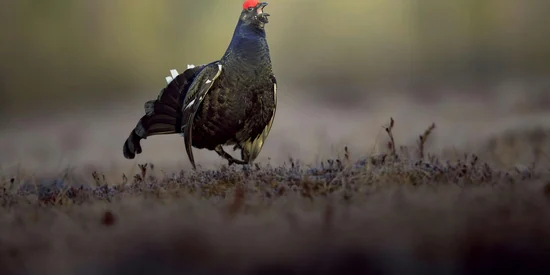
The black grouse is a bird with red patches of skin above its eyes that is abundant in Russia and Scandinavia. (PEXEL)
This state of affairs is especially unfortunate for black grouse, which have for decades been flying into chair-lift cables at Alpine ski resorts, often dying as a result. Twenty years of warning signs have failed to keep the birds away. New research published in Experimental Biology is revealing that most of these signs are in a colour the birds cannot easily see.
The black grouse is a bird with red patches of skin above its eyes that is abundant in Russia and Scandinavia. It also has a small subpopulation in the Alps, but it is getting smaller. An analysis from 2008 revealed that grouse numbers were 15% lower in the vicinity of ski lifts. This reinforced observations made at ski resorts that these birds frequently smacked into their cables.
To make these cables more visible, resorts adorned them with coloured markers 3.5 to 15 centimetres wide. Since the black grouse made up 70% of bird-cable collisions, and the assumption was that a bird with red on its head would be able to see that colour on its nearest and dearest, most markers were made red too. Collisions nonetheless continued. Puzzled by this, Marjorie Liénard at the University of Liège and independent sensory biologist Simon Potier decided to study the vision of captive-bred black grouse. They did this by placing them inside a black box with one clear wall, beyond which lay a screen on which different patterns were projected.
As birds cannot move their eyes nearly as much as mammals, they must move their heads to track moving objects. Dr Potier and his colleagues used this fact to remotely monitor the grouses’ head movements as various stripe patterns were moved across the screen. If the grouse turned their heads to track the stripes, he knew that the birds could see them. Separately, Dr Liénard and her team studied light-sensitive receptor proteins collected from the eye of a dead grouse to determine what colours it might be sensitive to.
The research revealed that the black grouse has poor vision. It can see contrast, but not as well as people can. And although it can see yellow, green, blue, purple and part of the ultraviolet spectrum, it does not see red well. Hence the collisions. The researchers’ findings at last provide the solution that ski resorts have been looking for. Warning markers ought to present strongly contrasting pairs of colour, like purple and yellow or black and white, rather than being monochrome. The contrast markers must also be made larger (no less than 14 centimetres across) and more widespread (at least one every 16 metres) if they are to deter the animals.
As for why a bird that struggles to see red nonetheless bears the colour, Dr Liénard has an answer. She explains that in addition to reflecting red light, those patches also reflect ultraviolet light that people cannot see but grouse can. The collisions are a case of inter-species communication gone wrong.
Curious about the world? To enjoy our mind-expanding science coverage, sign up to Simply Science, our weekly subscriber-only newsletter.