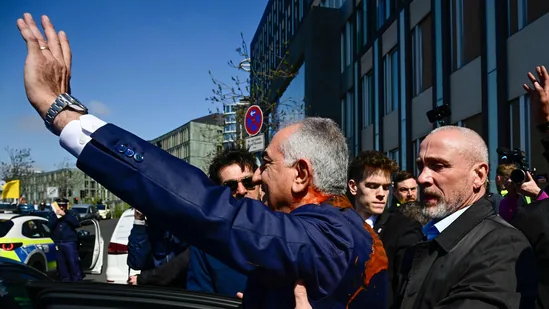
A man hurled red liquid at Iran’s exiled prince Reza Pahlavi outside a press venue in Germany shortly after he criticised the US–Iran ceasefire during a media briefing.
The incident took place as Pahlavi exited Germany’s federal press conference building after addressing reporters.
Despite the disruption, he waved to supporters before getting into a waiting car and leaving the scene, according to the Associated Press.
He appeared unhurt, with the liquid coating the back of his blazer and neck, and again waved to supporters before entering a car that drove away. Police said the substance appeared to be tomato juice, the report added.
The alleged perpetrator, whose name was not released in line with German privacy rules, was immediately detained by police.
Follow here for live updates on US-Iran war
What was the event?
Pahlavi was not invited to meet any government representatives during his visit to Berlin. Speaking on Thursday, he argued that the ceasefire agreement assumes the Iranian government’s behaviour will change and will all of a sudden “become pragmatists.”
“I don’t see that happening,” he said. “I’m not saying that diplomacy should not be given a chance, but I think diplomacy has been given enough chance.”
Pahlavi, who is positioning himself for a potential return to power if the Shiite theocracy falls, has backed US-Israeli military intervention in the Middle East.
Also Read | Trump extends US-Iran ceasefire; Iranian forces fire on 3 ships in Strait of Hormuz
Pahlavi’s claim to power
Reza Pahlavi, who has spent most of his life in exile, has emerged as a potential opposition figure following anti-government protests that erupted in Tehran and other Iranian cities last year.
However, Iran’s opposition remains deeply fragmented, and many Western governments have been cautious about backing him, with uncertainty over the level of support he commands nearly half a century after his father’s rule was overthrown.
European countries, including Germany, have ruled out joining the United States and Israel, which opened the war on February 28 with a wave of airstrikes that killed Iran’s Supreme Leader, Ali Khamenei.
Pahlavi’s visit to Germany comes as efforts to end the conflict appear to have stalled, with Iran and the United States both maintaining blockades of the strategic Strait of Hormuz, a key route for roughly a fifth of the world’s oil supply.
He said it was a shame that Chancellor Friedrich Merz’s government had not offered him a meeting during his visit.
In Berlin, he also called on European countries to do more to support Iranians fighting for democracy. He claimed that 19 political prisoners were executed by Iranian authorities in the past two weeks and that another 20 people have been sentenced to death.
“Will the free world do something, or watch the slaughter in silence?” Pahlavi said.