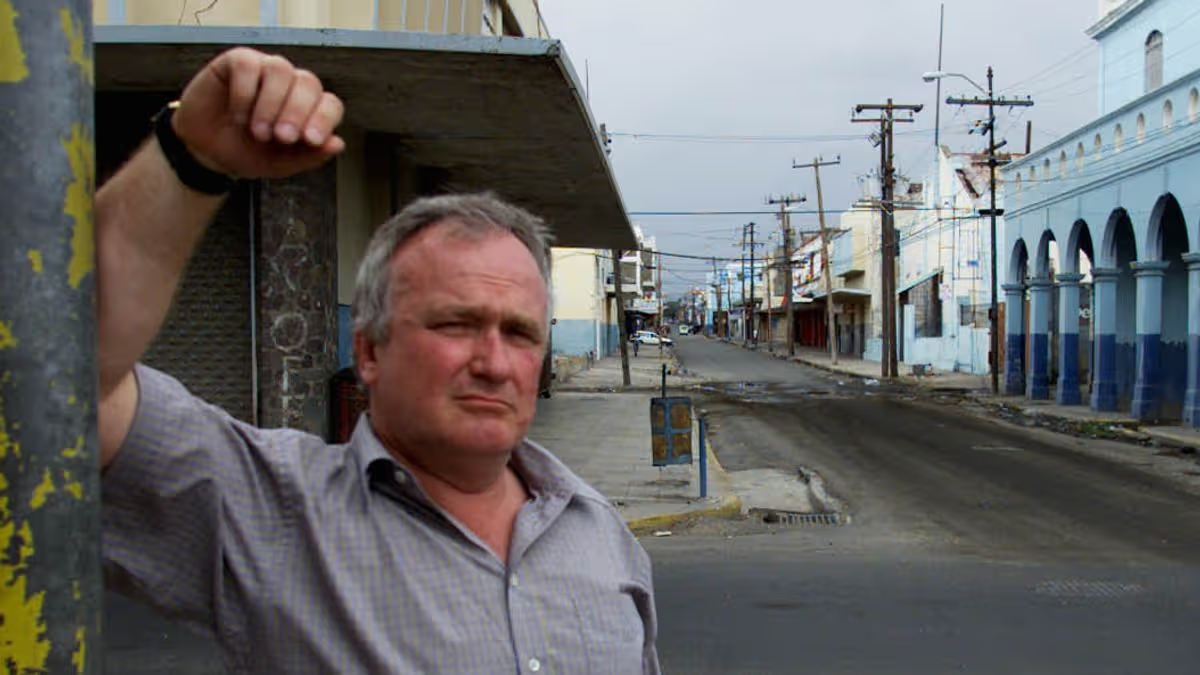
Jeff Edwards was Chief Crime Correspondent on the Daily Mirror, covering robbery, narcotics, burglary, sex crimes, people trafficking, kidnap and extortion and more
It was my first day as the Chief Crime Correspondent on the Daily Mirror and I was keen to make an impact on my new bosses. It was a job I’d always wanted. I’d been the ‘crime man’ on several national papers already in my career. But I had always admired the Mirror’s brand of hard hitting and campaigning journalism and when the chance came to join them in early 1993, I jumped at it.
Like any reporter starting a new job, I wanted to get off to a flying start. But this first Monday in late February in the news room had been quiet on my front. About 6.30 pm, I was thinking about heading off to meet some police contacts in a pub near Scotland Yard, when my pager, which was clipped to my trouser belt, began to vibrate.
For anybody under about 50, it is important to understand there once was a world without mobile phones. I wasn’t issued my first one by the Mirror until later in 1993. But most people back then had a pager and I will never forget the message which appeared that evening, because in some ways, it changed my life. It read: ”If you want to learn something to your advantage, call me urgently.” It was from a police detective who I’d known for many years.
READ MORE: Mum-of-five goes on surprise date night before the unthinkable happens
I called him and he said: “I have just been with some colleagues from the Homicide Squad to a house in north west London. In the garage we found the bodies of two men stuffed into cardboard boxes. They’ve both been shot in the head several times. Apparently they are Russians.” That is exactly how he phrased it. I can’t remember what my first question was; Who? What? Why? What the heck? My friend had no more information. But he did give me the private number of another friendly detective, who he said would have more answers.
I called this officer. I told him what I had just heard. He replied: ”Ever heard of a place called Chechnya?” I had not. I would guess most people in the UK hadn’t either. Chechnya was a small province rarely visited by outsiders which had made up the Union of Soviet Socialist Republics, better known as the USSR. By the early 1990s, the collapse of communism and the end of the ‘cold war’ meant the USSR and the whole of the so called ‘Eastern bloc’ was spinning apart. Nations which had been tightly controlled for years from Moscow were gaining freedom and independence. One was Chechnya.
My contact told me how a delegation of four Chechens, calling themselves ‘diplomats,’ arrived in Britain a couple of weeks before. They’d rented a very expensive flat in a mansion block near Regents Park and a house at Harrow. Tasked with setting up their nation’s first ever embassy in the UK, they had arrived carrying about $1million cash. But two of the group went off the rails immediately and blew most of the money on casino gambling, hookers and cocaine. There was a furious row and the others had ‘executed’ their colleagues with Russian made pistols. We were still in a world where the first things most of us thought about when Russia was mentioned was spies, the KGB, the Kremlin and James Bond films.
It was getting late in the day. I thanked my mate from homicide, hung up and hurried over to the Daily Mirror news desk where my direct line manager, news editor Phil Mellor was just putting his coat on to go home. I told him: “Phil, listen to this. This has come from reliable police contacts and it’s all 100% and exclusive to us. Phil, a bluff Mancunian, asked one question: ”Any KGB involvement?”
My response was: “Yes, bound to be.” I turned out to be spot on. I got writing. There were gaps in the story, because the information was so hot. It was clear to me even the police only knew less than half the facts at that stage. I wrote furiously for an hour and submitted my story. The next day the world woke up to my story in the Daily Mirror. Two men, both mysterious characters, were arrested for those murders.
What I had no way of knowing was that a year later those events, which had enabled me to be an instant hit in my new job, would explode into headlines a second time. It transpired that one of the men who shot his colleagues was married to a British woman, Alison Ponting, a journalist for the BBC World Service on their Russian desk, at Bush House in The Strand.
She had met him while studying Russian in Moscow. In total secrecy, for her own safety, the police moved her to stay with her sister, Karen Reed, 33, at her house on a private estate in Woking, Surrey. The following year, on April 30 1994, Alison went out for the evening, but her sister was at home when the doorbell rang. When she answered she was shot five times in the head and body at point blank range and died instantly.
Clearly the intended victim was Alison. The bullets used were specially made with hollow points containing mercury. Designed to explode inside the victim’s body, they were a classic assassin’s choice, straight from the pages of a Cold War spy novel. The case remains unsolved 33 years later.
There was more to come. A phial of deadly snake venom was delivered to one of the Chechen killers in his British jail cell with an invitation to commit suicide. The KGB man who delivered it was gunned down on a Moscow street a few months later. Everyone involved, both killers and their victims, was mixed up with the KGB one way or another.
In a career spanning nearly 45 years, I have reported on well over 1,000 murders. Which is why, years after I retired from the Mirror I was persuaded to write my book ‘The Murder Guy’. Because the body on the floor – shot, stabbed, or strangled to death – is always only part of the story. It’s the intrigue, the events leading up to it and the mechanics of the police investigation afterwards.
It wasn’t all murder of course. I dealt with robbery, narcotics, burglary, sex crimes, people trafficking, kidnap and extortion; art theft, fraud, and so much more. Terrorism was a huge part of my brief. I reported on over 200 attacks by the IRA on mainland Britain between the 1970s and the 1990s. There were shootings involving Israelis, Iraqis, Turkish Kurds, and Sri Lankan Tamils.
And later, mostly notably on July 7, 2005, with the London tube bombings, terrorism inspired by Islam reared its head. Britain, during my career, became a crossroads of terrorism. One of the most memorable incidents I covered was the horrific bombing at Omagh, in Northern Ireland in 1998, which left over 30 innocent victims dead.
Part of my job was to drive south to the Republic of Ireland with a colleague and confront the IRA man who set up the slaughter. But there were no horrible deaths in what came to be my greatest journalistic coup ever. Over many years I had forged friendships with members of Scotland Yard’s legendary ‘Flying Squad’. It enabled me to be on board with them at London’s Heathrow airport in 2004, when they sprung their trap to net a gang of robbers raiding a warehouse containing a vast consignment of cash and gold bullion worth a mind boggling £200million.
The iconic picture of bandit Lee Cotton being unmasked, as he sat propped against a wooden packing case of gold ingots, won my colleague Roger Allen the ‘News Picture’ of the year prize at an annual industry awards the following year and my story gained the Daily Mirror an award in the ‘Scoop of the Year’ category.
*The Murder Guy by Jeff Edwards (Mirror Books, £10.99) is on sale April 23rd. Preorder on Amazon.
READ MORE: Mum-of-one’s car message from beyond the grave solves grim murder riddle