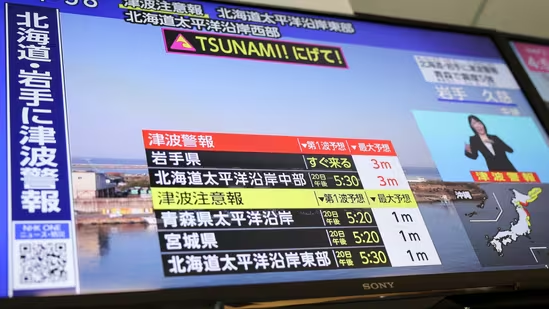

A powerful 7.4-magnitude earthquake struck northern Japan on Monday, according to national broadcaster NHK, prompting tsunami warnings across coastal regions. Authorities have cautioned that waves as high as 3 metres could reach parts of Iwate Prefecture and Hokkaido, urging residents to move to higher ground. Emergency services are on alert as officials assess potential damage and monitor the evolving situation.
In its advisory, Japan said tsunami waves were already approaching coastal areas and could strike repeatedly, stressing that people must evacuate without delay and remain in safe locations until all warnings are lifted.
It also cautioned that waves could arrive earlier or later than forecast and may be higher than expected, while advising those in affected regions to stay away from coasts and river mouths that could overflow.
Japan is one of the world’s most seismically active countries, sitting on top of four major tectonic plates along the western edge of the Pacific “Ring of Fire”.
The archipelago, home to around 125 million people, typically experiences around 1,500 jolts every year and accounts for about 18 percent of the world’s earthquakes.
The vast majority are mild, although the damage they cause varies according to their location and the depth below the Earth’s surface at which they strike.
In 2011, a magnitude-9.0 quake triggered a tsunami that left 18,500 people dead or missing and caused a devastating meltdown at the Fukushima nuclear plant.