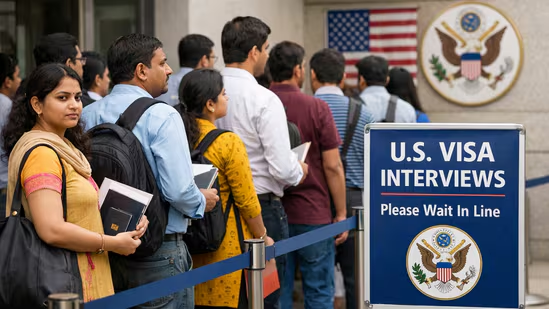
The rejection rates for US student visas among Indian applicants have surged to 61%, marking the highest level in several years, due to increased policy restrictions and more rigorous vetting processes. Experts caution that escalating costs, uncertainties in the job market, and inaccurate return on investment assessments are influencing the decisions of Indian students regarding overseas education.
Also Read: US expands visa restriction policy amid Trump crackdown, targets families of those acting for…
Here’s what the new report on visa refusal says
According to Shorelight’s report titled ‘Beyond the Interview: A Decade of Student Visa Denials and What Comes Next’, the rate of Indian student visa refusals in the US rose from 53% to 61% within a single year, positioning India as one of the most severely affected countries.
This situation is particularly striking when compared to the 9% refusal rate for European applicants, with neighboring South Asian countries such as Nepal, Bangladesh, and Pakistan also experiencing significant increases. Analysts observe that this trend is indicative of a decade-long tightening that disproportionately impacts nations in the Global South.
Reason behind rejections of Indian student visas
- The US implements more rigorous screening processes, which include a compulsory examination of applicants’ online activities and social media accounts
- All categories of F, M, and J visas are included in this broadened vetting process
- The US positions visas as a privilege, indicating a structural rather than a temporary tightening of regulations
- Policy-driven scrutiny impacts various regions, with South Asia and Africa being the most significantly affected.
Experts warning
Experts warn that several Indian students tend to overvalue the return on investment associated with studying abroad, believing that prestigious universities ensure lucrative employment opportunities. In truth, fewer than fifty percent obtain pertinent full-time positions right away, and unforeseen expenses such as living costs, currency exchange rate variations, and extended job searches diminish returns.
As visa regulations evolve and job markets remain unpredictable, students are progressively prioritizing long-term benefits over mere acceptance.
Indian students enrolments in US
Indian students constitute nearly 30% of all international enrolments in the US and represent a significant portion of graduate-level STEM programs. They are responsible for approximately 75% of H-1B visa holders in the technology industry and nearly half of STEM-OPT participants, as reported by Y-axis. According to the IIE Open Doors report, Indian students account for over 70% of enrolments in certain advanced STEM programs.
The statistics are already indicating the pressure. Enrolment of Indian students in US graduate programs decreased by 9.5% in the 2024/25 academic year, as per the Institute of International Education. Parliamentary data reveals that the number of Indian students heading to the US has declined by about 28% over the past year.
The total of Indian students in the US dropped from 378,787 in February 2025 to 352,644 in February 2026. Overall enrolment patterns indicate a reduction of nearly 45% in specific segments.
When this pipeline diminishes, the repercussions are not unilateral. American universities could potentially forfeit between $3 billion and $8.6 billion in revenue, while research output diminishes and laboratory capacity declines.