
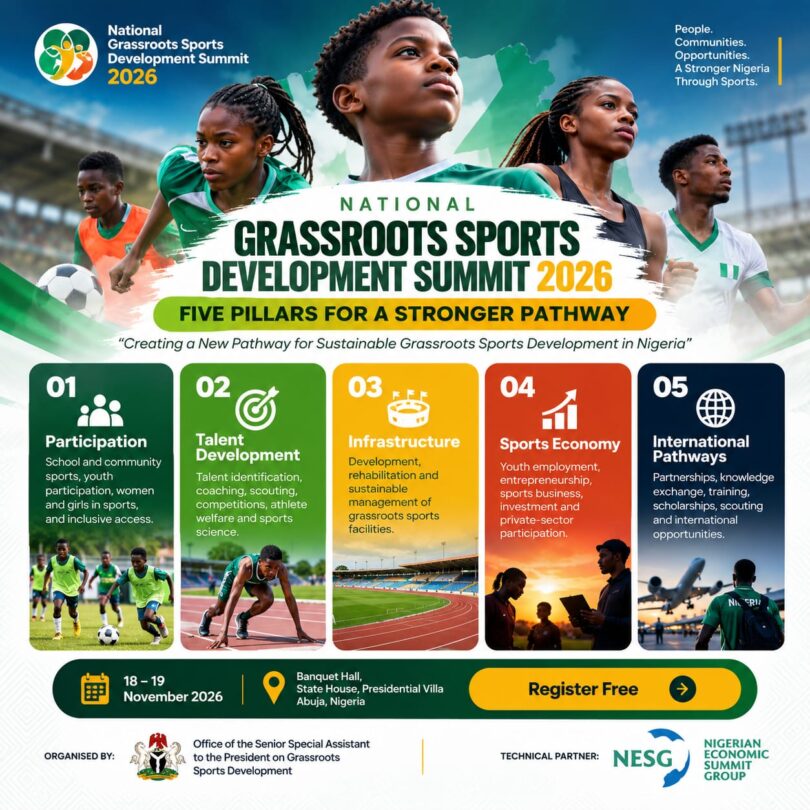
As the countdown continues to the National Grassroots Sports Development Summit 2026, organisers have identified five strategic pillars that will guide discussions towards building a sustainable sporting future for Nigeria.
The Summit, scheduled for November 18–19, 2026, at the Banquet Hall, State House, Presidential Villa, Abuja, will focus on Participation, Talent Development, Infrastructure, Sports Economy and International Pathways.
Read Also: Countdown to Grassroots Sports Summit: Organisers Unveil Official Website, Strengthen Technical Partnership With NESG
Organised by the Office of the Senior Special Assistant to the President on Grassroots Sports Development, Hon. Adeyinka Anthony Adeboye, the two-day gathering has the theme, “Creating a New Pathway for Sustainable Grassroots Sports Development.”
The five pillars reflect a deliberate effort to move Nigerian sports beyond occasional talent discovery towards an integrated system that creates opportunities, nurtures athletes and generates lasting economic and social benefits.
The first pillar, Participation, will examine how to expand access to sports through schools and communities, encourage youth involvement, promote women and girls in sports, and eliminate barriers preventing talented Nigerians from participating.
Talent Development, the second pillar, will address scouting, coaching, structured competitions, athlete welfare and sports science, with emphasis on establishing clear pathways from grassroots participation to elite performance.
The third pillar, Infrastructure, will focus on developing, rehabilitating and sustainably managing sports facilities, particularly at community and local government levels, where limited access to suitable facilities continues to restrict sporting opportunities.
Under the fourth pillar, Sports Economy, stakeholders will explore how grassroots sports can stimulate youth employment, entrepreneurship, private-sector investment and sustainable sports businesses.
The fifth pillar, International Pathways, will examine opportunities for partnerships, technical exchanges, scholarships, scouting, international training and exposure for promising Nigerian athletes.
Speaking on the significance of the framework, Adeboye stressed that Nigeria must adopt a comprehensive approach to sports development rather than treating talent identification, infrastructure and funding as separate challenges.
“You cannot talk about discovering champions without providing facilities, qualified coaches, regular competitions and opportunities for progression. These five pillars are interconnected, and that is why the Summit will examine them as essential components of one sustainable development system,” he stated.
The Presidential aide explained that the ultimate objective is to establish a practical framework that connects schools, communities, local governments, sports federations, educational institutions and private-sector organisations.
“Our ambition is to create a Nigeria where a talented child, regardless of location or background, can participate in sports, receive proper training and have a realistic pathway to national and international excellence,” Adeboye added.
The Nigerian Economic Summit Group (NESG), engaged as technical partner, is expected to support the policy-focused discussions and development of actionable recommendations.
With 20 days remaining before the Summit, organisers are encouraging sports stakeholders, development partners, corporate organisations and interested Nigerians to participate in shaping the proposed roadmap.
Registration is free through the Summit website /https://grass-root-sports.vercel.app/
The Summit is expected to conclude with recommendations aimed at strengthening grassroots sports structures, expanding opportunities for young Nigerians and positioning sports as a more significant contributor to national development.