KILMARNOCK: FRANK BEATTIE
By Eddie Isaac
In 1965, an ecstatic Willie Waddell watched his players perform a lap of honour after winning the league title, the only Kilmarnock side ever to do so.
Asked to name a standout performer, he breathlessly told reporters: ‘I have a team without an individual star, they’re all stars.’
Fast forward 60 years and his words could have summed up the task of choosing the club’s greatest ever.
The list of men who have given their all for the Rugby Park outfit over the years is as solid and lengthy as their strengths and talents were varied. How do you single one out?
If it’s goalscorers that take your fancy, have there been any as prolific as Kris Boyd – or his fellow Ayrshireman Willie Culley almost 80 years before him?
Flair players? Kilmarnock fans who watched Alexei Eremenko in action over two spells will never forget the mesmerising talents of the Finnish playmaker.
Local heroes? How about Ray Montgomerie, the skipper who led the club to their 1997 Scottish Cup triumph at the peak of a career that saw him make more than 300 appearances for Killie.
And has anyone arguably done more for the club than Celtic legend Tommy Burns who, as a midfielder, helped them climb out of their near perilous state in the third tier before leading them back to the top-flight as player-manager?
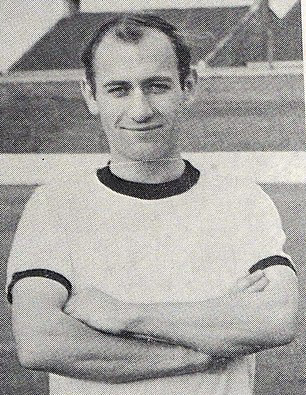
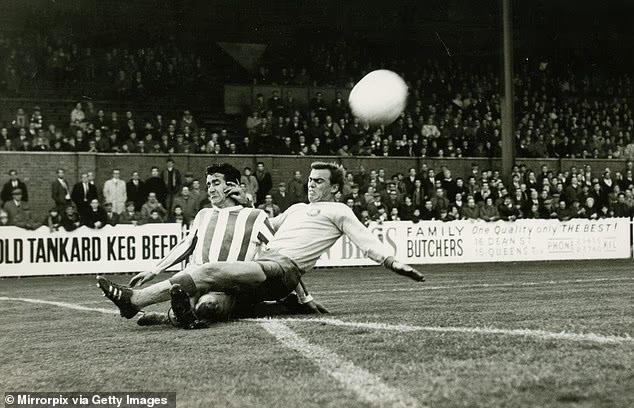
Frank Beattie is tackled by Manfred Geisler of Locomotive Leipzig during a Fairs Cup match in 1967
All of which leads us back to that glorious final day of the league season in 1965 when Waddell’s Kilmarnock defeated Hearts 2-0 at Tynecastle.
It saw them pip the Gorgie side to the title by a goal average of 0.042 after finishing level on 50 points.
Amid the euphoria of that day, Killie skipper Frank Beattie will also have been only too aware of the anguish being suffered by his vanquished opponents.
Part of a superb Rugby Park side who had nonetheless seemed destined to always be the bridesmaid, he had finished a runner-up in the league on four occasions and a losing finalist in the Scottish Cup in 1960, and League Cup in 1960-61 and 1962-63.
That latter occasion was a particularly sore one, Beattie heading home what he thought was an equaliser against Hearts in the final seconds only for referee Tiny Wharton to bizarrely rule it out for a handball that no one else could see.
Now, two years on, it was Killie’s turn to savour the glory with the league title, and no one summed up their grit, determination and never-say-die attitude better than coal miner Beattie as he raised the trophy above his head.
‘Frank Beattie was a legend in his own time,’ said David Sneddon, who scored the first goal that day after converting a cross from another Killie hero Tommy McLean. ‘As a man, Frank was a gem, as straight as a die. As a team-mate he was great to have behind you, a rock.
‘He was a real leader. He was the captain all over the field yet never neglected his job of marshalling the defence.’
In a one-club career spanning 19 years, Beattie made more than 600 appearances, including Killie’s most famous European night in 1964 when they recovered from a 3-0 defeat in the first leg of a Fairs Cup tie with the mighty Eintracht Frankfurt to beat them 5-1 in the return at Rugby Park.
His bravery would be summed up by his eventual return from what looked like a career-ending leg break at Celtic Park, one which was so horrendous that Jock Stein insisted on accompanying him from the field as he was stretchered off.
Killie’s heroes are numerous, but Beattie was always a standout, and his claim to be their greatest ever was cemented when a stand was named in his honour at Rugby Park in 2010.
LIVINGSTON: SCOTT PITTMAN
By Eddie Isaac
Has anyone characterised Livingston’s uncanny ability to survive – and occasionally thrive – in Scottish football over the years better than Scott Pittman?
The club formerly known as Ferranti Thistle and then Meadowbank Thistle drew as many suspicious glances as admiring ones when the latter outfit suddenly relocated 20 miles west from Edinburgh to Livingston in 1995 and were rebranded under the town’s name.
Flush with new cash, their rise was meteoric: winning the Third Division title at their first attempt; securing promotion to the SPL in 2001; qualifying for the UEFA Cup in their maiden season in the top flight after finishing third behind the Old Firm; and lifting the League Cup in 2004.
Some of the men who contributed to those glory years like David Fernandez, Stuart Lovell and Marvin Andrews duly staked their claims as candidates for the title of the club’s greatest player of all time.

Scott Pittman has proved he is the man for big occasions at Livingston
The bubble quickly burst, though, as Livi entered administration just weeks before that Hampden triumph against Hibs.
Since then, of course, the Lions have continued to go up and down, with promotions followed by relegations – and even a demotion to the Third Division following a further financial meltdown.
Despite all the trials and tribulations, the club have somehow prevailed, with players like Pittman providing the strength and character required to keep them punching above their weight when star names were no longer around.
After the disappointment of being released as a teenager by Hamilton Accies, he re-learned his trade in the hard-knock school of the Juniors with Broxburn Athletic and Bo’ness United before joining Livingston in 2015.
The team were relegated from the Championship in his first season, but the attacking midfielder came into his own the following campaign, playing a pivotal role in their capture of the League One title and hitting a crucial volley in the victory over Alloa that secured it.
Successive promotions ensued as Livi made their long-awaited return to the top flight in 2018, Pittman scoring again in their victories over Dundee United and Partick Thistle in the Premiership play-off semi-final and final.
Any doubts about whether he could cut it in the big time were dispelled as he became an established Premiership midfielder over the next five seasons, including a prized sixth-placed finish in 2020-21.
The supporters knew they had a player on their hands, and a local hero to boot; one who could read the game, who never stopped running, and could pop up with a goal or two when needed.
It was apt that, on the day he became the club’s record top-flight appearance holder in April 2022 – taking over from Oscar Rubio with 124 matches to his name – he should find the net in a 1-0 victory over visitors Hibs.
The goal was so typical, too, of a player fans had grown to love and rely on. It showcased his wonderful ability to know just the right time to make runs forward, finishing off a wonderful pass-and-move goal involving Jason Holt and Morgan Boyes.
Relegation would follow in season 2023-24, followed by a short-lived return to the top flight last season.
As they bid to escape from the Championship again, Livingston fans will be praying for more players to emerge of Pittman’s calibre, or even a fraction of it.
Is he their GOAT? The club have had their pick. As well as the heroes who took Livi into the top flight for the first time at the start of the century, the roll of honour at the club has included talents as diverse as Keaghan Jacobs, Robert Snodgrass and Lyndon Dykes.
But have supporters ever witnessed a player who has given his all for the club quite like Pittman over this last decade or so? Is someone emerging who will match his record of well over 400 matches for the team?
Truthfully, they may struggle to see a man as dedicated to the cause again.
MONTROSE: LES BARR
By Paul Forsyth
Legends are prone to grow with the passage of time, as are their prodigious feats, which is why Les Barr’s famous strike for Montrose in a League Cup quarter-final against Hibs has lengthened as the years have passed.
By most accounts, he was inside his own half (some friends later nicknamed him ’75 yards’) when his shot/clearance on September 24 1975 beat goalkeeper Jim McArthur and knocked Eddie Turnbull’s side out of the competition.
According to some others, his contribution to the Angus side’s seismic 3-1 victory at Links Park could be traced to nearby Wellington Street or perhaps even the tidal basin across the A92.
Whatever the distance, it was a shot heard round the Scottish football world. So much so that Barr’s brother, Charlie, is said to have been arrested for invading the pitch in celebration.
Only the week before, Hibs had beaten Liverpool in the UEFA Cup, but here they were, being booted out of the League Cup by a part-time club from the division below.

Montrose fans loved Les Barr for his nimble feet and voracious work ethic
Montrose were cup specialists, though. In the semi-final against Rangers at Hampden, Barr’s 44th-minute penalty gave them a shock half-time lead. Although they conceded five after the interval, it had been a heroic effort.
There have been some ‘greats’ in the Montrose history books, from all-time top scorer Bobby Livingstone to long-serving goalkeeper David Larter, but Barr sprinkled some magic in among the stats with a starring role in the club’s 1970s heyday.
What times these were for Montrose who were third in the second tier – still their highest finish on the league ladder – at the end of that Hibs-conquering season. They also reached the quarter-finals of the Scottish Cup, coming within 90 seconds of knocking out Hearts, who had Graham Shaw’s late equaliser to thank for sparing them humiliation.
That 2-2 draw was followed by a pair of replays, both of which needed extra time before Hearts went through. Barr scored from the spot in the second instalment of an epic trilogy that denied Montrose a winnable semi-final against Dumbarton and a potential place in the European Cup-Winners’ Cup.
Barr was at the heart of those halcyon days. A strong, committed right-back, he had a sleight of foot that is remembered by some as the ‘Les Barr shuffle’ and a work ethic that made him a stalwart of the club between 1971 and 1989.
In two lengthy spells, separated by a four-year stint with Dundee, Barr played 500 times for Montrose. He held the club’s all-time appearance record until last season, when Terry Masson eclipsed his total.
His achievements also included a championship medal, earned when Montrose won the 1985 Second Division, their first-ever league title. When he no longer played, Barr had short spells as reserve-team coach and assistant manager before later being inducted into the club’s hall of fame.
The lad who was signed from Stobswell juniors in 1971 made a little go a long, long way, not least on that famous night when Hibs came to town.
MOTHERWELL: DAVIE COOPER
By Eddie Isaac
When the Graeme Souness revolution exploded into life at Rangers, not many would have expected the benefits to extend beyond the boundaries of Govan.
Try telling that to the Motherwell fans who rubbed their eyes in disbelief one August morning in 1989 when it emerged that Davie Cooper had joined their club from Ibrox for £50,000.
So how come this unexpected stardust was being sprinkled on Fir Park?
Well, to cut a long story short, even a magician like Cooper had discovered the first-team starts he once took for granted were disappearing as quickly as the expensive new recruits were arriving en masse at his beloved Rangers.
Not content with sitting on the bench, he still felt he could do a job elsewhere at the age of 33. Some remained to be convinced, thought it might just be a convenient place to go out to pasture. It says much for the impact he would make in the claret and amber that Souness later admitted letting him go was one of his biggest mistakes.
‘I didn’t want to sell him but he insisted he wanted to play every week and I couldn’t guarantee him that,’ said Souness. ‘I reluctantly sold him and I shouldn’t have done that.’
Cooper’s debut in a League Cup tie for Tommy McLean’s side against Kilmarnock was instructive. After giving Motherwell fans a salute that seemed to say: ‘I’m one of you now,’ he completely dazzled them by setting up three goals in a 4-1 win.

Silky winger Davie Cooper had a magnificent Indian summer at Motherwell
He had started as he meant to go on.
A love affair was born as one of Scottish football’s finest wingers thrived on a new challenge that had clearly put fire in his belly. The left foot, the feints, the flicks, the astonishing free-kicks, the passes that no one else could see; they were all still present and correct.
Cooper’s natural football brain would eventually lead to a more central role for the Steelmen, allowing him to dictate play like never before in his career. No wonder Souness was privately kicking himself.
Motherwell would be royally entertained for another five years as Cooper played more than 150 games and scored 17 goals, including being part of the team who lifted the club’s first trophy in 39 years when they beat Dundee United in the 1991 Scottish Cup final.
Some of the heroes who played alongside him that day, including Tom Boyd, Phil O’Donnell, Dougie Arnott and supersub Stevie Kirk, could lay their own claim to being the Lanarkshire side’s greatest ever player.
Going further back, Joe Wark, Willie Pettigrew, Andy Paton, Hughie Ferguson and George Stevenson could do likewise.
But most fans will admit that Cooper’s arrival and his contribution to the cause felt different somehow, like one of those moments when the planets aligned in their club’s favour.
A gift from the gods? That might be giving Souness more credit than he deserved, but it’s not far from the truth.
PARTICK THISTLE: ALAN ROUGH
By Paul Forsyth
He may have been laid-back, slightly unorthodox and the butt of a few jokes south of the Border, but when it comes to service, silverware and international recognition, Alan Rough is an unbeatable figure in Partick Thistle’s history. In what might be described as a gloveless marriage, the goalkeeper who liked to play with his bare hands dedicated 13 years of his career to the Firhill club, won several trophies and set all sorts of records in the process.
For lifting the League Cup alone, Rough has legendary status down Maryhill way. The entire team have a place in the club’s Hall of Fame thanks to that shock 4-1 victory over Jock Stein’s Celtic in 1971, which earned Thistle only their second major trophy. Alex Rae, Bobby Lawrie, Denis McQuade and Jimmy Bone are remembered for scoring the goals in a stunning first half, but 19-year-old Rough was no less heroic when their opponents tried to stage a Hampden comeback.

Alan Rough lifts the League Cup for Partick Thistle back in 1971
It was the highlight of a Thistle career notable also for its eye-popping statistics. Between joining them in 1969 and leaving them for Hibs in 1982, Rough made a club-record 631 appearances. In those games, he kept 191 clean sheets, another unmatched total. He also happens to be their most-capped player, with 53 Scotland appearances, all but two of which were while he was at Partick.
With an acrobatic save that denied Wales’ John Toshack in a winner-takes-all World Cup qualifier at Anfield, Rough played a huge part in Scotland’s qualification for Argentina 78. He was the country’s goalkeeper in all three of their matches there, as he was at Spain 82. He also travelled to the 1986 World Cup in Mexico, this time as back-up for Jim Leighton and Andy Goram.
As well as lifting the League Cup, Rough twice won promotion as champions with Thistle and twice won the Home International Championship with Scotland. He didn’t have the goals of Willie Sharp or the grace of Alan Hansen, but he was the Scottish Football Writers’ Player of the Year in 1981 and Thistle were lucky to have him for so long.
Perhaps blessed with a sense of perspective born of a boyhood accident in which he nearly lost an arm, Rough would later say he never yearned for money or a big move south. It was enough for him to be a Partick Thistle player, standing in the tunnel at Wembley alongside Kevin Keegan or Emlyn Hughes. He was appointed an MBE in the 2022 Birthday Honours list for his services to football and to charity in Scotland.
Agree or disagree? Get in touch at [email protected] and let us know what you think
Part Eight features Rangers, Ross County, St Johnstone and St Mirren