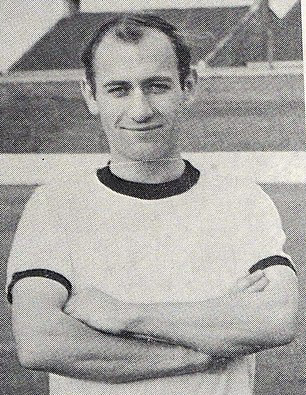
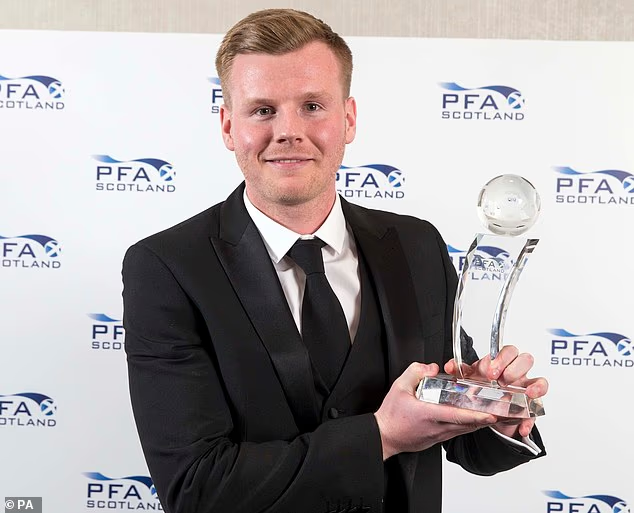
EDINBURGH CITY: BLAIR HENDERSON
By Alan Hendry
When looking for Edinburgh City’s greatest player, it feels harsh to overlook the claim of record appearance holder Dougie Gair, the talismanic midfielder who led the Meadowbank side to back-to-back Lowland League titles in the 2010s.
Unfortunately for Dougie, our search for Citizen Goat is limited to Edinburgh’s time in the SPFL, even though it was his play-off goal against East Stirlingshire in 2016 that got them to the Promised Land.
There has been a sprinkling of star quality turning out for City in their ten years in the SPFL, whether it be young guns on loan from bigger clubs like Ryan Porteous in 2016-17 or older pros winding down at the tail end of their career, like Craig Beattie and Derek Riordan – who at one point combined as a wily strike duo for the club.
Former Hibs phenomenon Riordan’s career is a cautionary tale of incredible talent unfulfilled and he joined City for a short spell in 2017, claiming he had to get back into football because he was sick of watching Jeff Stelling’s Soccer Saturday!
Blair Henderson was named League Two Player of the Year for season 2018-19
‘I’ve been sitting on so many Saturdays, sitting in the house watching Soccer Saturday – bored silly, basically!’ said the striker, who scored three goals in his seven appearances.
Porteous would go on to play for Scotland at Euro 2024 (for 45 minutes anyway) as well as a strong club career so far with Hibs, Watford and Los Angeles FC.
Around Meadowbank, though, he is famous for scoring in City’s first ever league win (against Annan Athletic) in November 2016.
Club stalwart Ouzy See has not only racked up more appearances (192 and counting) than anyone else since the club’s rise to the SPFL but he also found fame during a ‘loan spell’ on ITV’s Love Island.
As See prepared to head into the villa, City tweeted: ‘We want to wish our striker @ouzysee all the best in the @LoveIsland House, behave yourself big man aye?’
Alas the bold Ouzy was dumped after 44 days in the villa before returning home to his true love at Meadowbank.
Liam Henderson showed his Premiership class with Falkirk last season but City regulars knew all about his skills both as a ball-playing centre-half and a hard-tackling midfielder from his three years at the club. But our title goes to Liam’s namesake Blair, who scored an incredible 54 goals in 68 starts for the club and also earned the SPFL League Two Player of the Season Award in 2018-19.
Henderson, who also enjoys legendary status at Spartans, built his stellar reputation on being a physical penalty-box striker but his most memorable goal for City – against Cowdenbeath in 2021 – was more Marco Van Basten than Mark Yardley.
Cushioning a cross on his chest, he swivelled to volley past Blue Brazil goalkeeper Nicky Hogarth. Hat-tricks against Elgin and Albion Rovers in that 2018-19 season ensure Henderson is still spoken about in reverential tones down Meadowbank way.
He said: ‘I had a great time at Edinburgh City and won awards that I will keep forever.
‘Scoring 54 goals in 68 starts is a great achievement and I couldn’t have done it without the other players and staff at the club.
‘The fans were also great with me and that pushed me on even more.’
ELGIN CITY: BRIAN CAMERON
By Alan Hendry
Forget the blink-and-you’ll-miss-them cameos from Jinky Johnstone and Andy Goram, Elgin City prefer their legends to stick around for decades rather than weeks.
Brian Cameron made his Elgin debut as a callow 16-year-old in 2008, eight years after their ascension to the SPFL. Since then, presidents, prime ministers and popes have come and gone but the evergreen Cameron has endured.
Once called ‘one of the best part-time players in Scotland’ by then manager Gavin Price, and with more than 600 appearances (and counting), Cameron is setting records at Borough Briggs that may never be beaten.
Price said it best about the man Elgin have relied on in good times and bad: ‘He’s such an all-round player.
‘He’s good in the tackle, but he’s also such a threat going the other way. We can play him almost as a striker sometimes. He can play a variety of positions, but his best position is obviously central midfield. In my opinion he’s one of the best players in part-time football.’

Midfielder Brian Cameron has been a mainstay at Elgin City since 2008
Cameron first pulled on the black and white shirt in 2008 and is still going strong 18 years later, racking up 24 appearances last season.
Only a few have trumped Cameron’s 92 goals for Elgin but fellow hall of famer Craig Gunn is one, scoring 128 in 316 appearances – the first player to achieve more than a century of goals since the Moray side entered the Scottish League.
Gunn famously made the 250-mile commute from his home in Caithness for training and matches, not that the journey ever seemed to affect the striker’s lightning reflexes and eye for goal.
While our focus is on players who played for the club in their Scottish League era, there is a smattering of famous names who graced Borough Briggs in their Highland League days.
Ian Wilson made more than 100 appearances before being sold to Leicester City for a Highland League record of £20,000. The midfielder went on to make his mark at the highest level with Scotland, Leicester and Everton.
Going back even further, Willie ‘King’ Grant scored an incredible 348 goals in just 255 games between 1959 and 1967, including a famous Scottish Cup strike against Celtic.
When BBC Sport ran a cult heroes poll in 2004, Grant claimed 90 per cent of the vote.
Gerry Graham was even more prolific in the sixties and seventies, scoring 371 in 257 games during the Black and Whites’ halcyon days as Highland League giants.
FALKIRK: KEVIN McALLISTER
By Eddie Isaac
It may have been a pre-season friendly, but Leeds and Scotland star Frankie Gray was the first senior player to suffer the effects of the whirlwind that was Falkirk’s Kevin McAllister.
Making his debut at Brockville after signing from Junior side Camelon in 1983, the little winger showed absolutely no signs of nerves as he gave the Elland Road full-back a torrid time.
‘He destroyed him,’ recalled then Bairns boss Alex Totten. ‘Eddie Gray, who was Leeds manager, had a cup of tea with me after the game and said: “If that had been me, I’d have put him up in the air”. I said: “No you wouldn’t, you’d never have caught him”.
‘He was a gem. The best player I ever signed was Kevin McAllister.’
It was the start of a love affair between ‘Crunchie’ and his hometown club which would span 20 years. The supporters couldn’t get enough of this speedy and mesmerising wide man who would regularly leave a trail of cursing defenders in his wake.

Legendary winger Kevin McAllister has a stand named after him at the Falkirk Stadium
They immediately identified with the local boy, the guy living their dreams on the field, and could relate to the passion and commitment he showed every time he pulled on the jersey.
Of course, he was too good to stay but, in between moves to Chelsea and Hibs, McAllister would return to his beloved Bairns on no less than three occasions – the first of these on loan from a Stamford Bridge side which was then crammed with fellow Scots.
His final homecoming in 1997, when he was again signed by Totten, was perceived in some quarters as a 34-year-old working his ticket with one eye on retirement.
Nothing could have been further from the truth. His fourth spell turned out to be his longest and most productive, effectively sealing his legend at Falkirk.
McAllister had lost none of his sparkle and trickery as he played a starring role in the First Division side’s rollercoaster run to the 1997 Scottish Cup final, beating Tommy Burns’ Celtic in an unforgettable last-four clash at Ibrox.
They would ultimately lose to top flight Kilmarnock in the showpiece, but would reach the semi-finals again the following season.
Hearts were their opponents this time, with Tynecastle boss Jim Jefferies allegedly pinning full-back Gary Naysmith to the dressing room wall at half-time after he had failed to shackle a marauding McAllister.
The warning was prophetic, man-of-the-match McAllister chipping Gilles Rousset from 25 yards for a wonderful 85th-minute equaliser before the Jambos scored two even later goals to secure a victory they never really deserved on the balance of play.
It was another disappointment on the big stage for the winger after his Hibs side had been trumped in the 1993 League Cup final by Ally McCoist’s late overhead kick for Rangers.
But Bairns fans had already acknowledged that their hometown hero meant much more to them than mere silverware.
That was evident when, in recognition of more than 350 appearances in which he gave his heart and soul for the club, he was named their Player of the Millennium, before the new Falkirk Stadium’s South Stand was renamed in his honour in 2022.
‘I was a bit emotional, it was a bit surreal and I was embarrassed,’ said McAllister of that latter accolade. ‘When you see how it looks, it’s fantastic, but I don’t like a fuss, I just wanted to play for the club.’
Spoken like a true humble hero. And equally deserving of the title of Falkirk’s greatest ever player.
FORFAR ATHLETIC: IAN McPHEE
By Alan Hendry
With more than 500 appearances over two spells under his belt, as well as a successful stint as manager, Ian McPhee’s contribution to Forfar Athletic is well worth raising a glass to. You can even pay homage to the legendary midfielder at the Station Park lounge named in his honour.
McPhee may be the undisputed GOAT but we shouldn’t discount the efforts of legendary striker John Clark, the club’s all-time scorer with 127 goals between 1978 and 1991. Or silky winger David Bingham, who made an indelible mark on quite a few outposts in Scotland during a sparkling career that began with 44 goals in 99 appearances in Light Blue from 1992-95.
If you are looking for a modern hero then Martyn ‘Foxy’ Fotheringham is your man. The wily midfielder earned a testimonial in 2017 after a decade of service to the club.
The highlight of his near 300 appearances was perhaps one of the most important games he played for the club. In a nervy, two-legged play-off final in 2010 against Arbroath, where local bragging rights were up for grabs as well as a place in the Second Division, Fotheringham struck a spectacular early goal to set Forfar on the way to a famous victory.

Silky midfielder Ian McPhee made more than 500 appearances for Forfar Athletic
It all could have been so different for Fotheringham, if he had followed his early instincts.
Speaking ahead of his testimonial, he revealed: ‘I always enjoyed and loved football. But I had this mad thing when I was younger where I wanted to be a butcher. My mum reminds me of that every now and again.
‘I’m now told I’m a bit of a fans’ favourite at Forfar but I don’t really understand why. Maybe it’s because I’m the one who goes to all of the presentations, quiz nights and race nights with the club.’
Fotheringham may have been as popular as the bridies on sale at Station Park but most Loons would agree McPhee was simply a cut above.
While he was very much THE local hero in that part of the world, the club stalwart was actually a missed penalty kick away from making even bigger headlines in 1985.
Playing in a League Cup third-round tie against Rangers at Dens Park, McPhee only had to beat Nicky Walker from 12 yards in the shootout to seal a historic victory. Alas the match turned from dream to nightmare for McPhee, who recalled: ‘I will never forget that game. If my penalty had gone in, I could have been the new Sammy Reid (scorer of the Scottish Cup goal for Berwick that knocked Rangers out in 1967) .’
Missed penalties aside, McPhee’s highlights reel at Forfar contained much more delight than despair.
The finest moment of his first spell (1978-1988) was captaining the club to the Scottish Second Division title in 1984. Grainy footage of McPhee lifting the trophy in front of an adoring Station Park crowd gives only a hint of the exalted status he enjoyed.
The versatile midfielder returned for another seven years in 1991, after spells at Dundee United and Airdrie, to further cement his legacy. Forfar fans still talk about the last-day, title-winning free-kick scored by Bobby Mann against Ross County in 1995, with McPhee playing his part.
While Mann waited for his cue, and County foolishly setting up just a three-man wall against such a formidable setpiece expert, McPhee’s role was to distract and misdirect. Pointing this way and that for a cross or pass that would never come, he then deftly laid the ball off for centre-half Mann to curl into the top corner from all of 30 yards. Even when he wasn’t taking the spotlight, McPhee was always calling the Light Blue tune.
GREENOCK MORTON: ANDY RITCHIE
By Eddie Isaac
When Jock Stein warned Andy Ritchie he was going to ‘an elephant’s graveyard’ after leaving Celtic for Morton in 1976, the big man was probably only half joking.
With the talented but seemingly aimless starlet having realised he wasn’t going to hack it at Parkhead, the general perception was that he was going to be out of sight, out of mind by slumming it 25 miles down the road in Greenock.
In fact, the opposite was true.
After one disagreement too many with Stein, the Ton turned out to be the right club at the right time for Ritchie, and he turned out to be the ideal secret weapon for an ailing team that was being transformed by manager Benny Rooney.

Andy Ritchie excelled at Morton despite being told he was joining an ‘elephant’s graveyard’
Hal Stewart was the club’s madcap entrepreneurial chairman and, to complete the elephants and circus analogies, the Amazing Andy would become the ringmaster’s prize exhibit.
With all due respect to Ritchie’s rivals for the title of Morton’s greatest ever player – a list boasting far more traditional heroes like Allan McGraw, Jimmy Cowan and Billy Steel – did any of them put the Greenock club on the map quite like the so-called Idle Idol?
It’s worthy of debate, but no one can deny that Ritchie lit up the Scottish game like a firecracker when he helped Morton climb from the old First Division into the top flight.
His great ruse was ambling around the pitch, looking for all the world like he couldn’t be bothered being there. Having lulled the opposition into a false sense of security, he would then produce goals of the greatest ingenuity and quality, seemingly from nowhere.
Astonishing dribbles; flicks and feints from one who looked so cumbersome; free-kicks bent round walls at dizzying angles. His repertoire was breathtaking.
Ritchie made everyone around him look distinctly average when the mood took him, and Cappielow was the place where he clearly felt most comfortable away from the glare of Celtic Park.
His victims were the great and the good of the Scottish game, most notably Alex Ferguson’s otherwise all-conquering Aberdeen as the Greenock side punched above their weight for a few memorable seasons.
Fergie later admitted that Morton were his bogey team during the Pittodrie golden years, with Ritchie occasionally making mugs of the normally rock-solid defensive pair Willie Miller and Alex McLeish.
His powers reached their peak in the 1978-79 campaign, 22 league goals making him the Premier Division’s top scorer and his maverick style prompting the sportswriters to name him their Player of the Year.
On the day he was due to receive the award, his part-time status meant he was laying tar on the roads while others prepared for the ceremony.
Alas, he was too much of a wild card to ever trouble the senior Scotland set-up.
The goals continued during Ritchie’s seven years at Cappielow – 136 in 276 games to be precise – but a nagging feeling remained that he was ultimately wasting his talents at a provincial club.
Ritchie obviously felt the same way, and his cause wasn’t helped by Morton owner Stewart slapping a prohibitive £1million price tag on his head.
Stuck in Greenock as the team’s fortunes began to fade, it all came to an end when Ritchie joined Motherwell in a move that never worked out.
Sadly, he retired from the game at the age of 28, and later confessed that his addictive personality had hastened his demise.
At least he shone brightly for a short but glorious spell. The consolation for Morton fans is that they got to witness him up close and in full technicolour.
Agree or disagree? Get in touch at [email protected] and let us know what you think
Part Five features Hamilton Academical, Heart of Midlothian, Hibernian, Inverness Caledonian Thistle and Kelty Hearts