There’s something about a great sporting arena that stirs the soul. I’ve been lucky enough to visit some special ones, and I always close my eyes and try to imagine the sights and sounds of the great days there.
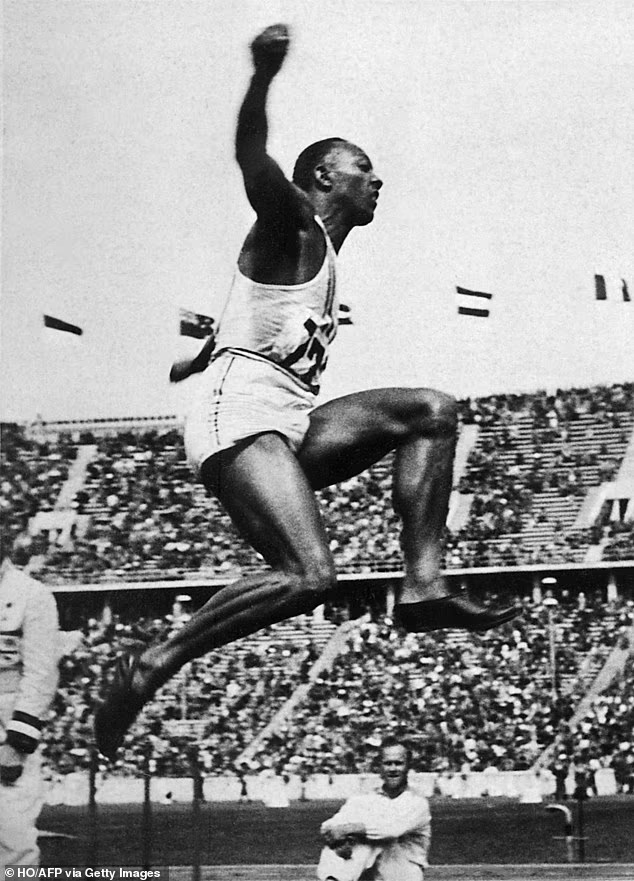
Even empty, the Olympic Stadium in Berlin evoked the magic of Jesse Owens but also the hysterical menace of Adolf Hitler.
Wembley and Lord’s brought up the great names of those sports as they walked onto the turf ready to make history. Croke Park brought real history closer to home, while even in its redeveloped banality Lansdowne Road never fails to spark memories of heroic deeds.
Jesse Owens at Berlin Olympics
Those stadia are well cared for still, the events they witnessed still venerated and conserved. But other grounds were not so lucky, chewed up and spat out when their useful life was over.
Bruce Springsteen’s Wrecking Ball captured that brilliantly, written as it is from the perspective of the old New York Giants and Jets stadium in the Meadowlands as it waits to be demolished:
I was raised outta steel here in the swamps of Jersey, some misty years ago.
Through the mud and the beer, the blood and the cheers,
I’ve seen champions come and go.
So if you’ve got the guts mister; yeah, if you got the balls
If you think it’s your time, then step to the line
And bring on your wrecking ball.
Here are ten historic Irish sports venues that fell to our own wrecking balls.
Milltown
FOR 60 years, Glenmalure Park in Milltown was the home of Shamrock Rovers. A compact stadium with a snooker table pitch, it was packed to its 20,000 capacity on many occasions as Rovers collected trophies for fun and played host to European ties. Occasionally, in those under-regulated times, many more squeezed into the venue, the official record being 28,000 when Waterford visited in 1968.

Last game was played at Milltown in 1987
The club was founded in Ringsend and played there until the mid-1920s when it moved to the suburb south of Donnybrook. It leased land from the Jesuit Order and its supporters helped build the stadium.
The Kilcoyne family bought the club in 1972, later acquiring the ground from the Jesuits. In 1987 they decided to sell up and move to Tolka Park, sharing with fellow Ringsenders Shelbourne.
A large fan group, Keep Rovers At Milltown, picketed the new venue and raised funds to buy Glenmalure, but were outbid by a developer. After lengthy appeals and protests, the ground was demolished in 1990 and housing erected.
Rovers were condemned to an itinerant existence for the next 20 years, fetching up at Dalymount Park, the RDS, Tolka Park (thrice) and Richmond Park before they found a permanent home in Tallaght.
Fitzwilliam Square
FITZWILLIAM Lawn Tennis Club was founded in November 1877, based at Upper Pembroke Street in the south of Dublin city. In 1879 it hosted the first Irish championships in Fitzwilliam Square, including the world’s first women’s tournament, although that was held at the old ground ‘to keep the matches as private as possible’, The Field reported.
The following year it purchased a site at Wilton Place, on the banks of the Grand Canal, but played host to the championships at the square until 1902, when redevelopment encouraged them to move to the club premises.

Fitzwilliam was founded in 1877
For several years the Irish championships were considered one of the ‘majors’ with the US Open, Wimbledon and the North of England championships. Thus many of the greatest players were seen, and before tennis became ‘open’ in 1967 it was part of the tour. Some of the legends who won tournaments at Fitzwilliam included Billie Jean King, Rod Laver, ‘Little Mo’ Connolly and Evonne Goolagong.
In 1972 Wilton Place closed its doors and the club made another short move, across the canal to Appian Way, where it remains. The original ground is still a park, albeit open only to residents of Fitzwilliam Square, while Wilton Place is now a small public park surrounded by office blocks and apartments.
Celtic Park
BELFAST Celtic were founded in 1891, playing at Celtic Park on the Donegall Road in the west of the city. They lasted barely half a century, but won 14 Irish leagues and eight cups, with several notable players including Patricio O’Connell.
As a catholic club in a mostly protestant league they developed fierce rivalries and the political violence of the early 1920s forced them to withdraw for four seasons. On their return they won the next four titles.
The late ’40s side was packed with stars, including Republic internationals Jackie Vernon and Bud Aherne, and future Glasgow Celtic legend Charlie Tully.
When Linfield equalised in the last minute in a 1949 meeting their fans invaded and attacked Celtic players, kicking Jimmy Jones unconscious and breaking his leg, while the RUC stood by.

Celtic Park was located in west Belfast
Celtic were left with little option but to pull out of the league. ‘It wasn’t hooligans in blue scarves that killed off Belfast Celtic,’ wrote journalist Eamonn McCann in the Sunday Tribune on the 50th anniversary. ‘It was society constructed to hooligan specifications.’
In 1927 a greyhound track was installed and continued to operate until 1985 when it was demolished and a small shopping mall, the Park Centre, built, featuring a small memorial museum to Celtic Park and the club.
Belfield track
IRELAND was never well served with sporting infrastructure, so there was much excitement when a tartan running track was opened in Belfield in 1977.
It cost IR£175,000 and impressed future world champion Eamon Coghlan: ‘It’s a rubber surface and as a result there’s a greater bounce on the track. A tartan track enables the runner to get into a rhythm a lot easier than on a cinders surface where the rhythm is broken throughout the race.’
It was mainly a student facility but also hosted Christmas day GOAL runs, and international stars such as Steve Ovett and John Walker won the annual Morton Mile race.

Belfield had reputation as a ‘fast’ track
It had a reputation as a fast track, and still holds a world record, for the 4 x 1 mile relay, set in 1985 by Coghlan, Marcus O’Sullivan, Frank O’Mara and Ray Flynn.
In November 2011 the track was closed, ‘due to health and safety concerns’. The authorities claimed, ‘the surface is badly worn and becomes slippery when wet’, which was strongly disputed by athletes.
It soon became a staff car park, and part of the track torn up and covered in stones.
In 2022 a new athletics track was installed at the Roebuck end of the campus, after an anonymous donation of €3million.
Phoenix Park
THE Phoenix Park racecourse, which staged meetings from 1902 to 1990, was not part of the enormous facility it shared a name with. It occupied a space just to the north, straddling Castleknock and Ashtown.
It was owned and run for many years by the Peard and Arnott families, and many important races were staged there, including the Irish Champion Stakes (now held at Leopardstown) and the Phoenix Stakes (the Curragh). Some of the greatest horses raced there, including Sadler’s Wells and Roberto.
King Edward VII attended a meeting in 1907 and it became a popular venue with the public. It was later sold to developer Patrick Gallagher, but closed when his group collapsed in 1981. Robert Sangster and Vincent O’Brien were part of a consortium which reopened it two years later, and it hosted a legendary U2 gig in 1983.

Phoenix Park staged important race meetings
However the course struggled financially and it closed in 1990 after staging the Cartier Million, then Europe’s richest race. After the last race a bugler played the Last Post and the crowd sang Auld Lang Syne.
An attempt to build a casino failed, and after the grandstand was destroyed by fire the site was sold for £37m and houses and apartments erected.
Nowadays Leopardstown is the only racecourse in Dublin, with Howth Park and Baldoyle also long since shuttered.
Beech Hill
A FEW hundred metres from RTÉ, and across a busy road from the mecca of Leinster schools rugby lies Beech Hill. At the entrance to the estate a carved chunk of granite sits, its engraving telling the passersby that this was where the first All-Ireland senior football final was held in 1888.
The grounds, known as O’Byrne’s field, were the home of Benburb GFC one of whose members was Luke O’Toole, the only person to serve as president and general secretary of the GAA.
That competition was very different to the modern championship – counties were represented by clubs and there was an open draw for the nine entries. The 1887 final was not held until the following April, when Limerick Commercials beat Dundalk Young Irelands 1–4 to 0–3.

Memorial at the Beech Hill site
In 1955 the adjacent bus garage hosted a European featherweight title fight when Billy ‘Spider’ Kelly lost to Ray Famechon.
Council houses were built on O’Byrne’s field in the 1950s, with later social housing projects. Benburb merged with Kilmacud Crokes in the 1970s but local councillor Dermot Lacey drove a campaign to erect a memorial on the site, which was unveiled by GAA president Seán Kelly in 2005.
Ormeau
THE North sportsground in the centre of Belfast was one of the most historic venues in the land when it closed in 2001.
It was here in 1871 that the first ‘international’ rugby game took place, when North of Ireland played West of Scotland. Six years later Ireland hosted Scotland for the first time there, and the first Ireland win against any other side came at Ormeau in 1881, beating the Scots.
In all, Ireland played nine games at the venue, which was shared between the rugby (NIFC) and cricket (NICC) clubs. Ulster’s greatest rugby players, Mike Gibson and Jack Kyle played for both.

An aerial view of the Ormeau venue
It became the main northern venue for cricket internationals for three-quarters of a century from 1924, but the demographics around Ormeau bridge changed and the ground became a target for a series of arson attacks on the historic pavilion. The last hurrah saw the visit of Shane Warne’s Australia to play Ireland, but rain forced abandonment after an hour.
The clubs merged with Collegians in 1999 to form Belfast Harlequins, moving to Deramore Park. The cricketers subsequently moved to form CSNI at Stormont.
The site was cleared and is now residential housing known as Lavinia Square.
Western Road
GREYHOUND racing may have had its day as a sport – it would probably be extinct without the annual state subsidy of €20.4m to Greyhound Racing Ireland – and several tracks have closed over the years. Dublin has just one now, Shelbourne Park, while an Educate Together school stands on the site of Harold’s Cross, which closed in 2017. Drumbo Park in Lisburn shut its doors in August.
Cork people speak fondly of the old stadium on Western Road which was built in 1936.
On a site near Wellington Bridge on the north bank of the Lee, it replaced the Showgrounds in Ballintemple, and hosted several historic races such as the Irish Greyhound Laurels.
Crowds were excellent, but when Bord na gCon purchased the stadium in 1996 it decided to move to Curraheen Park. Shane MacGowan wrote ‘White City’ about the closure of a London dog track:

A sign banning ball games
Oh, sweet city of my dreams
Of speed and skill and schemes
Like Atlantis, you just disappeared from view
And the hare upon the wire
Has been burnt upon your pyre
Like the black dog that once raced out from trap two
The old Western Road stadium closed too, and the lands sold to UCC. The Western Gateway Building, the university’s science block, stands where dogs once raced.
Woodbrook

Ireland used Woodbrook for cricket matches
SIR Stanley Cochrane was the wealthy heir to the C&C mineral water fortune and the family estate at Woodbrook, on the Dublin-Wicklow county boundary. Cochrane was a passionate cricketer and set up his own club and ground there, hiring several English professionals and inviting top sides to play there, including Australia, South Africa and India. Cochrane, a mediocre player, picked himself for several high-profile games.
Ireland used it for some matches too, but the most amazing story concerns a bid to stage a Test there. Cochrane had a contract with Australia to visit in September 1912, at the end of an English tour that featured a triangular series with the hosts and South Africa. As the tournament neared a close it was clear a play-off might be needed, and Cochrane was asked to waive his contract. He replied by telegram: ‘Will give up date if you play match here, every facility, and would do a lot of good for cricket in Ireland.’
The brinkmanship ended when Cochrane conceded and the playoff wasn’t needed anyway. He closed the ground in 1913 and opened a concert hall, hosting Dame Nellie Melba and the London Symphony Orchestra. He later tired of that and installed a golf course instead. It is still a thriving club, hosting the Irish Open on its revival in 1975.
Londonbridge Road
ON the banks of the River Dodder, just across from Lansdowne Road, lay the Irish Hockey Union grounds on Londonbridge Road. The site was purchased for £3,000 in 1929, and a splendid pavilion erected. Lansdowne tennis club, then recently evicted by the IRFU, used the grounds in summer.

Londonbridge Road was bought for £3,000
Three Rock Rovers moved from Stillorgan to become anchor tenants while the ground became the home venue for the Irish sides. It was a boom time for hockey – Ireland’s women beat the USA there in 1933, and from 1937 to 1949 Ireland’s men were unbeaten in the Home International Championship. In that time, they collected five Triple Crowns, winning 17 out of 18 games.
In 1949, an Irish record 7,000 spectators crammed into Londonbridge Road, including Taoiseach John A Costello, for the Triple Crown decider with England which Ireland won 3-2.
By 1981 the days of grass pitches were numbered and most of the ground was sold and Three Rock moved out to Rathfarnham. The tennis club remained, and expanded, but the bulk of the grounds became a housing estate.