
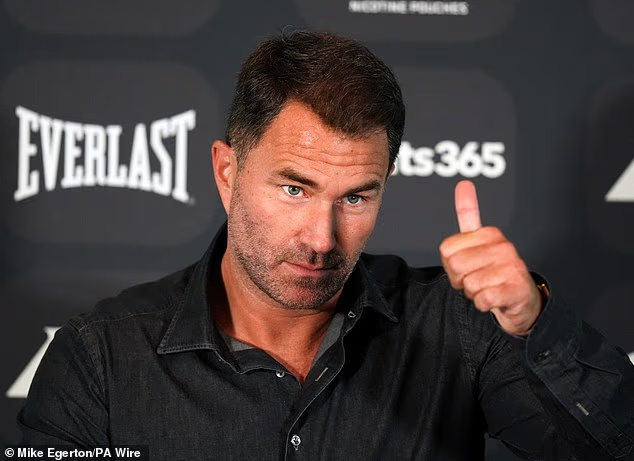
Eddie Hearn’s foray into English club rugby is set to expand after PREM boss Simon Massie-Taylor hailed the boxing supremo’s arrival in the sport as a ‘force for good.’
Matchroom head honcho Hearn has already signed English tyro Henry Pollock and Scotland and Lions No 10 Finn Russell to his sporting stable, the pair joining the likes of heavyweight superstar Anthony Joshua.
Hearn’s presence in the oval-ball game is only going to grow in the future. Earlier this month, he held talks with PREM chief executive Massie-Taylor on his yacht in Monaco. On the discussion table was how Hearn can help not only individual players, but rugby as a whole.
‘I met Eddie. We were out in Monaco for a few things actually, so I took the liberty of going to see him,’ Massie-Taylor said. ‘He’s enjoyed his initial chapter within rugby.
‘I think he sees a load of positives with the sport and the athletes. He thinks they’re incredibly marketable and he sees rugby is on a great trajectory.
‘He’s very pro the PREM. I think his ambition goes beyond just representing top athletes. I’d expect him to represent some more of the top stars in the PREM and I think he’ll do a good job for them.
Eddie Hearn’s arrival in boxing via the signing of Henry Pollock proceeds a new larger role in the sport

PREM chief executive SImon Massie-Taylor met with the promoter on his yacht in Monaco
‘Then you start to move into other options you could consider, whether that’s around events, big games, or something specifically commercial around the players across the league. I don’t think he’s there to buy a rugby club, but he could definitely help introduce people to it and partner with that. There are a few different options we’re talking through.
‘He doesn’t want to be a disruptor. He wants to work with the league. He definitely wants to agitate for more growth. I think he sees a lot of potential.
‘I think he’s a really positive person to have in the environment and it’s encouraging he sees such positive signs. I’d like to see them (Matchroom) more involved. I think they’ll be a force for good.’
After losing three of its clubs in Worcester, Wasps and London Irish to administration – a rot which began in 2022 – the PREM has moved to financially stabilise the league. All 10 of its current teams remain loss making. But the PREM’s latest financial report shows they have all passed stringent financial criteria.
Hearn’s input is likely to be a key part of what the PREM is calling ‘Project Forge’ – its ambitious growth strategy for the next decade. Revenues have grown by five per cent, with losses down 51 per cent compared to 2023. The league’s broadcast deal with principal partner TNT Sports is locked in for the next five years. PREM sides Newcastle, Bath and Exeter have all received fresh financial investment from Red Bull, Sir James Dyson and Black Knight Capital respectively.
Massie-Taylor hopes that will continue, which is why he will spend November’s Test period in the USA looking for other financial suitors.
The PREM wants to expand to 12 teams by 2029, but will initially focus on English teams joining rather than the prospect of adding those from Wales.
Any team which would join the PREM would have to spend a season in the Champ – English rugby’s second division – before doing so.

With Hearn’s backing, Pollock has become a much more visible breakout star beyond the sport
America represents a target area for growth not only for the PREM, but rugby as a whole ahead of the 2031 men’s World Cup being played there. England’s women’s side will take on the USA in New Jersey this weekend. RFU chief executive Bill Sweeney is in the country to sell English rugby’s brand.
The RFU has said it believes ‘the combination of the Red Roses’ success, the strength of the English rugby system and the sport’s untapped commercial potential creates a compelling proposition for partners and investors looking at the next phase of growth in global sport.’
Sweeney said: ‘The United States is entering what could be a transformational decade for rugby. With two World Cups heading to the country and growing investment flowing into women’s sport and British sports properties, now is the right time for us to start building relationships. We’re here to share our ambition for the future of English rugby including our men’s and women’s top-flight leagues. Ultimately, this is about creating connections and opportunities that can help support the long-term growth of the game in England.’
How can anyone see this as bad for rugby?