Pierre Sage is understandably under intense scrutiny after Crystal Palace’s shambolic 5-0 thrashing by rivals Brighton.
But that must not distract from the inexcusable failures of Sage’s bosses, chairman Steve Parish and sporting director Matt Hobbs, who have failed to create the conditions for him to succeed over multiple transfer windows.
It does not absolve the Frenchman of blame. He is not helping himself with how he is setting his side up defensively. But it does provide important context to the conditions he is working under.
Palace have conceded the most goals in the Premier League, 17 in seven matches. And it is not as though they have been unlucky: they have faced the most shots and shots on target of any team, conceded a league-high 252 touches in their penalty area and have the highest expected goals (xG) against. They have been inviting teams to score – and repeatedly failing to do things as basic as winning headers and clearing their lines at corners.
Ultimately, that comes down to the manager and his tactics. Sage’s emphasis on an intense press is leaving an already vulnerable Palace defence exposed. In his 3-4-3 formation, both wing-backs push into extraordinarily advanced positions and desert the back three. Under Oliver Glasner last season, one wing-back would hold a deeper position when Palace attacked, ensuring four defenders were in place to cover and react to transitions.
But now, the set-up is unbalanced – allowing teams to pick Palace apart quickly and attack their fragile backline. The midfield is not helping either, with Adam Wharton increasingly isolated as Quinten Timber marauds forward. There is too much focus on being front-footed and not enough caution with the personnel Sage has to choose from.
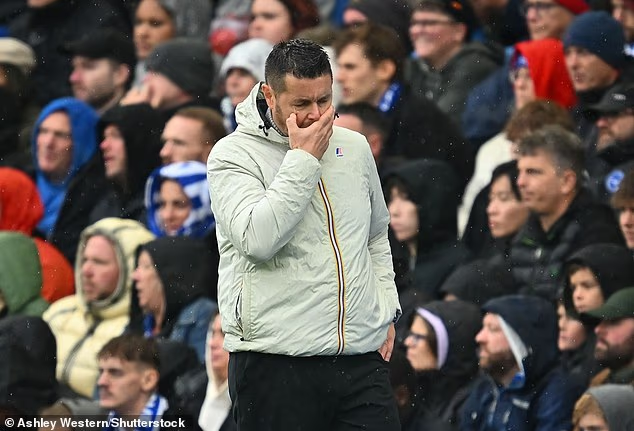
Pierre Sage is under serious pressure at Crystal Palace after a disappointing start to the Frenchman’s tenure

Palace have looked shambolic at the back, especially in their 5-0 thrashing by Brighton (pictured)
Palace have frequently tried to play out in tight areas with the back three and Wharton while the rest of the team push forward, leaving them just one sloppy pass – of which there have been plenty – away from disaster.
Palace have taken seven points from seven games this season, matching Manchester United, and have won twice. In that respect, they are not yet in crisis. But both of their victories were fortuitous. Against Nottingham Forest, they should have been 5-0 down inside the first 40 minutes and rode their luck before punishing the visitors’ profligacy.
Similar could be said about their victory at Fulham, where the hosts scored twice despite having 3.14 xG and Palace overperformed theirs with freakish goals. Their defensive performances have been consistently unconvincing, to say the least.
Sources at the club have echoed that view, too. Some in the dressing room are concerned about the lack of control in games and have been left confused by Sage’s ideas. Questions have also been raised about whether Palace have done enough defensive work on the training pitch and been given enough instructions. Sage remains well-liked on a personal level, however.
Again, there is mitigation: Sage, who impressed in taking Lens to a historic second-place finish in Ligue 1 with a similar system last season, has been unable to field a consistent back three due to injuries and Axel Disasi’s suspension.
Perhaps he does not have the personnel to play how he wants at Palace, especially with a back three that lacks recovery pace to deal with counter attacks. But even if that is true, the onus is on the manager to be pragmatic and adapt. Aside from an anomaly at Leeds, where Palace kept a clean sheet and were solid defensively, there has been no sign of that.
Sage was fighting to save his job against Leeds, with Parish considering sacking him over Palace’s defensive vulnerability. Daily Mail Sport understands Parish and Sage met on the week of the game, and the Palace chairman urged his manager to concentrate on defending.
Sage’s job is once again at risk and if Palace fail to improve against Besiktas on Thursday night, Parish may be forced to act. However, Sage’s saving grace could be the quick succession of fixtures, which would leave limited time to find a replacement.

Palace chairman Steve Parish (centre) must take some of the blame after appearing complacent about the club leaving their business late in the transfer window

Sporting director Matt Hobbs has also failed to give Sage the conditions to succeed
HOW SAGE WAS SET UP TO FAIL
Sage has created plenty of problems for himself and his relative inexperience has done little to help him navigate adversity.
However, the root of the problem lies with errors made by the club’s hierarchy. Sage’s predecessor, Glasner, was brave enough to call out their deficencies in several scathing press conferences. His public criticism raised eyebrows but it was never misplaced.
Glasner grew tired of inadequate transfer business and repeatedly scolded Parish for it. Sage does not seem the type to air his dirty laundry in public, although he surely holds a similar opinion behind closed doors.
Palace are paying the price for a lack of urgency in the summer window. Glasner criticised the club for two things: late transfer business and a failure to build a deep enough squad. In fairness, they addressed the latter ahead of their second European campaign, with options in each position. But the late panic buys continued, most damningly at centre back – the position where Palace most urgently needed to strengthen.
Two centre backs arrived after the season started, despite Palace selling England international Marc Guehi in January without a replacement and losing France international Maxence Lacroix to Chelsea during the World Cup.
Not only did those signings arrive too late, leaving Sage limited time to implement his ideas amid a hectic schedule, but both represented a significant downgrade. Palace received £72million for Guehi and Lacroix but replaced them with an 18-year-old loanee in Honest Ahanor and Chelsea cast-off Axel Disasi.
Disasi, to his credit, significantly improved West Ham’s defence in the second half of last season, albeit as a wide centre back. At Palace, he has been forced into the middle simply because they lack a natural option for the role. It is, quite frankly, poor squad planning.
Ahanor is an exciting prospect but remains a work in progress. With Palace also developing their own young centre back, Jaydee Canvot, their back three lacks the experience and proven quality required at this level, as the thumping at Brighton demonstrated.
Lacroix and Guehi lifted those around them, whether Canvot, Chris Richards or both. Palace no longer have that commanding, standards-raising figure and look feeble as a result. In fact, Takehiro Tomiyasu, signed as an understudy on a comparable wage to Nathaniel Clyne, who left the club in the summer, has been Palace’s best performer in the back three when available this season. He is now sidelined with injury.

Palace have lost two high-quality international centre backs this year, and replaced them with an 18-year-old loanee in Honest Ahanor (pictured) and a Chelsea cast-off in Axel Disasi

Youngster Jaydee Canvot (left) is among the defenders suffering from a lack of experience around him and Sage’s bold set-up
Parish was naive when reviewing the club’s transfer business in an interview with The Athletic last month. Five of Palace’s summer signings arrived after the season began, four of them on deadline day, denying Sage vital time on the training ground in an already curtailed pre-season because of the World Cup.
Parish claimed the fact business was done late becomes irrelevant as the season progresses, but that disregards the difficult position it places the manager in to begin with. Particularly heading into a campaign in which Palace will be playing every three days for much of the season.
Parish said: ‘The important thing is that you get to the end of the transfer window and you say: “Have we done good business for the club?” We needed to make a bit of money on transfers, we needed to strengthen the squad in a different way with loans so that we had the squad depth but we weren’t necessarily carrying that cost going forward. In three months’ time, nobody cares if you did it early.’
The reality is Palace were hamstrung this summer because they overspent in January, splashing £83m on Brennan Johnson – a Glasner request – and Jorgen Strand Larsen. And those January signings were only necessary because Palace had failed to build a deep enough squad in the previous summer window. Consistently poor planning – it has consequences.
Hobbs and Parish took the importance of recruiting genuine quality at centre back far too lightly and are now paying the price. At some point, Sage will likely be the fall guy. But at least one of the Palace chiefs should take responsibility for their errors.