
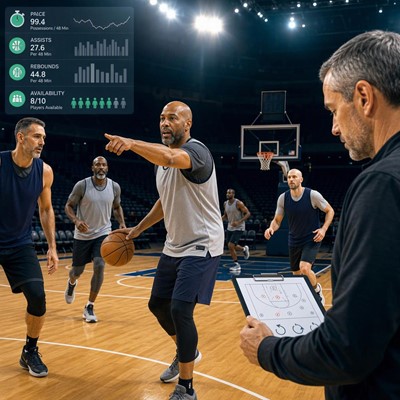
The NBA’s regular season does not begin until 20 October, so this week’s slate sits firmly in the pre-season window. That matters. Results can still tell us something about conditioning, new combinations and tactical priorities, but they should not be read like mid-season evidence.
For supporters, it is a useful chance to see how summer changes are taking shape. For coaches, it is about solving practical questions: who starts, which bench pairings work, and how much responsibility can be given to new faces before the games count in the standings?
The official NBA schedule remains the most reliable place to confirm fixtures, tip-off times and any late alterations. With travel, back-to-backs and limited preparation time all part of the pre-season routine, a listing can change faster than you might expect.
The fixtures that offer the clearest early clues
There are no standings to chase just yet, but there is still context around every prominent fixture. Teams with a new head coach will naturally draw attention, as will sides integrating major additions or trying to establish a different identity after an uneven previous campaign.
This is particularly true where a club has changed its approach at either end of the court. A team talking about playing faster needs to show that it can secure the defensive rebound, move the ball promptly and avoid handing possessions straight back through careless turnovers. A side promising more defensive resistance needs to demonstrate communication in transition, not merely effort during isolated half-court possessions.
Schedule pressure is a real factor even in October. A road game after travel can reduce practice time, while a second game in quick succession often leads to restricted minutes for established players. That makes it sensible to treat a pre-season scoreline as one piece of information rather than the whole story.
The NBA’s standings page will become far more meaningful once the regular season begins. Until then, the better questions are simple:
- Which line-ups are receiving repeated minutes together?
- Are teams protecting the ball and finishing defensive possessions?
- Do starters look organised, even if their playing time is brief?
- Are younger rotation players making a credible case for a role?
- Is a coach testing a clear style, or still experimenting widely?
Form is more than the final score
Early form can look strange because teams have different objectives. One coach may play the established starting group for a short first-quarter spell, while another gives a young unit a lengthy audition. The latter team might win the game, but that does not automatically mean it is further ahead.
Instead, look at how a side produces its points and prevents them.
Offence: where are the shots coming from?
A healthy attack generally creates a mix of shots at the rim, open three-pointers and free throws. If an offence depends entirely on difficult pull-up jumpers, it may be vulnerable once opponents begin game-planning properly.
Useful signs include:
- Assist rate: are teammates creating for one another?
- Turnover rate: is the ball moving with purpose rather than being thrown away?
- Shot quality: are attempts coming in rhythm and from sensible areas?
- Offensive rebounding: can the team create an extra possession when the first shot misses?
- Free-throw attempts: is there enough rim pressure to put defenders under strain?
It is also worth separating hot shooting from repeatable execution. A side can make a high percentage of threes on one night, but the more useful question is whether those looks were open and generated through good ball movement.
Defence: the less glamorous but revealing side
Defensive form often takes longer to settle, particularly when a team has changed personnel. Players need to learn coverages, help positions and who is responsible for switching or recovering to shooters.
Useful defensive indicators include:
- Transition defence: do players sprint back after a missed shot or turnover?
- Defensive rebounding: does the possession end cleanly?
- Fouls: repeated unnecessary fouls can disrupt rhythm and place pressure on the rotation.
- Three-point coverage: are shooters being left unattended through missed assignments?
- Paint protection: can the team discourage straightforward finishes near the basket?
Home versus road splits are another useful lens once meaningful games begin. Home teams tend to benefit from familiar surroundings and less travel, while road teams need dependable communication and composure. In pre-season, though, the venue alone may matter less than how many regular contributors are available.
Availability can change a fixture in minutes
The injury report is essential reading, especially during a period when minutes restrictions are common. It is not only a question of whether a leading scorer plays. The absence of a primary ball-handler can alter the entire offence, while missing a centre may affect screening, rebounding and rim protection all at once.
For the latest official updates, check the NBA’s news hub alongside team announcements. Availability should be checked close to tip-off because designations and participation plans can change after warm-ups.
A few situations deserve special attention.
Returns from injury
When a player is returning, the key issue is rarely whether they can contribute in a short spell. It is whether they can move freely, defend their usual position and fit into the team’s timing. A restricted appearance may tell us more about progress than readiness for a full workload.
New rotations
Pre-season is often where coaches test unusual pairings: two creators together, a smaller switching line-up, or an extra shooter beside a traditional big. If a combination appears repeatedly, it is worth noting. If it appears for three minutes and disappears, it may simply have been an experiment.
The knock-on effect
A change in availability can affect several tactical areas:
- A reserve guard may become the main organiser.
- A wing may take more on-ball defensive assignments.
- A forward may be used as a small-ball centre.
- Bench scoring could become a larger concern.
- The pace may slow if a team lacks its usual transition initiator.
That is why a short injury note should never be treated as a footnote. It can be the central tactical detail of the night.
Numbers worth keeping beside the box score
Raw points are easy to find. The more useful picture comes from the possessions underneath them.
Pace and possession control
Pace estimates how many possessions a team uses. Faster teams create more opportunities, but speed only helps when decisions remain controlled. A high-possession game with a pile of turnovers may be entertaining, though not necessarily encouraging.
Rebounding
Rebounding is a possession battle. Defensive boards prevent second chances, while offensive boards can keep pressure on an opponent even when shots are not falling. Look at total opportunities, not just one standout rebounder’s tally.
Turnovers
Turnovers become especially costly against teams that run well. Live-ball mistakes can quickly become lay-ups at the other end. A side that protects the ball and forces opponents into awkward passes has a strong foundation, whatever its shooting percentage happens to be that evening.
Shooting profile
Three figures are particularly handy:
- Three-point attempts: how willing is a team to use perimeter shooting?
- Attempts at the rim: can it generate high-value looks?
- Free throws: is it creating contact and placing pressure on the defence?
Head-to-head history can provide colour, but it needs context. Rosters, coaches and roles evolve quickly. A meeting from last season may be less relevant than a current injury update or a new rotation seen during the last two games.
For broader league data, the NBA statistics page is a sensible starting point.
Game-by-game preview cards
Because the regular season has not started, the most responsible way to preview the week is through the factors that should shape each contest, rather than pretending that pre-season results carry the same weight as a January game.
Card one: New-look offence versus established defensive structure
What to watch: Whether the offence can create clean shots without relying on individual improvisation.
A newly assembled team may look sharp for a few possessions, then lose shape when the first option is taken away. Against a well-drilled defence, ball movement and sensible spacing become more important than spectacular shot-making.
Numbers to monitor: assists, turnovers, corner three-point attempts and paint touches.
Useful reading: Follow the relevant team pages through the NBA’s team directory for official reports and roster updates.
Card two: Front-court depth under the spotlight
What to watch: Defensive rebounding, foul discipline and how teams cope when their preferred centre sits.
A deep front court can change the tone of a game. It allows a coach to keep physicality on the floor and maintain the screen-setting and rebounding standards that underpin a functional offence. A thinner group may counter with smaller, quicker line-ups, but must protect the glass collectively.
Numbers to monitor: second-chance points, offensive rebounds, points in the paint and free-throw attempts.
Card three: Ball-handlers against pressure
What to watch: Whether the lead guards can organise the offence when opponents pick them up early.
Pre-season offers a good setting for defensive pressure because coaches can test young guards in difficult situations without the standings consequence. A composed response, using screens well, making the simple pass and getting the team into its sets, can be more meaningful than a high scoring total.
Numbers to monitor: assist-to-turnover ratio, transition points conceded and turnovers forced.
Card four: Travel and rotation management
What to watch: Energy levels after travel and the quality of the second unit.
A team can begin brightly but fade once the bench enters, particularly if its rotation is unsettled. Watch whether reserves maintain defensive communication and whether the offence still has a clear organiser.
Numbers to monitor: bench minutes, points allowed in transition and rebounding during non-starter stretches.
Reading the market context sensibly
For readers following NBA coverage closely, it helps to separate reporting from prediction. A fixture’s context can change with one availability update, a minutes limitation or a decision to rest an experienced player. Pre-season uncertainty makes that even more pronounced.
The strongest routine is straightforward: consult official schedules, verify team injury information, read the box score in context and avoid drawing sweeping conclusions from a single exhibition game. Basketball is a long season, and the opening weeks are often more about establishing patterns than proving them.
Gambling is for adults only, where legal, and should be approached responsibly with limits in place. If it stops being enjoyable, take a break and seek appropriate support
Basketball betting information: Readers seeking basketball betting on Bally Casino information can consult this NBA resource.