
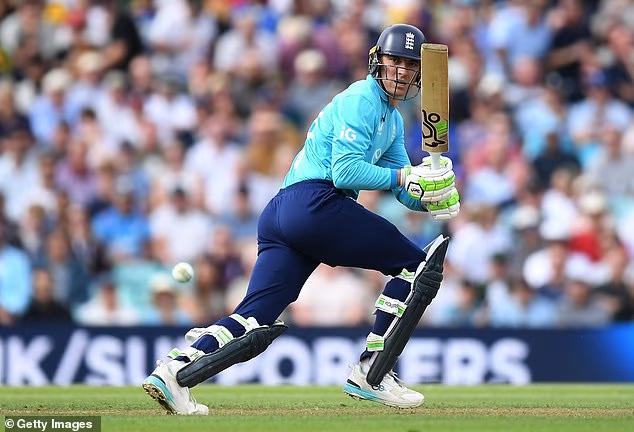
With exactly a year to go before the 50-over World Cup in southern Africa, Daily Mail Sport examines the state of England’s one-day team, who are starting to turn things round after a few years in the doldrums.
Brendon McCullum has the team firing now that the white-ball business is his sole focus and with the help of ‘specialist mentor’ Kevin Pietersen, England can go to Africa with hope of adding to their sole 50-over World Cup.
But there are questions to be answered in the 12 months between now and England’s opening fixture against Bangladesh on 8 October in Windhoek, Namibia.
WHO OPENS WITH DUCKETT?
The knee injury that ruled Jacob Bethell out of the recent 2–1 series win over Sri Lanka opened the door for Tom Banton – and he barged through, with a 62-ball 73 at Headingley followed by a powerful 126 off 105 at The Oval.
And with Bethell also missing this month’s tri-series in Pakistan (also involving Sri Lanka), Banton will get another chance to show that he should be Ben Duckett’s opening partner when battle commences.
It’s hard to imagine that Bethell, whose most recent ODI knock was a polished 91 against India at Lord’s in July, will remain on the sidelines, not least because he also offers tidy left-arm spin and electric fielding. But, like Duckett, he’s a diminutive left-hander, while Banton – tall, right-handed and strong on the drive – offers a tempting contrast.
It’s not impossible that England play both in the same side, with Bethell coming in at No 3, though that risks less strength in depth among the bowling line-up.
Tom Banton was superb in the recent series against Sri Lanka, hitting a 62-ball 73 at Headingley followed by a powerful 126 off 105 at The Oval

Jacob Bethell, like Ben Duckett, is a diminutive left-hander which could count against him if England want variety at the top of the order
DOES THE MIDDLE ORDER LOOK AFTER ITSELF?
At this stage, yes. This year, Joe Root went 404 runs between ODI dismissals, taking his average back above 50, and could easily move down a place to No 4 if England feel they want both Banton and Bethell in the top three.
The equally irreplaceable Harry Brook is next in, while Jos Buttler has split his time since the 2015 World Cup mainly at No 5 or 6, and was hitting the ball as cleanly as ever before a hamstring injury cut short his series against Sri Lanka.
But with Buttler missing the Pakistan tri-series, and possibly the subsequent white-ball trip to Australia, Jordan Cox can build on the good impression he made against Sri Lanka at The Oval, both during an inventive 76 off 52 balls and with the gloves, which may scupper Jamie Smith’s attempts to re-establish himself in the one-day side.
Despite the lack of domestic 50-over experience for the current generation of batsmen, England are building up a decent pool.

During the forthcoming series in Pakistan Jordan Cox can build on the good impression he made against Sri Lanka at The Oval, both during an inventive 76 off 52 balls and with the gloves
WHAT ABOUT THE No6 AND No7 FINISHING ROLES?
After England moved on from Liam Livingstone, the rise to prominence of Will Jacks, both as a finisher and a handy off-spinner – witness his five-for against Sri Lanka at Chester-le-Street – has restored their all-round ballast.
But if he bats at No 6, as he did successfully against the Sri Lankans because of injury to Sam Curran, it risks a slightly longer tail than England would like: both Jamie Overton and Rehan Ahmed feel a place too high at No 7.
The return of Curran for this month’s trip to Pakistan should bring clarity, though an ODI average of just 22 from 33 innings means it’s reasonable to ask whether he too should be any higher than No 7.
But his left-arm seam – not to mention his very slow slower ball – offers variety, and allows England to field six bowlers (or seven, if Bethell and Root count as half a bowler each).

Sam Curran is back in the England fold – but has a point to prove
HOW DO THE SPINNERS FIT IN?
England’s one-day set-up does not face the Test side’s existential crisis when it comes to spin, mainly thanks to Adil Rashid. He turns 39 in February, but remains central to the middle-overs strategy, and needs just 27 more victims to overtake Jimmy Anderson and become England’s leading ODI wicket-taker.
Just in case, though, the selectors are casting their net wide. When Rashid sat out the Sri Lanka series, Liam Dawson (who went at just 3.25 an over) fared better than Ahmed (6.26).
And, as well as Jacks, England are taking both James Coles of Sussex and Glamorgan leg-spinner Mason Crane to Pakistan.

England’s one-day set-up does not face the Test side’s existential crisis when it comes to spin, mainly thanks to Adil Rashid

But Rashid is 39 and so England are taking both James Coles of Sussex and Glamorgan leg-spinner Mason Crane (above) to Pakistan
AND WHAT’S THE FAST BOWLING HIERARCHY?
Since the last World Cup, England’s undisputed attack leader has been Jofra Archer, who has the most wickets among the quicks (29) and the best economy-rate (5.50), and is bowling as fast as ever.
Jamie Overton and Gus Atkinson have elbowed their way up the queue, and are both good enough to bat at No 8, while Sonny Baker put a pair of harrowing white-ball debuts in 2025 behind him to bowl with pace and heart against Sri Lanka. Josh Tongue, too, is now part of the 50-over battery.
The joker in the pack is Brydon Carse, who in the last three years has sent down more ODI deliveries (805) than any fast bowler bar Archer, but is currently being investigated by the Cricket Regulator after his arrest in Derby in August, and has been told by McCullum to go away and ‘get his house in order’.
Others in the mix include Saqib Mahmood, Matthew Potts and the uncapped Sussex seamer Henry Crocombe, who will be on the plane to Pakistan. But if Curran and Jacks both feature, and Rashid is a lock-in, there will only be room for three more quicks. With a year to go, there is plenty to play for.